

I recently read Professor Zheng Ge’s latest book review, also a set of reflections on David M. McCourt’s The End of Engagement. I found this exercise in “watching America’s China watchers from China” particularly interesting and wanted to introduce readers to a Chinese scholar’s observations on how knowledge about China is produced in the US.
Zheng is a professor at KoGuan Law School of Shanghai Jiao Tong University. he earned his Doctor of Laws degree at PKU in 1998 and subsequently remained as a faculty member. He was a visiting scholar between 2000 and 2004 at the University of Toronto in Canada, as well as at the University of Michigan, Duke University, and Columbia University. From January 2004 to January 2014, he taught at the University of Hong Kong's Faculty of Law.
This Jan, I had the honor of translating his article, “When Wars of Aggression Become 'Law Enforcement': The Imperial Logic of American Counterinsurgency Law.”当侵略战争成为“执法行动”:美国平叛法的帝国逻辑 to English

Zheng’s observation is that rather than an expert community shaping policy, a policy framework comes first, and those in power then cherry-pick whatever serves their needs. This is also a form of path dependence in knowledge production in which, from the moment knowledge is produced, it no longer belongs exclusively to its author but becomes available to anyone seeking to use it. Both the earlier “engagement” camp and today’s “competition” camp operate within frameworks constructed by their respective communities. Yet replacing one framework with another is not fundamentally a matter of the community evolving. Instead, it depends on changes in the structure of power, followed by the construction of a new framework from the ground up.
For Zheng, the problem in America’s understanding of China is not simply a question of whether a particular framework is right or wrong. The problem is in the mechanism that produces these frameworks; it inevitably compresses a complex subject into a single narrative, then uses jobs, funding, and prestige to reward those who disseminate that narrative and penalize those who question it. Optimism and pessimism about China may appear to be polar opposites, but both involve fitting empirical evidence about what China actually is into an a priori framework of what China ought to be.
Whatever the prevailing framework, the American model of knowledge production about China is now gradually unraveling. Zheng cites Rush Doshi’s article “America Is Losing the Ability to Train Tomorrow’s China Experts” as the number of American students in China declines, younger Americans have fewer opportunities to experience life there firsthand. They become increasingly dependent on congressional hearings, intelligence summaries, and translated policy documents prepared for them by others.
(As someone who provides those kinds of translations, I know the limits. I can point out particular combinations of policy terms, but policy documents often contain nuances that are easier to grasp than to explain. Consider the difference between “implementing a more proactive fiscal policy with precision and effectiveness” and simply “implementing more proactive policies.” For readers who do not consult the Chinese original, the difference in emphasis can be difficult to discern.)
Zheng argues that competition within America’s China-watching community has relegated knowledge grounded in the closest contact with China to the lowest position in its hierarchy. Meanwhile, the shortage of emerging talent leaves fewer people to carry that knowledge forward. The knowledge underpinning U.S.-China policy is thus subject to a structural process of cherry-picking to support an existing policy direction. Incentive structures and generational turnover then entrench it, while the absence of firsthand experience in China deprives the resulting biases of a crucial corrective.
Some readers of this newsletter are part of the US China-watching community whose work I regularly read and from which I have learned a lot. I translate this essay not to judge that diverse community, but to share how it looks from a Chinese scholar’s perspective. Zheng’s judgments are open to debate. What makes it worth sharing, to my mind, is that he also turns the mirror toward China. In his view, the book’s greatest value for China lies in the cautionary tale it offers about China’s own mechanisms for producing knowledge about the US. China, too, tends to substitute secondhand narratives for firsthand research. It must also guard against a mirror-image form of self-Orientalism that treats America’s present as China’s future. When discussing the construction of an "autonomous knowledge system" (自主知识体系), China should move beyond the urge to coin new terms and instead establish practices of knowledge production that can withstand scrutiny.
Why Does America Keep Misreading China?
On David McCourt’s The End of Engagement
Zheng Ge
Over the past twelve months, China and the United States have staged a drama that has unfolded at a dizzying pace. On October 9, 2025, China’s Ministry of Commerce issued six announcements in succession, bringing key links in the rare-earth supply chain—from ore to finished products—under export licensing requirements. Announcement No. 61 extended the scope of these controls beyond China’s borders: any product containing more than one part per thousand of Chinese rare-earth content, regardless of where it was manufactured or to whom it would ultimately be sold, would first require a license from China. A week later, U.S. Treasury Secretary Scott Bessent issued a stern warning at a press conference, declaring that if China proved to be an unreliable partner, the entire world would decouple from it. Five days before that, Trump had announced on social media that he would impose an additional 100 percent tariff on Chinese goods beginning November 1. The threats were thunderous. But what happened next? On October 17, Trump himself reversed course in an interview, acknowledging that a 100 percent tariff was unsustainable. Just seven days had passed between the threat and its retraction. Another nine days later, Bessent revealed his own hand: the tariff threat had always been a negotiating tool, and the threatened outcome had now been avoided.
If you followed these headlines merely for their spectacle, you might take them as bluffing at the negotiating table—Trump’s version of the art of the deal. But pull the camera back, and a more unsettling fact comes into view: American decision-makers lacked even a basic assessment of the cards China held and the consequences of playing them. The U.S. Geological Survey’s figures were there for anyone to see: 83.7 percent of American rare-earth imports came from China, while dependence on China for heavy rare earths reached 97 percent. The International Energy Agency’s 2026 report stated clearly that, in 2024, China accounted for 91 percent of global refined rare-earth output used in magnets and 94 percent of sintered permanent-magnet production. These were public figures, not intelligence secrets. A country possessing this information should not have been surprised when China played its rare-earth card. Yet the United States was surprised—and kept making the same mistake. When the first round of controls took effect in April 2025, China’s rare-earth permanent-magnet exports to the United States fell from approximately 600 tonnes in March to 246 tonnes in April, then to just 46 tonnes in May. Ford’s Chicago plant shut down for a week. Six months later, Washington was still erupting in anger over the same kind of development.
What followed looked even more like a carefully scripted drama of reversals. On October 30, 2025, the two countries’ leaders met on the sidelines of the APEC summit in Gyeongju, South Korea, and announced a trade truce. In May 2026, Trump flew to Beijing. On September 23, Xi Jinping arrived in Washington for a state visit—the first state visit to the United States by a Chinese leader in eleven years—with Trump personally greeting him on the tarmac at Andrews Air Force Base. The two sides announced a further two-month extension of the truce. China pledged to purchase more American soybeans and postponed the implementation of its new rare-earth export controls until January 10, 2027. Treasury Secretary Bessent told Fox News that he had discussed with Vice Premier He Lifeng whether they could reach a bigger deal rather than a collection of small, piecemeal arrangements. A man who had called for decoupling a year earlier was now talking about a bigger deal. On the surface, this was diplomatic theater. At a deeper level, it was a forced recalibration after repeated collisions between perception and reality.
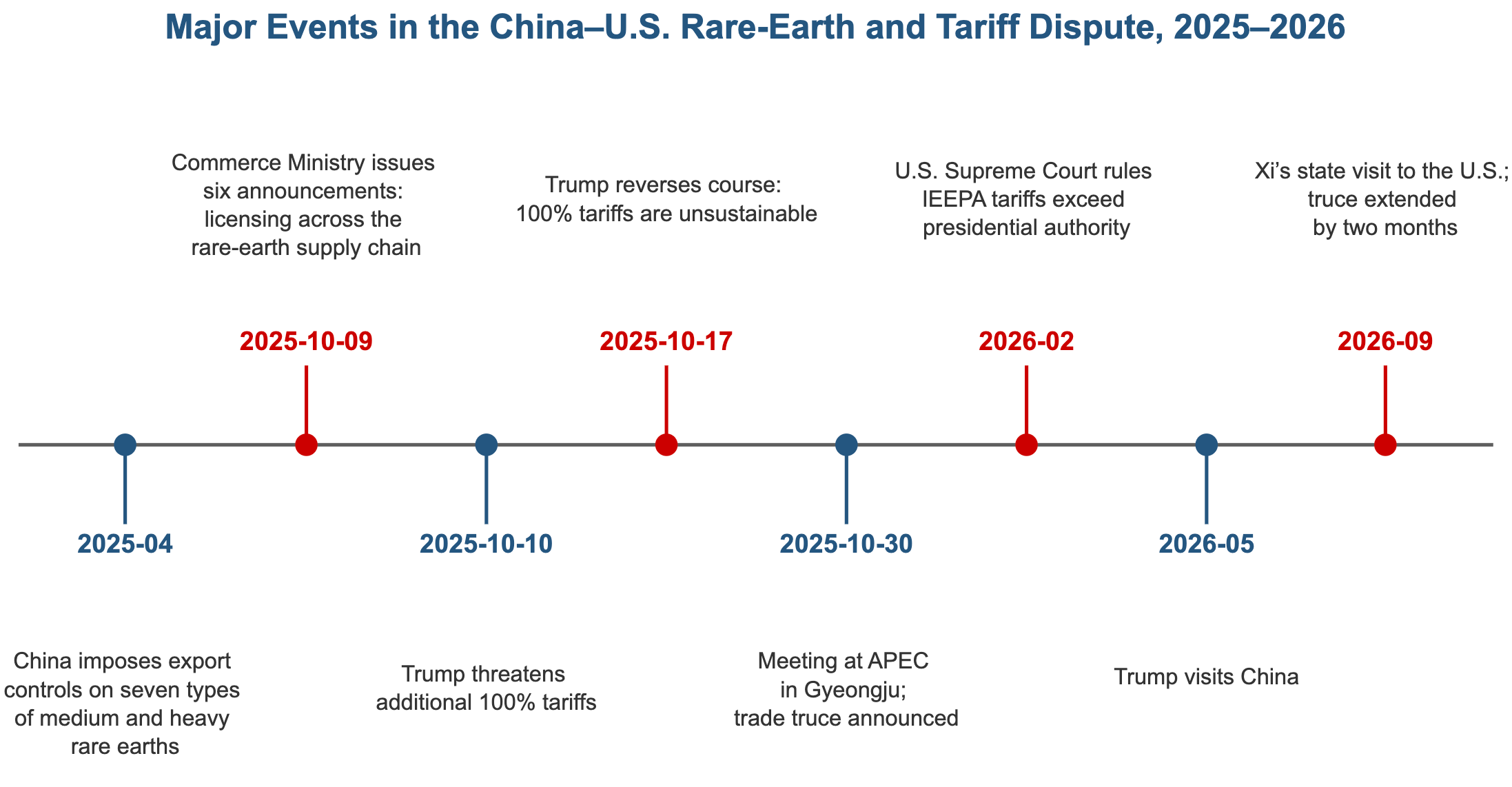
Figure 1: Major events in the China–U.S. rare-earth and tariff confrontation, 2025–2026 (compiled from public reporting)
This brings us to the question this article seeks to address: What kind of knowledge underpins American policy toward China? If that knowledge is systematically distorted, what mechanisms produce the distortion? David McCourt, a sociologist at the University of California, Davis, has published a new book that addresses precisely this question. Its title is The End of Engagement: America’s China and Russia Experts and U.S. Strategy Since 1989, published by Oxford University Press in September 2024. The book is not about China or Russia themselves. It is about where the knowledge informing American policy toward China and Russia is produced. A review in Foreign Affairs captured its conclusion particularly well: American policy too often swings between the extremes of optimism and pessimism, with swings far larger than changes in the target countries’ behavior can explain. That observation cuts through an obscuring layer: if policy responds to reality, fluctuations in reality and fluctuations in policy should broadly move together. What we see instead are small provocations triggering major shifts, and major facts eliciting slow responses. The distortion lies not at the point of input, but in the processing machinery in between. After reading this book, one discovers that the astonishing reversals and misjudgments in today’s China–U.S. contest were already foreshadowed in its pages.
A Book That Does Not Study China, Yet Does So Much to Explain the China Question
McCourt’s starting point is straightforward. After the Cold War, the United States pursued engagement with both Russia and China, believing that incorporating these countries into the world market and the American-led international order would, in time, make them more like the West. The first two chapters trace this history clearly. After 1989, George H. W. Bush and Bill Clinton continued engagement with China despite domestic opposition. Annual debates over most-favored-nation status recurred throughout the 1990s, until legislation granting permanent normal trade relations in 2000 and China’s accession to the World Trade Organization in 2001 brought engagement to its high point. In 2005, Robert Zoellick’s call for China to become a “responsible stakeholder” articulated the policy’s expectations most clearly: China’s rise was welcome, provided it rose in accordance with the role the United States had assigned it. Russia followed much the same script, joining the Group of Seven in 1998 and the WTO in 2012. By the late 2010s, this optimism was dead. Obama announced the pivot to Asia in 2011; Trump’s first National Security Strategy designated China a strategic competitor in 2017; and the trade war began in 2018. The age of engagement had ended. The conventional explanation attributes this transition to changes in the target countries’ behavior: China had become more assertive, and Putin more aggressive. McCourt does not deny these external factors. But he raises a question that almost every analysis overlooks: What role did America’s own expert communities play in the transition? Why did it occur at that particular moment, and why did it move in that particular direction?
To investigate, he conducted 170 semi-structured interviews, including 117 with China experts and 53 with Russia experts, between 2016 and 2023. His interviewees ranged from retired diplomats and former National Security Council officials to think-tank researchers and university professors. Of the ten U.S. ambassadors to Russia who had served since 1991, he interviewed six. The interviews employed snowball sampling and abductive coding, and all interviewees were identified by anonymous numbers. He also analyzed several prominent open letters published in The Washington Post, Politico, and other media outlets in 2019 and 2020. These included the July 2019 letter “China Is Not an Enemy,” drafted by five figures—M. Taylor Fravel of MIT, former ambassador to China J. Stapleton Roy, Michael Swaine of the Carnegie Endowment for International Peace, former Assistant Secretary of State Susan Thornton, and Ezra Vogel of Harvard—and signed by nearly one hundred people, as well as the backlash it provoked. McCourt examined the composition of more than ninety signatories one by one: Richard Bush and Cheng Li of the Brookings Institution, David Lampton of Johns Hopkins University, Douglas H. Paal of Carnegie, and C. Fred Bergsten and Nicholas Lardy of the Peterson Institute for International Economics. The list was almost a roll call of the engagement era. The letter’s reception was itself a footnote to the book’s argument: its signatories sought to keep the engagement framework alive, only to discover that they had already been pushed beyond the boundaries of the mainstream. Ezra Vogel died a year after the letter appeared. He represented an era that still believed understanding China had to begin with understanding Chinese society. David McCourt is a sociologist working from a constructivist perspective. His concern is not whether China or the United States is more justified, but how threats are socially constructed. With sociology’s scalpel, he opens the black box of the foreign-policy knowledge community.
The book’s central argument can be summarized through a contrast. Policy toward China underwent a paradigm shift: engagement, the overarching framework that had dominated for thirty years, was uprooted and replaced by strategic competition. Policy toward Russia, by contrast, stagnated: no new framework replaced the old one; relations gradually froze over. Why did the failure of engagement produce a revolution in one case, but merely an unfinished project in the other? McCourt’s answer is that the difference lay not in what Moscow and Beijing did, but in the internal structures of the two expert communities. China’s size, the depth of trade relations, and the number of academic positions helped create an American China-studies community large enough, sufficiently stratified, and internally competitive enough to generate a paradigm revolution. The Russia-studies community, by contrast, continued to shrink after the Cold War. Funding declined, positions disappeared, and the community could not even muster the scale needed to launch a revolution.
The Russian half of the story also deserves close attention because it serves as the control group in this natural experiment. McCourt divides American Russia experts into two camps. One is the “Russia we want” camp, which advocates containing and transforming Putin’s regime. Its representative figures include Alexander Vershbow, Daniel Fried, Celeste Wallander, and Michael McFaul. The other is the “Russia we have” camp, which advocates bargaining with Russia as it actually exists. Its representatives include Thomas Graham, Rose Gottemoeller, Fiona Hill, and Matthew Rojansky. The former is more ideological; the latter places greater weight on analytical restraint and nuance. The two camps argued for more than a decade, yet neither eliminated the other. Policy muddled along between resets and sanctions until the war in 2022 finally froze it in place. Without the support of a sufficiently large community, even disagreement could persist only at low intensity. This control group neatly demonstrates the book’s central theme: the energy driving policy change comes from within the community, not from the country being studied.
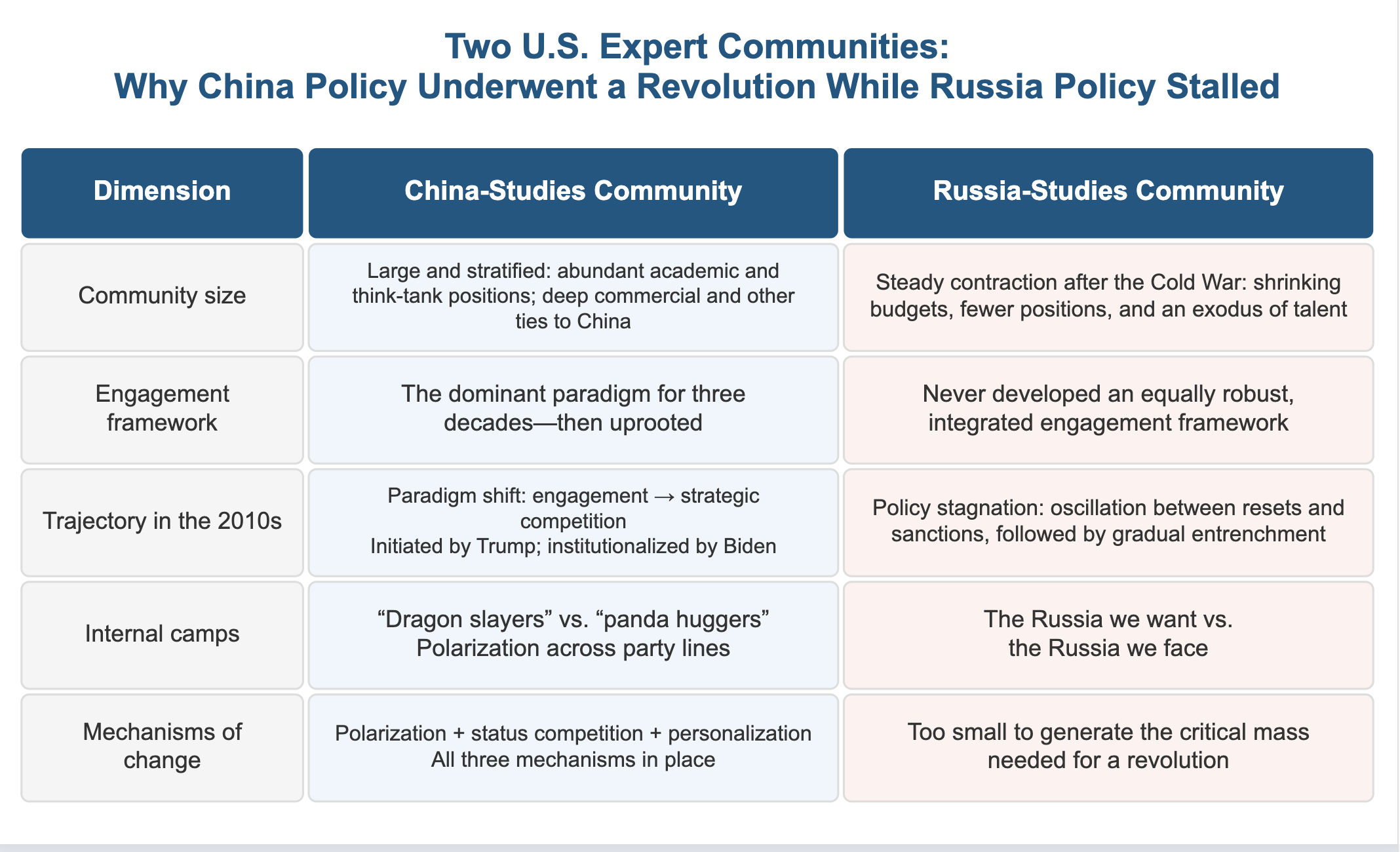
Figure 2: A comparison of America’s two expert communities (drawn from McCourt’s argument)
The book is particularly adept at dissecting the concept of engagement. McCourt argues that engagement has three faces. As a policy, it is a set of concrete arrangements, ranging from granting China most-favored-nation status and supporting its WTO accession to establishing various dialogue mechanisms. As a framework, it is a cognitive schema for understanding China, whose core belief is that economic interdependence will bring political convergence. As a community, it is a group of people who use that belief to determine who belongs and who is marginal, who is qualified to enter the National Security Council and who can only write reports that nobody reads. The three faces are mutually constitutive. Policies can be adjusted, but frameworks are difficult to loosen because they are anchored in people’s careers. For an expert who obtained tenure, a think-tank position, and government appointments through the engagement framework, overturning that framework amounts to repudiating the first half of their professional life. That is why engagement could not simply die of old age: its death required a coup.
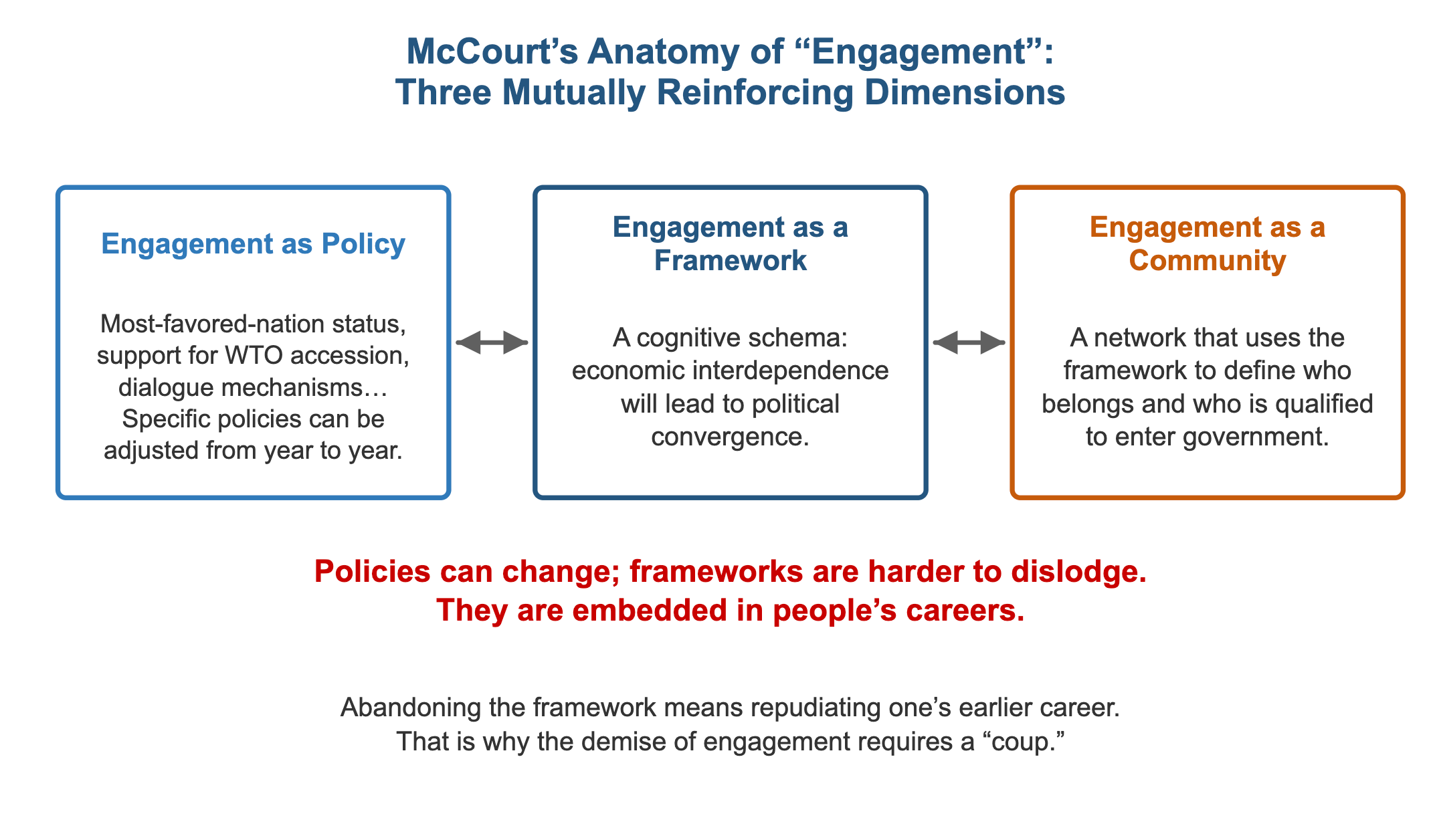
Figure 3: McCourt’s dissection of the concept of “engagement” (drawn from the book)
That coup occurred after 2016. Trump’s election brought hard-liners who had long stood at the community’s margins into the centers of power. McCourt carefully traces their routes to the top: they did not persuade the mainstream with better evidence; they bypassed it and occupied the positions directly. One of the book’s most dispassionate—and most brutal—conclusions is its policy-world confirmation of the famous observation associated with Kuhn and Planck: paradigms change not through persuasion, but through the replacement of people. The older generation retires with its frameworks, while new frameworks enter the establishment with new people. Knowledge here is not a truth-seeking activity independent of power, but a by-product of the distribution of power.
McCourt also devises an ingenious generational analysis. In his interviews, he asks everyone the same question: When did you first visit China or Russia? The answers reveal a strong relationship between an expert’s attitude toward China and the period in which they first experienced the country. Those who arrived in China in the late 1970s and early 1980s had seen a poor country beginning to open up, and developed an almost religious faith in engagement. The generation that came of age after the 1990s first encountered a China already rising and self-confident, and was naturally skeptical of the narrative of political transformation. No genuine debate took place between the generations. What happened was simply a replacement of the people occupying the positions. In retrospect, the so-called breakdown of consensus often amounted to little more than a different set of license plates in the parking lot.
How Taking a Hard Line Became Good Business
A paradigm shift occurred. But why did it move toward greater confrontation rather than in some other direction? This is the most explanatory part of McCourt’s book. He identifies three mechanisms.
The first is polarization. The American China-studies community had long been divided between “dragon slayers” and “panda huggers.” The nicknames themselves are revealing: one side imagines itself as heroic warriors slaying an evil dragon, while the other is mocked as sentimental people embracing a panda. Both labels emerge from cartoon-like imagery rather than empirical research into Chinese society. This divide, which cannot be neatly mapped onto either party or institutional affiliation, was fully activated by the broader political polarization of the 2010s. When society as a whole becomes polarized, the middle ground becomes an intellectual no-man’s-land. One interviewee’s account is especially telling: in Washington today, anything you say about China from a middle-ground position will be attacked by both sides. Moderate, qualified voices were not refuted; they lost their place in the discussion. The corrective mechanisms a knowledge community ought to possess depend on dissenters remaining inside the arena. Once dissenters have been collectively driven out, all that remains inside is a chorus.
The second mechanism is competition for professional status—the most subtle and consequential mechanism of all. McCourt finds a hidden hierarchy within the community: experts with security backgrounds rank above those with economic backgrounds, who in turn rank above area-studies specialists with extensive experience living in China and command of its language and culture. In other words, the more distant the knowledge is from China, the higher its status; the closer it is to China, the more its objectivity—and even its loyalty—is questioned. Every place in this hierarchy is occupied by people with real names. At the area-studies level are Kenneth Lieberthal, David Lampton, Susan Shirk, and Michel Oksenberg, together with observers such as Orville Schell, who brings a background in the humanities. What they have in common is that substantial portions of their careers were spent doing fieldwork in China. One interviewee from the Trump camp referred to them sarcastically, saying that forty years of American engagement with China had followed the expert advice of precisely these people—Lieberthal, Winston Lord, Stapleton Roy, and Schell—who had supplied the intellectual foundations of successive administrations’ engagement policies toward China. At the economic level are Bergsten and Lardy of the Peterson Institute, David Dollar of Brookings, and Yukon Huang of Carnegie. They understand China’s industries and financial system, but do not make threats their professional stock-in-trade. At the security level are Michael Pillsbury, Newt Gingrich, and Peter Navarro, author of Death by China. Pillsbury’s The Hundred-Year Marathon reads Chinese strategic history as a century-long deception, and the book was almost standard issue in Trump’s circle. One interviewed expert described the new fashion with penetrating sharpness: people who had previously worked on the Middle East, Russia, or international-relations theory, and had never studied China, were now switching fields because China had suddenly become the “flavor of the month.” Former Soviet and Cold War specialists were now all doing China—Michael McFaul, Hal Brands, Thomas Wright—people who had scarcely met a handful of Chinese people in their lives. “Flavor of the month” is a cutting phrase, but an accurate one: when the hierarchy was reordered, experience in China became a liability. At the moment of paradigm change, this hierarchy performed a selection function: the knowledge elevated to the highest level was securitized knowledge of China—the kind that treats China first and foremost as a threat. For a young scholar seeking to advance quickly in the field, the most rational career strategy was not to learn Chinese and conduct fieldwork in China, but to study China’s military modernization and cyber capabilities. Taking a hard line thus became good business.
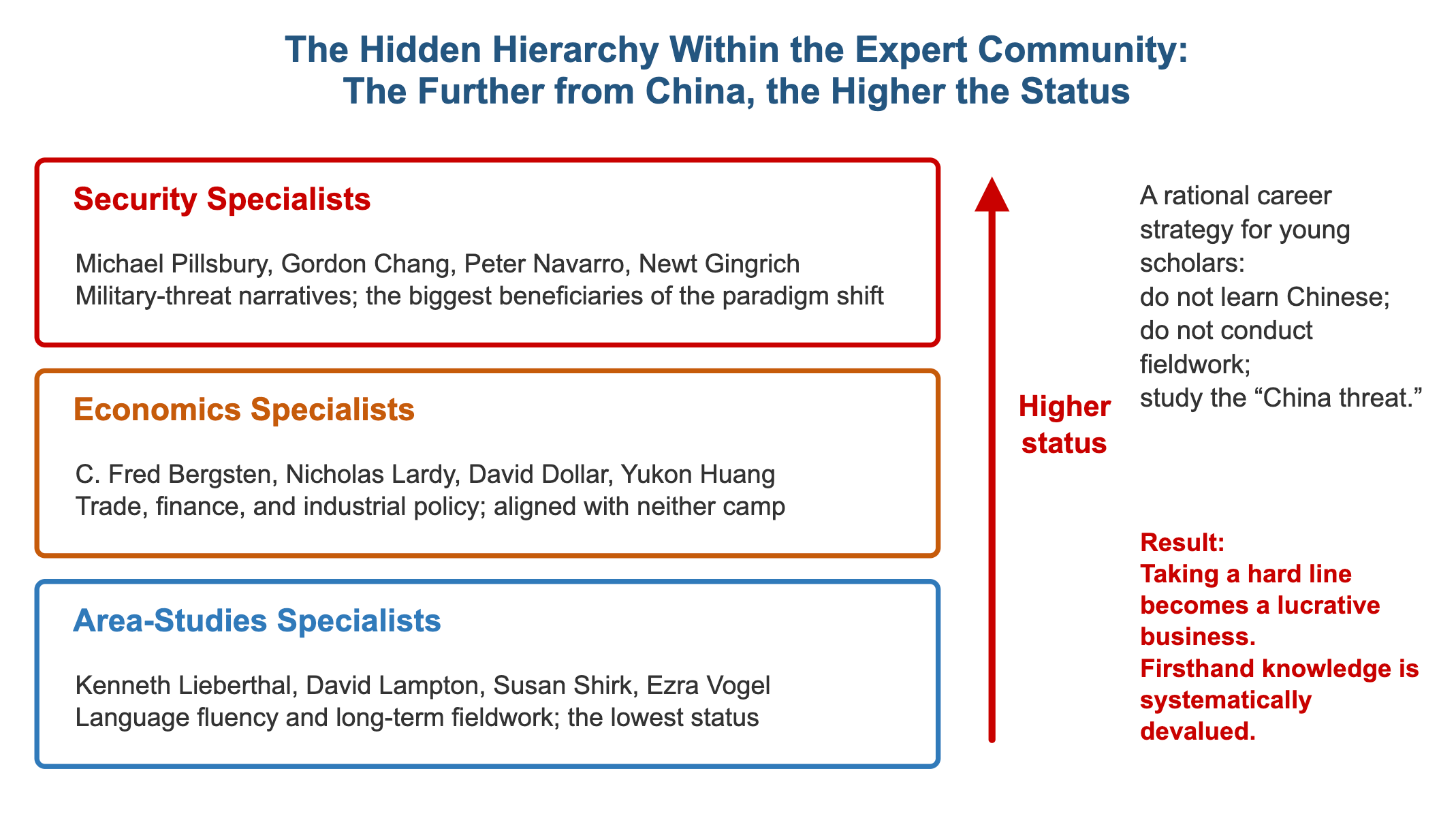
Figure 4: The status hierarchy within America’s China-studies community (drawn from McCourt’s argument)
The third mechanism is personalization. McCourt devotes two chapters to personal relationships and grievances. During Trump’s first term, Matt Pottinger’s ascendancy in China policy was inseparable from the personal experiences behind his hard-line stance. He had worked as a China correspondent for The Wall Street Journal, spending the early part of his career in its Beijing bureau. That experience shaped his profound distrust of China’s political system. He later put down his pen and joined the Marine Corps, eventually becoming deputy national security adviser and one of the most important architects of the White House’s hard-line approach to China. One detail recorded in the book is particularly symbolic: when a senior China expert submitted a policy report, Pottinger pushed it aside without even reading it. Personal distrust thus overrode the community’s accumulated knowledge. Navarro’s rise is even more revealing. This economist from the University of California, Irvine, had no standing in mainstream economics, and professional circles generally regarded his Death by China as alarmist. According to Josh Rogin’s account in Chaos Under Heaven, Jared Kushner discovered Navarro while searching Amazon for books about China and brought him into the campaign with a cold email. When citing this story, McCourt specifically notes that it may not be reliable. Yet the story circulated precisely because it captured something real: the selection criterion of the new paradigm was not recognition by the professional community, but compatibility with the boss’s instincts. The triumvirate of Trump, Navarro, and Robert Lighthizer thus tore a hole in America’s thirty-year free-trade consensus. An individual’s résumé became the underlying color of a national strategy. In Russia policy, meanwhile, Fiona Hill’s presence or absence directly determined whether policy traveled along the fast track of personalization or the slow track of bureaucracy. Changes in a knowledge community must ultimately be enacted through particular people, and particular people carry particular wounds, ambitions, and loyalties. Frameworks are abstract; the people who carry them are not.
Together, these three mechanisms explain why, once the transition occurred, it went too far. The book offers a compelling analysis of unintended consequences. In 2018, Kurt Campbell and Ely Ratner published their famous reckoning with China policy in Foreign Affairs, declaring engagement a failure. Both authors belonged to the Democratic establishment. Campbell later served as deputy secretary of state and Indo-Pacific coordinator in the Biden administration. Their intention in writing the article was to prepare the ground for a Democratic administration’s adjustment of China policy. It was an exercise in positioning: occupy the moral high ground of toughness toward China before the Republicans did, so as to avoid accusations of weakness in an election year. But the article’s actual effect was to give an even harder-line framework the appearance of bipartisan consensus, closing off any room for later recalibration. When the Biden administration genuinely wanted to ease tensions on certain issues, it discovered that its own article had already supplied the other side with ammunition. You intended to nudge the steering wheel, but ended up welding it in place. McCourt does not use the following term, so I will add it for him: this is path dependence in knowledge production—and path dependence with acceleration. Once a statement enters the public domain, it no longer belongs to its author. It belongs to everyone who wants to use it.
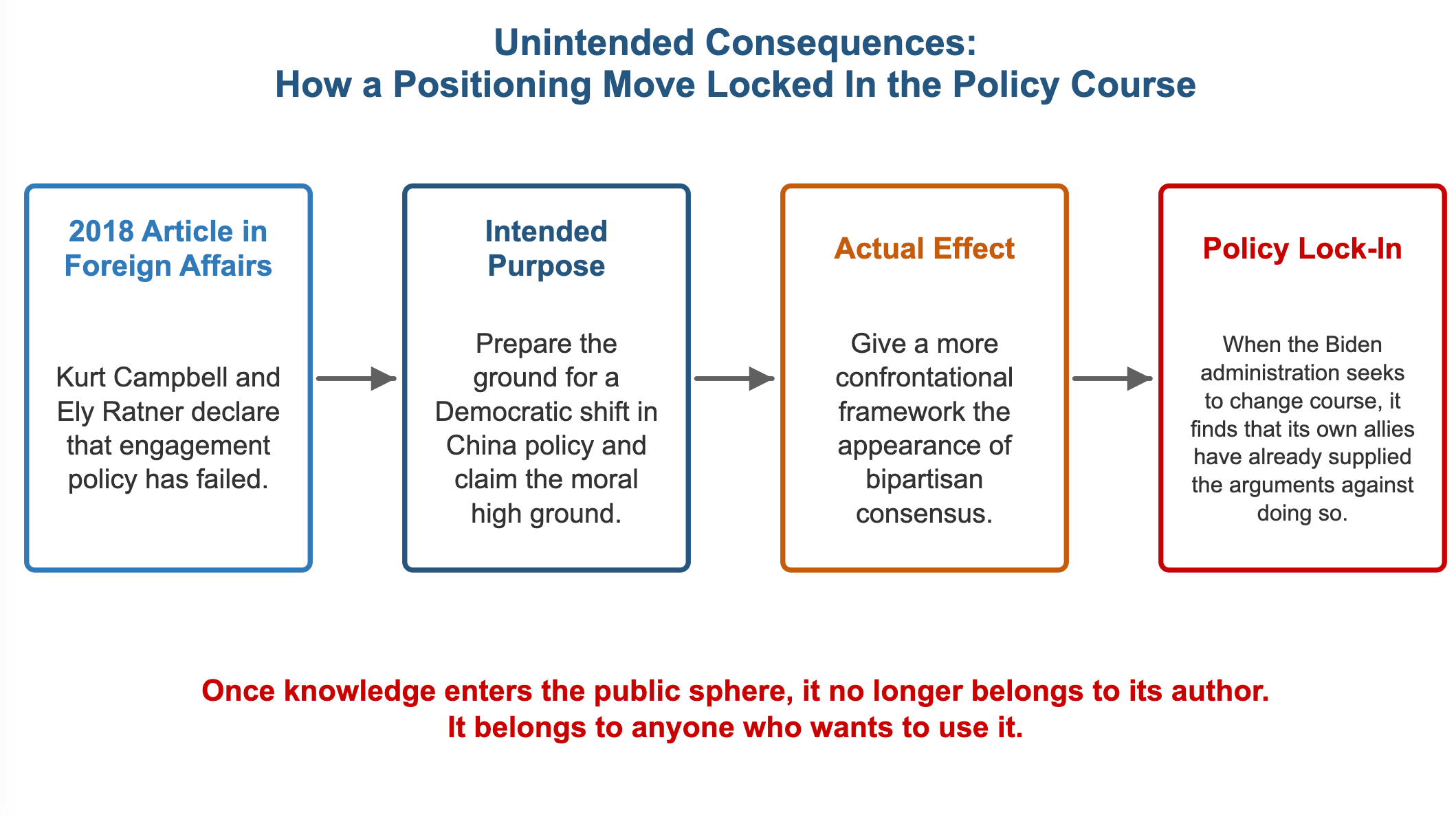
Figure 5: The unintended consequences of Campbell and Ratner’s 2018 article (drawn from McCourt’s argument)
At this point, a more fundamental question emerges: if today’s hard-line consensus is a product of the community’s internal dynamics, was yesterday’s engagement consensus not also such a product? McCourt’s answer is an honest one: it was. Engagement, too, was a framework constructed and maintained by a community, and it, too, involved the suppression of dissent. In the debates of the 1990s over separating human rights from trade, those advocating engagement as a means of promoting political transformation occupied the halls of power, while dissenters likewise had no place. This means that the systematic bias in American knowledge about China does not reside in the rightness or wrongness of any particular framework, but in the machinery that produces frameworks: it consistently compresses a complex object into a single narrative, then uses positions, funding, and prestige to reward those who disseminate the narrative and punish those who question it. Yesterday, the machine produced unrealistic optimism; today, it produces unrealistic pessimism. Optimism and pessimism appear to be opposites, but their cognitive structures are identical: both use an a priori framework of what China ought to be to trim and reshape the empirical evidence of what China actually is.
Psychologists call this confirmation bias: people tend to seek, interpret, and remember information that supports their existing beliefs. In Perception and Misperception in International Politics, Robert Jervis argued long ago that decision-makers do not first assess evidence and then form beliefs; rather, they begin with beliefs and then filter the evidence. Beliefs formed through historical analogies are particularly stubborn. Once embedded in a cognitive structure, subsequent evidence is assimilated into it and rarely becomes grounds for falsification. McCourt’s contribution is to place this individual psychological mechanism within the social structure of a community: confirmation bias ceases to be merely a defect inside the mind and becomes institutionalized. When the professional incentives of an entire community point in the same direction, individual cognitive biases are magnified into the collective certainty of a generation. That certainty is far more tenacious than an individual bias, because the feedback loops that penalize error have been severed. An ordinary investor who misreads the market loses money and adjusts afterward. An expert who gets China wrong, provided the error points in the same direction as the community, not only keeps their job but gains more opportunities to testify at hearings and appear in the media. Claims that China’s economy has peaked and predictions of China’s collapse have taken turns on Washington’s stage for more than twenty years. The predictions fail year after year, while the forecasters’ professional stock keeps rising. This is direct evidence of a failed feedback loop.
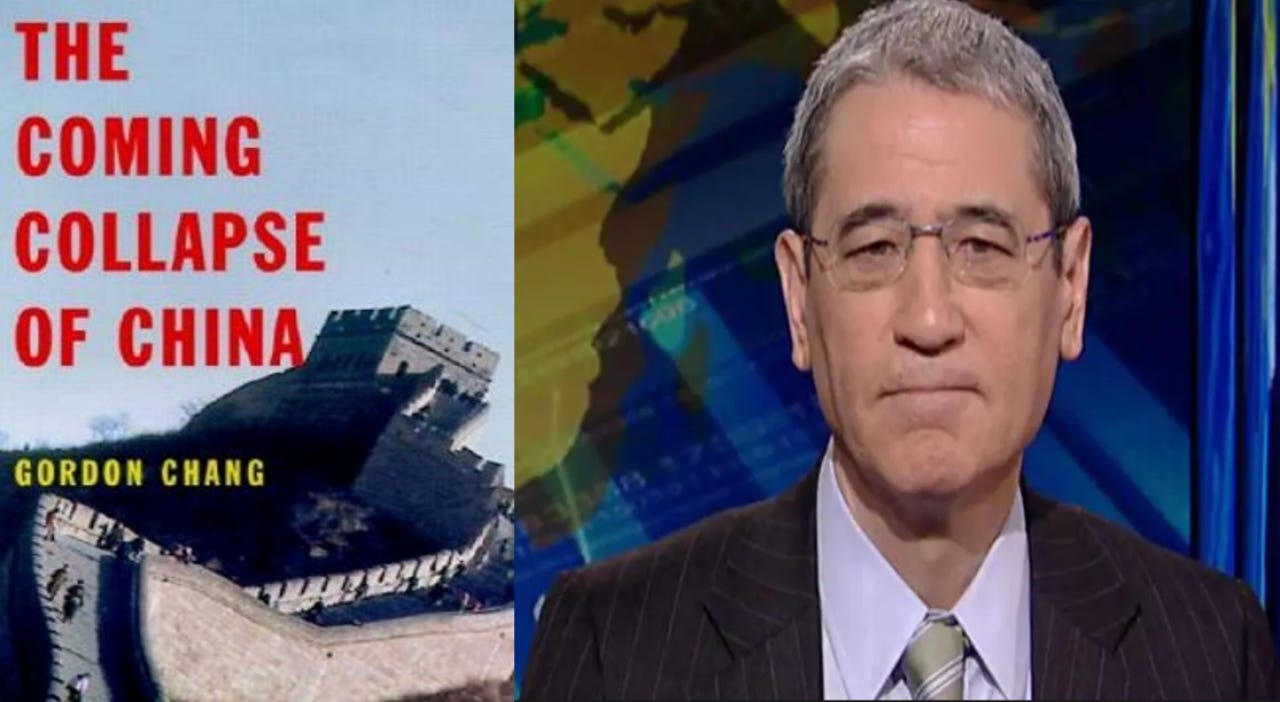
Three names are unavoidable on this malfunctioning production line. The first is Gordon Chang. In 2001, he published The Coming Collapse of China, predicting that China’s political regime would fall within five years. A quarter of a century later, the collapse has not occurred, yet he remains a regular guest on Fox News. One of McCourt’s interviewees offers a devastating assessment: having an argument and having a persona are two different things. What Chang has is a persona. In his portrayal, China is always weak, always on the brink of collapse, and this judgment bears no relation to on-the-ground observation. The second is Minxin Pei. McCourt’s book does not mention him, but he is the product of this production line with the most glittering academic credentials: a Harvard PhD, a former director of the China Program at the Carnegie Endowment for International Peace, and the first holder of the Library of Congress Chair in U.S.–China Relations. From China’s Trapped Transition in 2006 to China’s Crony Capitalism in 2016, then The Sentinel State in 2024 and The Broken China Dream in 2025, each of his books argues that China’s system is unsustainable. Meanwhile, the opinion pages of The New York Times, The Wall Street Journal, and Bloomberg remain open to him. A prediction’s deadline can be extended indefinitely, provided its direction accords with the community’s expectations. The third is Miles Yu. He appears in McCourt’s book as Mike Pompeo’s principal China-policy adviser and the author of the 2020 Nixon Library speech announcing the end of the engagement era. The book describes him as a historian in the mold of a new Cold Warrior. Born in China, he entered the State Department with the credentials of a U.S. Naval Academy professor. The central argument he sold to Pompeo was that the Chinese Communist Party and the Chinese people were two different things. This dichotomy became the theoretical foundation of that administration’s entire hostility toward China. The policy legacy he helped advance included large-scale investigations of ethnic Chinese scholars under the name of the China Initiative. The charges against University of Tennessee professor Anming Hu ultimately failed, but his career had already been destroyed. After leaving office, Yu followed Pompeo to the Hudson Institute and helped establish its China Center in 2022, with Pompeo serving as chair of its advisory board. At the end of that year, China’s Ministry of Foreign Affairs placed Yu on its counter-sanctions list through Order No. 4. What these three have in common is not an academic position, but their relationship to the machine: whatever the machine needs, they produce. In their writing, China is never a society to be understood, but a defendant awaiting conviction.
Another frequently overlooked fact deserves attention: although the paradigm shift began under Trump, it was the Biden administration that truly institutionalized and systematized it. Trump brought marginal figures into power; Biden’s team wrote the new framework into every strategic document, from the 2022 National Security Strategy to the entire architecture of semiconductor export controls. The seamless bipartisan continuity in the hardening of China policy is precisely the strongest confirmation of McCourt’s mechanism: once the new paradigm has completed its personnel replacement, it no longer belongs to any political party. It becomes part of the air the community breathes. Its opponents need not be persuaded; they need only be marginalized.
This Pathology of Knowledge Is More Than Seventy Years Old
As I read McCourt’s book, I kept thinking of the history I traced in my own Rethinking Law and Development. The capture of American foreign-policy knowledge by the cognitive structures of its communities is not a new disease that appeared in 2016. It is a new outbreak of an old affliction.
In the early Cold War, modernization theory was a standard product of this kind of knowledge. Walt Rostow’s The Stages of Economic Growth, whose subtitle is A Non-Communist Manifesto, cut human history into five stages and declared that every country would develop linearly along the path already traveled by Britain and the United States. This model, crude as it appears today, directly became the intellectual basis of American foreign-aid policy. The reason is exactly the mechanism McCourt describes: Rostow himself served first as deputy national security adviser in the Kennedy administration and then as national security adviser in the Johnson administration. Aid programs such as the Alliance for Progress were policy embodiments of his stages theory. An academic proposition became the will of the state not because of the model’s explanatory power, but because of the position held by its proponent.
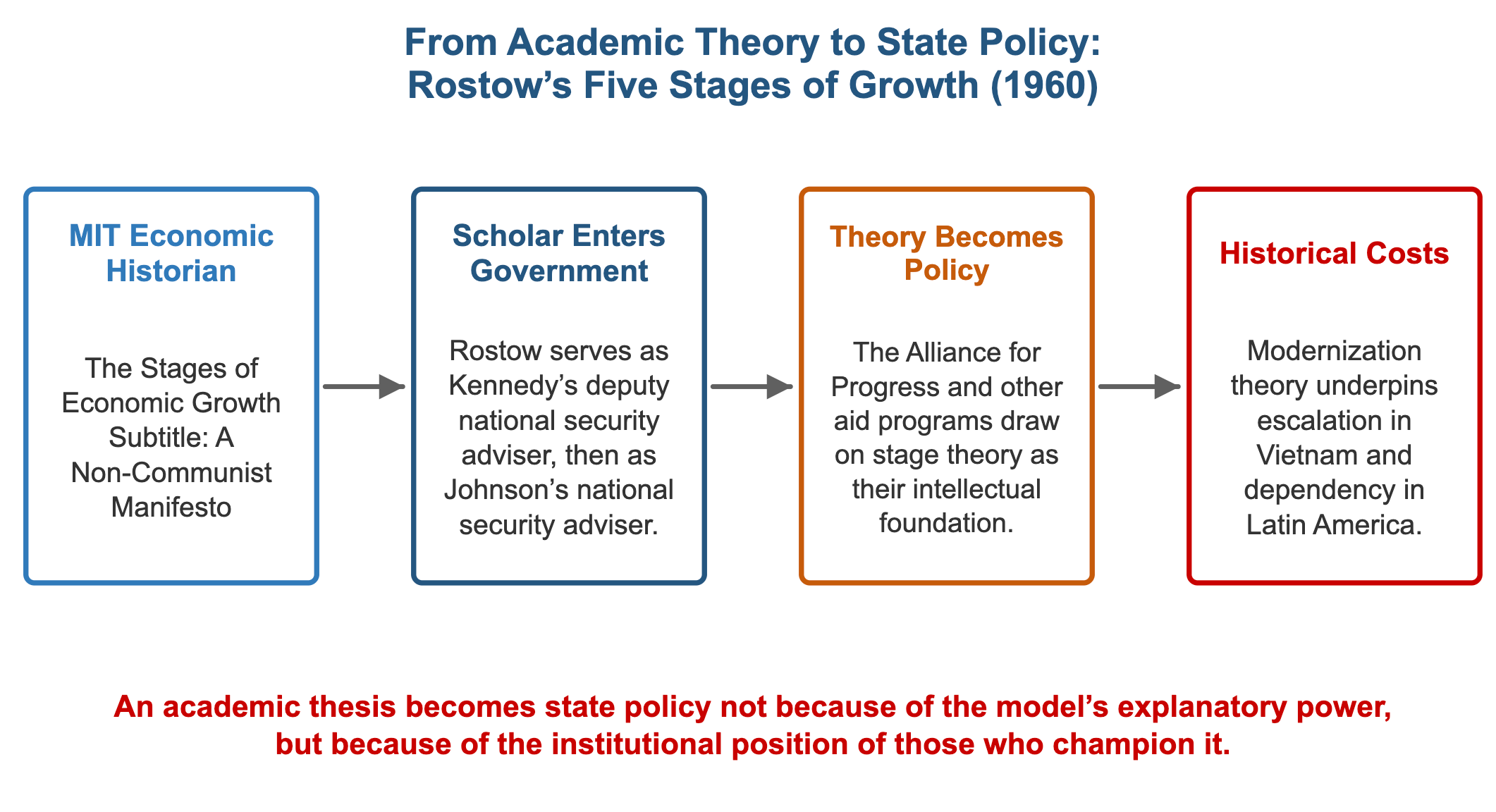
Figure 6: The policy transmission chain of Rostow’s modernization theory
Alongside modernization theory came an epistemological invention with even more far-reaching consequences: the concept of underdevelopment. Around the time Truman’s Point Four Program was announced in 1949, the world was divided into the two poles of “developed” and “underdeveloped.” Underdevelopment was presented as a primitive condition through which every society had once passed, rather than a historical product of relations of colonial exploitation. The problems of the Third World thus ceased to concern who owed whom a historical debt. They became technical problems arising from those countries’ failure to catch up. The solution naturally became accepting aid and reforming institutions according to the aid provider’s template. In my book, I summarize this logic as a three-step chain: first, international aid; second, the price of aid—namely, institutional reform according to the provider’s prescriptions; and third, subordination following reform. Countries that remake their own institutions according to an external template ultimately become locked into the world order dominated by the aid provider.
The origins of this politics of knowledge can be traced further back—and China itself stands at the source. In 1919, Sun Yat-sen completed The International Development of China,《中国之国际发展纲要》, actively lobbying the international community to participate in the development of China’s industries and hoping to use international assistance to advance Chinese industrialization. This was one of the earliest efforts by the Chinese to promote the concept of development to the international community, but it received little response. Thirty years later, the United States began exporting “development” to the world through the Point Four Program. The research of historian Amanda Kay McVety shows that Dean Acheson candidly explained to Congress that it was a security measure. Although George Marshall publicly claimed that aid was directed against no country or doctrine, McVety states plainly that this was not true. Aid thus became an instrument of Cold War geopolitics, and the law-and-development movement extended this arrangement into the realms of institutions and knowledge. The historical irony is that China was among the first to promote the concept of development internationally in the hope of obtaining assistance. After its proposal was rejected, however, it followed a path that did not depend on aid. The countries that had refused to assist China later used aid as a lever to control other countries’ institutions. “Not relying on foreign aid means not being subject to others’ control” is easy to write, but extraordinarily difficult to accomplish. It means completing the primitive accumulation necessary for industrialization through generations of frugality and sacrifice, exchanging the solitude of self-reliance for the freedom of independence. In How China Escaped Shock Therapy, Isabella Weber reconstructs how China’s policy debates in the 1980s enabled it to avoid the radical transition experienced by the Soviet Union and Eastern Europe. Kenneth Pomeranz’s The Great Divergence, meanwhile, fundamentally undermines the Whiggish narrative of the inherent superiority of Western institutions. Taken together, these studies cut the ground out from under the intellectual genealogy of modernization theory.
In Legal Orientalism, Teemu Ruskola reveals how nineteenth-century America constructed China as a civilization without law, thereby justifying extraterritorial jurisdiction. In 1906, the United States even established a permanent U.S. Court for China, yet the one body of federal law that did not apply in that court was the U.S. Constitution. The forcible export of the rule of law first corrupted the exporter’s own principles of legality. One of Ruskola’s observations is particularly intriguing: nineteenth-century America itself was regarded by Europe as a semi-civilized country. Its enthusiasm for legal Orientalism arose partly from projecting its own anxieties about civilization onto a weaker Other. A century later, this psychological structure of projected anxiety has not disappeared; only its object and vocabulary have changed. Today’s various accusations concerning China’s rankings in rule-of-law indices, intellectual-property enforcement, and state capitalism are structurally continuous with the century-old claim that China had no law.
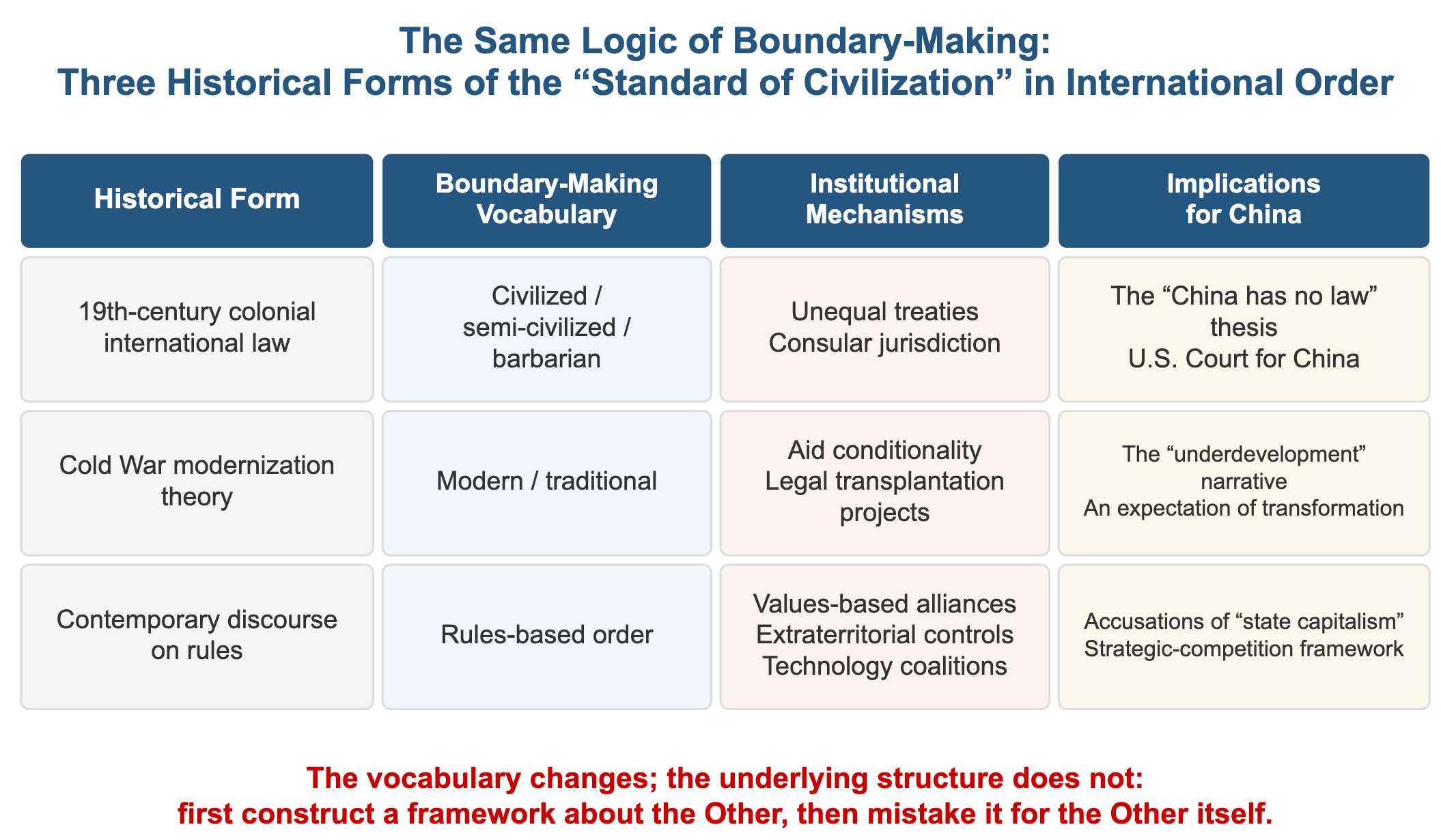
Figure 7: Three historical forms of the “standard of civilization” (adapted from Table 11-1 in Zheng Ge’s manuscript of Rethinking Law and Development)
In my manuscript, I organize this intellectual genealogy into three historical forms. Nineteenth-century colonial international law drew boundaries among the “civilized,” the “semi-civilized,” and the “barbarous,” with unequal treaties and consular jurisdiction as its institutional vehicles. Cold War modernization theory drew boundaries between the “modern” and the “traditional,” carried by aid conditionality and legal-transplant projects. Today’s discourse of rules draws boundaries through the language of a “rules-based order,” carried by alliances based on shared values, long-arm jurisdiction, and technology alliances. The vocabulary of boundary drawing has changed three times, but its logic has remained consistent: first, construct a framework of knowledge about the Other, then treat that framework as the Other itself, and finally, act on the basis of the framework.
The “Thucydides Trap” narrative now prevalent in Washington is the latest link in this genealogy. The metaphor’s academic formulation comes with qualifications, but once it leaves books and enters briefings and the media, it sheds the author’s limiting conditions and becomes an independent threat narrative. Policy circles embrace it precisely because it packages containment as obedience to the laws of history and disguises strategic choice as historical necessity. Its danger lies in its capacity for self-fulfillment: when both sides interpret the other’s intentions in the worst possible light and regard defensive measures as preparations for attack, the security dilemma spirals upward. Every repetition of the trap narrative adds fuel to that spiral. Knowledge here is not a mirror reflecting reality, but a mold shaping it.
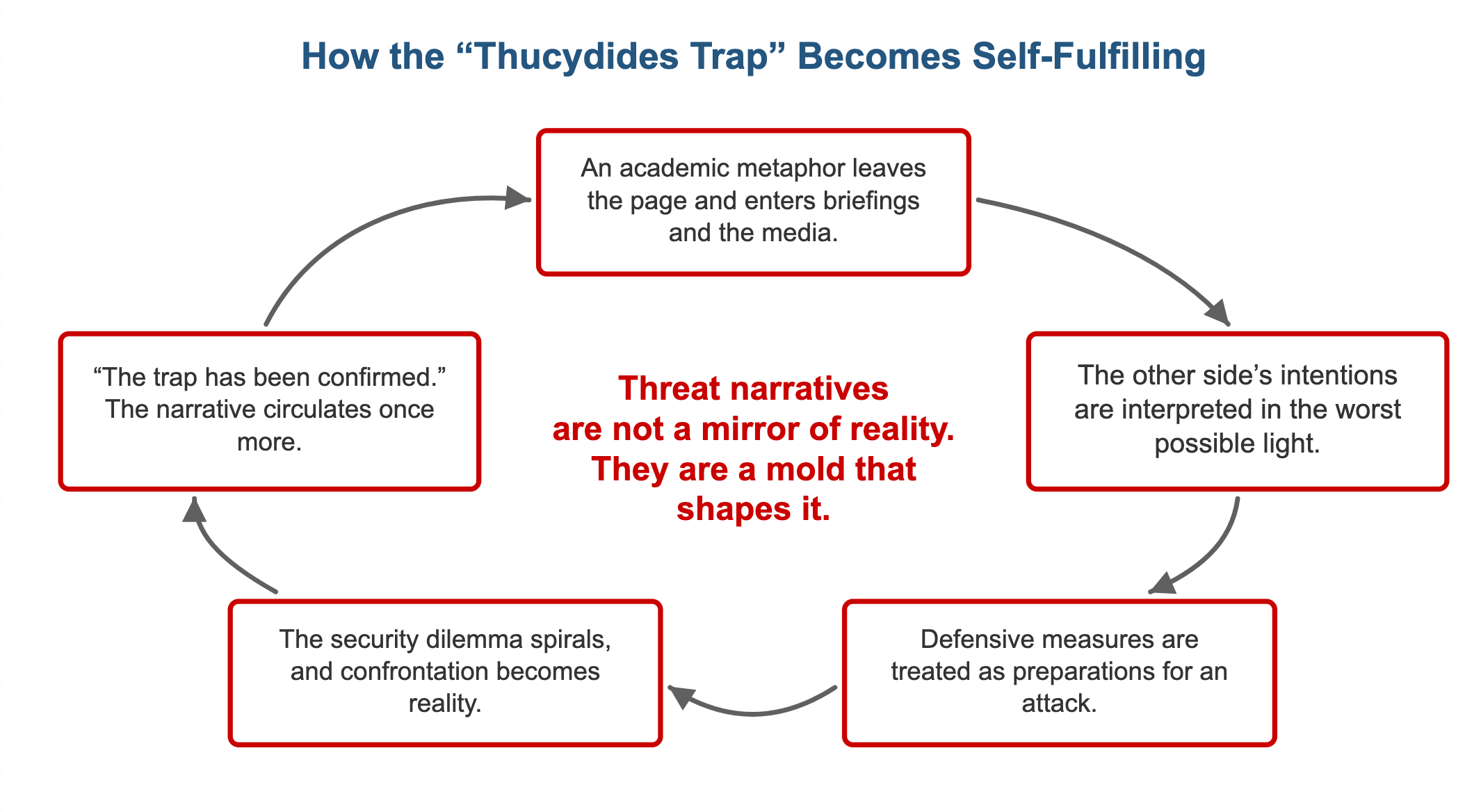
Figure 8: The self-fulfilling mechanism of threat narratives
The two examples spanning seventy years, from Rostow to the Thucydides Trap, illustrate the same point: American policy toward China has never lacked knowledge. What it lacks is reflection on the mechanisms through which knowledge is produced. David Kennedy’s questioning of the law-and-development movement remains relevant today: the central issue has never been the technical question of whether law can promote development, but the political question of who has the authority to define development, and through what knowledge. McCourt’s book fills precisely this gap. He turns the spotlight away from the object being understood and toward those doing the understanding, allowing us to see that the people who appear as experts are themselves shaped by their structural positions within the community, their career incentives, and their generational experiences. The so-called consensus on China is less an understanding of China than a barometer of the distribution of power inside America’s knowledge community.
When Those Who Understand China Leave the Stage
If McCourt describes how this machinery operated in the past, the news of the past year or more shows it spinning without traction today. The experiential foundations of knowledge about China are visibly crumbling.
This year, Rush Doshi of the Council on Foreign Relations published an article that provoked intense debate. Its title was “America Is Losing the Ability to Train Tomorrow’s China Experts.” Doshi himself served as a Chinese official on the National Security Council under Biden and belongs to the new-paradigm generation in McCourt’s account. Even he can no longer remain unconcerned. The facts listed in his article are alarming: the Fulbright, Boren, and Critical Language Scholarship programs—academic-exchange programs that had operated between China and the United States for decades—are all suspended. He called for them to be restored through the opportunity presented by the leaders’ meeting. There were approximately 11,000 American students in China in 2019. By the 2022–2023 academic year, only about 350 remained, the lowest level since the 1980s. Behind these numbers lie concrete ruptures: a young American who has never lived in China can know the country only through hearings and intelligence summaries; a researcher who does not read Chinese cannot read original policy documents and must rely on translations selected by others. At the same time, experienced China specialists in the State Department, think tanks, and universities are retiring in large numbers, while the proportion of younger researchers who speak fluent Chinese and have conducted sustained fieldwork in China is pitifully small. One think-tank report calculated that, between 2020 and 2025, the number of scholars in American think tanks with more than twenty years of experience studying China fell by approximately 40 percent. At a report launch, Nicholas Burns put it bluntly: future U.S. ambassadors to China would no longer have the deep bench of talent on which he had been able to rely.
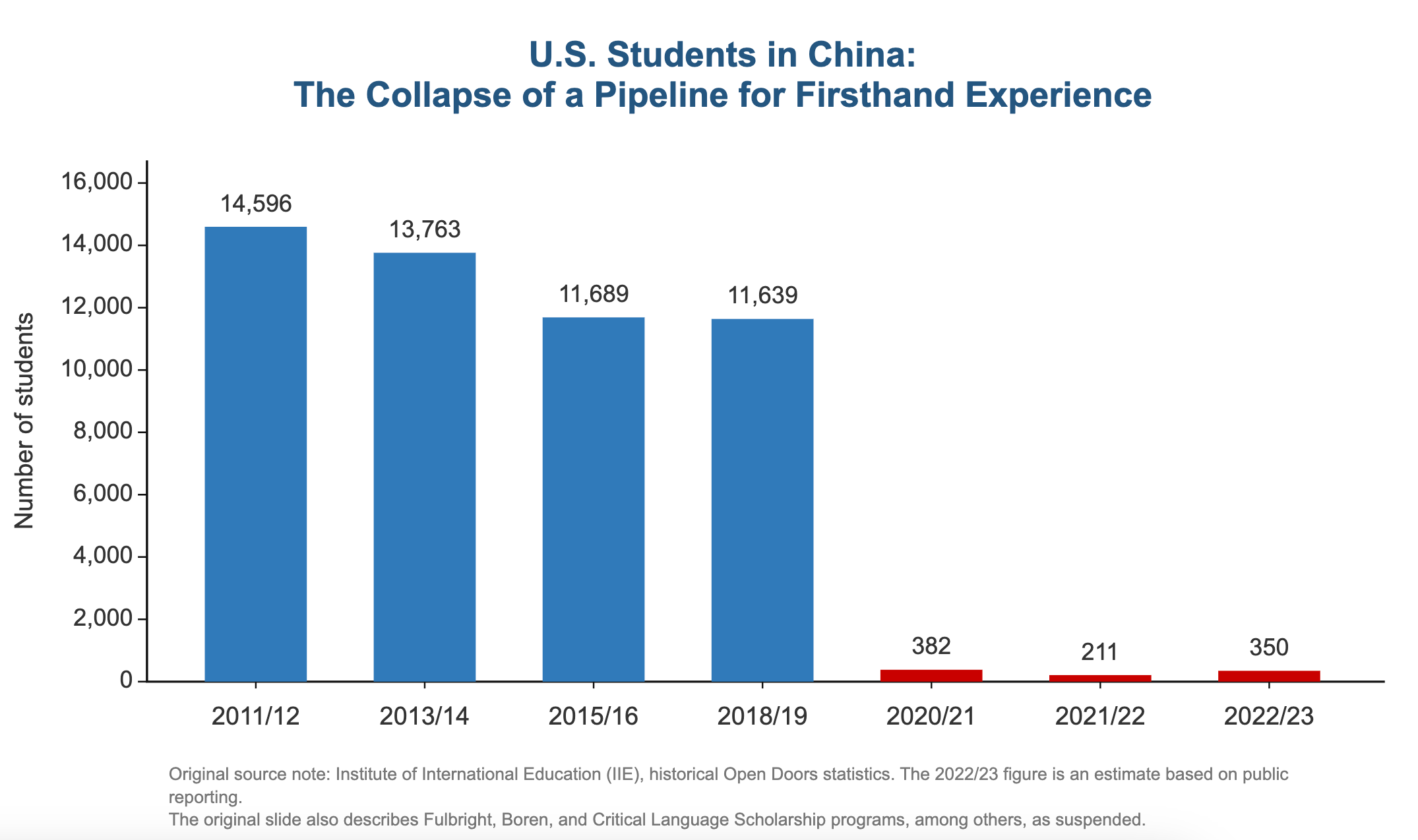
Figure 9: Changes in the number of American students in China (Institute of International Education Open Doors statistics and public reporting)
In a lecture at the University of Hong Kong late last year, Professor Diao Daming of Renmin University of China called this the cost of studying China from a distance. He pointed out that many younger researchers who came of age in the era of strategic competition have rarely set foot in China and know little or no Chinese. They substitute quantitative data and models for field experience and primary documents, forcing China’s institutional realities into templates derived from American politics and economics. At a time when mutual trust between the two countries is already extremely fragile, this abstract, assumption-driven approach to analysis is not merely regrettable; it is incubating a crisis. Since leaving office, former ambassador Burns has repeatedly stated in the media that America’s understanding of China is outdated, that decision-makers have underestimated China’s real strength, and that China is now an equal and worthy adversary whose capacity for sustained competition far exceeds Washington’s estimates. Cheng Li, former director of the Brookings Institution’s China Center, has observed that a group of scholars who understand China, including Zoellick and Lampton, have been marginalized, and that the influence of rational voices in decision-making circles has declined sharply. A wave of scrutiny by the executive branch and Congress has targeted scholars advocating engagement and cooperation. To avoid being labeled “pro-China,” scholars censor themselves, and fewer and fewer dare to voice views contrary to the mainstream. Some call this a new McCarthyism. Ezra Vogel has passed away, Lampton is advanced in age, and a generation’s experience is leaving the stage. The machine McCourt describes is still producing frameworks, but the pipes supplying it with experience are being pulled out one by one.
Read McCourt’s book alongside these facts, and the picture becomes complete. Competition for status within the community has already relegated the knowledge closest to China to the lowest rank, while the breakdown of the talent pipeline is leaving that knowledge without successors. Squeezed from both sides, the American understanding of China contains less and less experience and more and more framework. One expert interviewed by McCourt made a thought-provoking remark: the debate about China in Washington today consists of two groups of people, neither of whom visits China very much, arguing about what China is like. Once knowledge becomes detached from experience, all that remains is a war between frameworks—and a war between frameworks has no referee, only volume.
This helps explain the otherwise puzzling misjudgments in the rare-earth confrontation of 2025. China’s capacity to impose controls, its determination to enforce them, and its position in the industrial supply chain were all evident in public data. Any observer with a basic understanding of Chinese industrial policy would not have regarded the measures as mere bluff. Yet Washington’s chain of reactions suggests that few people there truly understood the weight of Announcement No. 61’s one-part-per-thousand rule. The U.S. trade representative first called it economic coercion, then said the rules could not actually be implemented. The two claims contradicted each other: Washington wanted every advantage while acknowledging none of the costs. In October 2025, Bessent promised to establish alternative rare-earth supplies within two years. By April 2026, he had revised that to four years, with progress reports every nine months. The shift from two years to four was not an update in technical assessment; it was reality finally breaking through the framework. Building a new rare-earth mine in the United States takes five to ten years from exploration to production. That timeline will not become a day shorter because someone speaks more aggressively on television. By January 2026, when Bessent discussed rare earths again, his message had become that supplies were flowing as expected, fulfillment exceeded 90 percent, and he was quite satisfied. Fewer than one hundred days separated “decoupling” from “quite satisfied.” What changed was not China’s behavior, but America’s understanding of the balance of power.
The semiconductor front tells the other side of the same story. In April 2025, Nvidia’s H200 chip, designed specifically for the Chinese market, became subject to additional restrictions. Three months later, sales were permitted to resume, and Jensen Huang publicly declared the Chinese market vitally important. In January 2026, the United States then imposed a 25 percent tariff on imported advanced semiconductors and changed the treatment of exports to China of H200-class chips from a presumption of denial to case-by-case review. The sales arrangements for a single product reversed repeatedly within a few months. What this exposed was not a carefully considered strategy, but a policy machine oscillating between the impulse to contain and corporate interests, between the demands of the framework and the constraints of reality. McCourt would say that this is a typical symptom of a community that has lost a stable framework: no framework is strong enough to unify policy, so every issue becomes a temporary battleground.
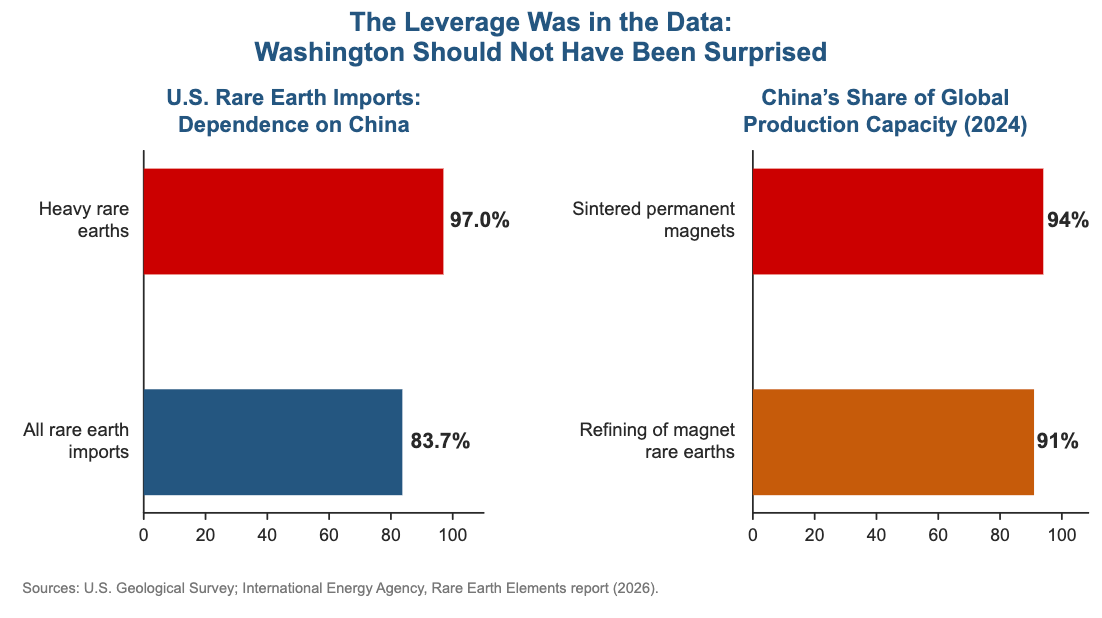
Figure 10: U.S. dependence on China for rare-earth imports and China’s share of production capacity (U.S. Geological Survey and International Energy Agency)
Even more revealing is the backlash generated by America’s own policy system. In February 2026, the Supreme Court ruled six to three that Trump’s sweeping tariffs imposed under the International Emergency Economic Powers Act exceeded presidential authority. The weapon of tariffs, used for more than a year, did not even rest on a secure foundation in domestic law. The White House immediately turned to other statutory authorities to continue imposing tariffs, but the new instrument had a statutory limit of only 150 days. It is difficult to describe a policy system that misjudges the external world and lacks a firm grasp of its own legal tools as acting on solid knowledge. Its actions rest on something else: whose voice is loudest within the community, which posture wins points during an election cycle, and a framework that continues to monopolize discourse despite repeated falsification by reality.
Another set of figures from this confrontation is worth recording. In 2025, U.S. soybean exports to China fell to their lowest level since 2018. Midwestern farmers were the first to receive the bill for distorted perceptions. The renminbi’s share of cross-border receipts and payments continued to rise, exceeding half in the first six months of 2026. As Washington escalated pressure over ports, chips, and currencies, the world did not stop to follow its script. Attributing all this to unfair competition is both a misreading and an evasion: it sidesteps the responsibility of developed countries for their own choices to deindustrialize. A system unwilling to confront the consequences of its own decisions will also struggle to confront the truth about others.
We can now answer the question posed at the beginning of this article directly. The knowledge underpinning American policy toward China is not simply insufficient. It is structurally biased toward reinforcing existing convictions. Confirmation bias is a psychological weakness at the individual level; at the community level, it is entrenched by incentive structures, amplified by generational replacement, and rendered increasingly uncorrectable by the severing of experiential pipelines. What McCourt demonstrates through 170 interviews is that this mechanism exists before any particular judgment about China. Yesterday it produced engagement; today it produces competition; tomorrow it will produce something else. What it produces depends more on the internal climate in Washington and less on China’s actual circumstances.
The Book’s Blind Spots—and the Work We Still Need to Do
Appreciating this book should not prevent us from recognizing its limitations. Some are methodological. All 170 interviews are anonymous, their quotations cannot be independently checked, and readers must trust the author’s coding and presentation. The author acknowledges that almost no one from conservative think tanks was willing to participate: only one of the 170 interviewees came from such an institution. This means that the description of the victorious side in the transition depends heavily on the recollections of the defeated side, and defeated participants tend to write history as a palace coup rather than as a debate they lost. The paradigm-shift argument also risks circular reasoning: the shift is defined as a change in framework, yet the evidence consists precisely of people’s statements about frameworks. Statements establish the framework, and the framework then explains the statements. More external evidence is needed to break the circle. Although the China–Russia comparison is elegantly designed, its causal attribution is not entirely clean. The two communities differ not only in size but also in disciplinary composition, funding sources, and relations with government. Attributing the divergence in policy trajectories mainly to community size is somewhat convenient. There is also a record that should embarrass the author: of the fifty-three Russian experts he interviewed, not one anticipated before 2022 that Russia would launch a full-scale invasion of Ukraine. If experts cannot grasp the largest upheaval occurring in the very area they study, even the most sophisticated causal account of how knowledge communities influence policy cannot conceal the failure of the knowledge itself. This may be the book’s deepest unintended lesson: communities can not only amplify bias but also collectively fail to see the elephant in the room.
A deeper limitation concerns perspective. McCourt’s camera remains trained on Washington throughout. China appears in the book only as something being discussed—a silent object. This American-centeredness is not an oversight by the author, but a faithful reflection of the condition of America’s entire knowledge community: the habit of understanding China policy as an internal American matter. In reality, however, China is not an object waiting to be defined. The contest of the past twelve months has shown that China has its own pace, its own toolbox, and its own ways of producing knowledge. The controls imposed in April 2025 on seven categories of medium and heavy rare earths have remained in force without interruption since their announcement. Under the Kuala Lumpur consensus, China’s six announcements were suspended, not canceled, with the expiry date clearly fixed on the calendar at November 10, 2026. Sitting down to negotiate while holding a decisive card and negotiating empty-handed are two different things. This predictable use of power contrasts with the American side’s constantly shifting posture. Observers can plainly see who is acting according to a framework and who is acting according to reality. Incidentally, McCourt’s research received funding from foreign-policy circles advocating restraint, something not adequately disclosed in the book. His repeated criticism that a community’s position shapes its knowledge applies to himself as well.
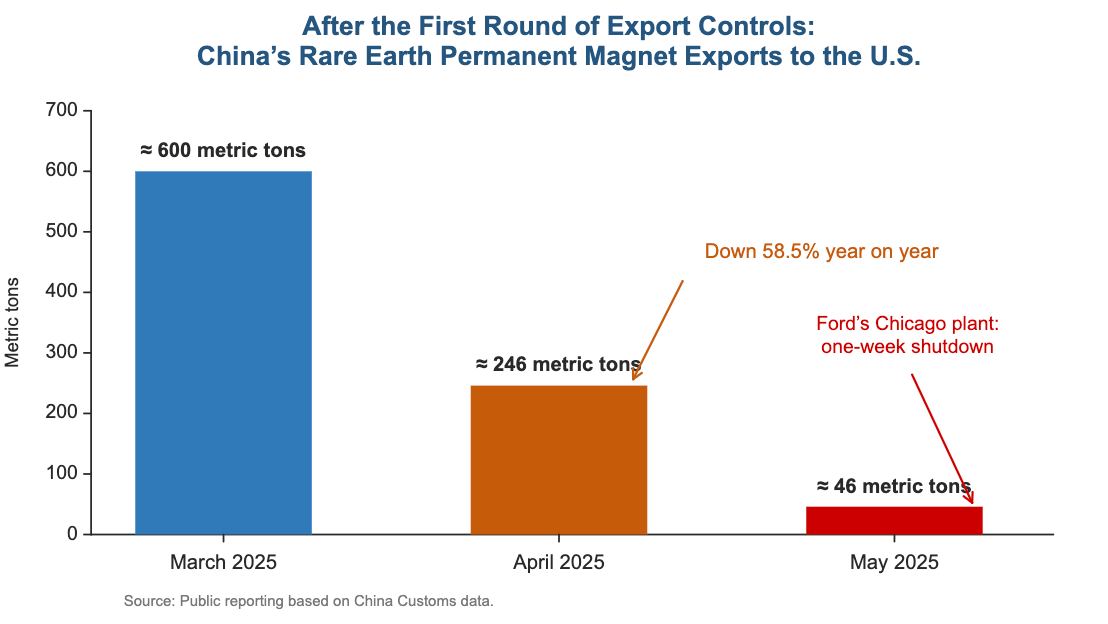
Figure 11: Changes in China’s rare-earth permanent-magnet exports to the United States (public reporting of Chinese customs data)
The book also fails to deal seriously with a basic historical question embedded in the engagement narrative. Rewriting more than thirty years of China–U.S. relations as the “failure of engagement” distorts history. Engagement did not fail; the illusion of changing China did. Engagement policy carried a concealed agenda of transforming China. When that agenda failed, some declared the entire policy a failure. But remove that agenda, and engagement itself brought the two countries and the world decades of overall peace and immense prosperity: hundreds of millions of Chinese people escaped poverty, American consumers gained access to affordable, high-quality goods, global supply chains achieved unprecedented efficiency, and the two countries engaged in tangible cooperation on financial crises, climate change, public health, and other issues. Judging success by whether China changed is like judging a friendship by whether the other person became a copy of oneself. The standard itself is wrong. What truly failed was never engagement, but the arrogance of treating another country’s development as one’s own engineering project. McCourt sees how frameworks change, but does not sufficiently pursue the question: Why must American knowledge about China always contain a prediction of what China will become? Why can it not accept China as itself? This question exceeds the scope of a single book, yet it is precisely the key to understanding American perceptions of China. From the assertion in the age of legal Orientalism that China had no genuine law, to the prediction in the age of modernization theory that China would eventually become “like us,” to today’s verdict that China necessarily constitutes a threat, only the conclusions have changed. The structure remains the same: China’s reality can acquire meaning only through an external framework.
Conclusion: Be Those Who Measure, Not Those Who Are Measured
At the end of his book, McCourt offers his American colleagues a prescription: reduce polarization within the community and allow experts with different positions to participate in policy debate. This is a mild recommendation and, judged against the mechanisms he himself reveals, one with almost no prospect of realization. Unless the logic of status competition is removed, polarization is not a matter of attitude but a structural problem.
For us, however, the value of this book lies not in its prescription, but in its diagnosis. It offers a rare case study of how a great power’s foreign policy can be held captive by its own mechanisms of knowledge production. This mirror should also be turned toward ourselves. Chinese academic discussion of America carries the same danger of frameworks preceding experience, the same tendency to substitute secondhand narratives for firsthand research, and the same need to guard against a mirror-image self-Orientalism that treats America’s present as China’s future. In the afterword to Rethinking Law and Development, I wrote: “Liberate China from being measured so that it can become the one who measures.” The other side of that statement is this: when measuring others, beware of the ruler in your own hand. The so-called “China puzzle”—a case scoring poorly on formal rule-of-law indicators yet sustaining rapid growth—already presupposes a Western yardstick. The right way to solve the puzzle is not to assign China a score, but to examine the markings on the ruler. The failure of the Washington Consensus and the success of China’s experience together demonstrate that institutions are not a prerequisite for development, but a variable that develops alongside it. Recognizing this requires not a political stance, but a method that gives empirical evidence priority and an epistemological humility.
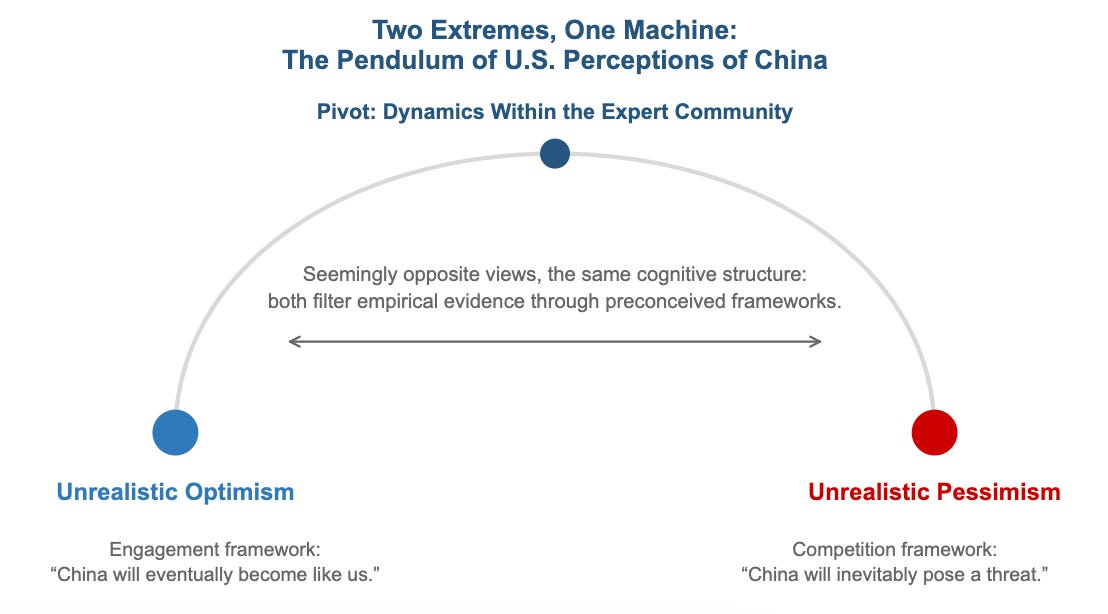
Figure 12: The pendulum of American perceptions of China (schematic)
The sociology of knowledge offers a simple lesson: those who seek to understand must include themselves within the field of understanding. McCourt accomplishes half of this task. He makes America’s expert community an object of study, but does not extend that objectifying gaze to the fuller picture of how China understands China and how China understands America. America’s China-studies community no longer has the capacity to undertake this second half of the work; the generational gap in expertise and the chilling effect leave it struggling to sustain itself. This is precisely the responsibility—and the opportunity—of Chinese academia. The foremost requirement in building an independent Chinese system of knowledge is not to propose a profusion of new terms, but to establish a discipline of knowledge production that begins with experience and submits to empirical testing, ensuring that every judgment contained in our concepts can withstand reality pushing back. Understanding China and studying America depend neither on prophecy nor on condemnation. They depend on the long accumulation of experience and an honest acknowledgment of our own epistemological limitations. The outcome of great-power competition ultimately depends not on who shouts loudest, but on whose understanding of reality is more firmly grounded. The story of rare earths has already taught this lesson once. It will teach it many more times.
Appendix: Principal Works Referenced in This Article
David M. McCourt, The End of Engagement: America’s China and Russia Experts and U.S. Strategy Since 1989. Oxford University Press, 2024.
Robert Jervis, Perception and Misperception in International Politics. Princeton University Press, 1976.
W. W. Rostow, The Stages of Economic Growth: A Non-Communist Manifesto. Cambridge University Press, 1960.
Teemu Ruskola, Legal Orientalism: China, the United States, and Modern Law. Harvard University Press, 2013.
Kurt M. Campbell and Ely Ratner, “The China Reckoning.” Foreign Affairs, Vol. 97, No. 2, 2018.
Rush Doshi, “America Is Losing the Ability to Train Tomorrow’s China Experts.” Council on Foreign Relations, 2026.
Zheng Ge, Rethinking Law and Development. Peking University Press, forthcoming in 2027.
Zheng Ge, “From Bringing the Rule of Law to China to Making the Rule of Law Chinese: Lessons from Legal Orientalism.”
This made me think of Goodhart's Law, which states..."When a measure becomes a target, it stops being a good measure."
Essentially, once a goal is set, people will optimize for that goal in a way that neglects equally important parts of a system. America stopped "measuring" and created a target; they are optimizing for negative interpretations, and elevating individuals whose ideas align with their target.