

It's been two days since Maduro came under U.S. custody. And what I find most worth researching is how such an invasion can be framed as "law enforcement" rather than a traditional war. As a realist, I'm not surprised to see the U.S. bypass the UN Security Council to bomb others, but it's still a shock for many Chinese observers to witness the U.S. "forcibly seizing" another country's president and charging him as a drug dealer. Rather than focusing on how the US military took Maduro, I think it's more interesting to examine how the lawfare operates.
That’s why I want to introduce the analysis Professor Zheng Ge郑戈, a professor at KoGuan Law School of Shanghai Jiao Tong University. he earned his Doctor of Laws degree at PKU in 1998 and subsequently remained as a faculty member. He was a visiting scholar between 2000 and 2004 at the University of Toronto in Canada, as well as at the University of Michigan, Duke University, and Columbia University. From January 2004 to January 2014, he taught at the University of Hong Kong's Faculty of Law.

In his article When Wars of Aggression Become 'Law Enforcement': The Imperial Logic of American Counterinsurgency Law.当侵略战争成为“执法行动”:美国平叛法的帝国逻辑 Professor Zheng, using the Maduro case as an example, argues that the U.S. has increasingly blurred the line between war and policing since 9/11. Instead of treating certain overseas actions as armed conflict—where the UN Charter, sovereignty, and strict limits on force should matter—U.S. officials can present them as “pursuit,” “counterterrorism,” or “assisting with security.” That shift alters the rules applied and reduces the political and legal costs of using force abroad.
Zheng describes this as a form of “counterinsurgency law”: a means of utilizing U.S. domestic law to extend its reach into other countries. In this logic, a foreign government can be rhetorically and legally downgraded—from a sovereign authority to something akin to a criminal organization or an “insurgent” threat to the U.S.-led order. Once that happens, the issue is no longer handled mainly as an international-law problem; it becomes a U.S. criminal case, built around expansive claims of extraterritorial jurisdiction.
In this scenario, the world is divided into "responsible stakeholders" and "rogue states." The former adhere to the international rules led by the United States, while the latter represent a "rebellion" against this order. Once a regime is labeled a "rogue state," it is no longer regarded as a legitimate member of the sovereign equality system but is instead demoted to a rebellious force that needs to be "pacified."
In practical terms, it actually asserts that whenever its domestic law defines an act as criminal and deems it a threat to U.S. interests, it may exercise criminal jurisdiction over any individual anywhere in the world — including heads of sovereign states. This effectively circumvents fundamental principles of international law, such as sovereign immunity and the laws governing diplomatic relations.
He warns that if the strongest country can unilaterally apply its own criminal law worldwide—and treat “legitimacy” as something it can grant or withdraw—then key international-law principles like sovereign equality and non-intervention start to lose real meaning. And if the U.S. normalizes this approach, other major powers will be tempted to copy it in their own way, turning global politics into a kind of escalating “legal warfare,” where law becomes another weapon rather than a shared set of constraints.
Below is the full article. I want to thank Professor Zheng for his kind authorization and Beijing Cultural Review
When Wars of Aggression Become ‘Law Enforcement’: The Imperial Logic of American Counterinsurgency Law
On January 3, 2026, U.S. President Trump claimed that the U.S. had successfully “apprehended” Venezuelan President Maduro and his wife, and removed them from Venezuela. Subsequently, U.S. Attorney General Bondi announced on social media that the current Venezuelan President Maduro and his wife had been indicted in the U.S. District Court for the Southern District of New York. The peculiarity of this news lies not in the indictment itself—absent indictments of foreign political figures by the U.S. judicial system are hardly news—but in Bondi’s deliberate omission of Maduro’s presidential title, characterizing him instead as a criminal suspect facing charges of “narco-terrorism conspiracy, cocaine importation conspiracy, possession of machine guns and destructive devices, and conspiracy to possess machine guns and destructive devices for use against the United States.” This seemingly technical choice of terminology actually reveals a deeper structural problem in the operation of the U.S. legal system: in American legal discourse, when can a sovereign state’s legitimate head of state be stripped of his political identity and instead be subjected to the jurisdiction of U.S. domestic courts as an ordinary criminal? The answer to this question is precisely hidden in the legal techniques developed by the U.S. since the “9/11” attacks, which transform foreign military interventions into domestic law enforcement operations.
To understand the legal essence of the Maduro case, one must first understand how the U.S. has reconstructed the boundary between “war” and “law enforcement” through legal interpretation techniques. Traditional international law is built upon the principle of sovereign equality in the Westphalian system, where armed conflicts between states are strictly constrained by Article 2 (4) of the UN Charter, allowing the use of force only with Security Council authorization or in response to armed attack. However, since the passage of the 2001 Authorization for Use of Military Force Against Terrorists, the U.S. executive branch has systematically redefined certain cross-border military operations as “law enforcement pursuit” rather than war in the traditional sense, through a series of legal memoranda and opinions from the Department of Justice’s Office of Legal Counsel. The core of this transformation lies in the creative expansion of the concept of “insurgency”: in traditional international law, insurgency refers to armed forces within a state challenging their own government, but American legal rhetoric extends this to “challenges to international order by transnational non-state actors,” thus enabling the U.S. to position itself as a law enforcement force “invited to assist in counterinsurgency” rather than a belligerent launching a war of aggression.
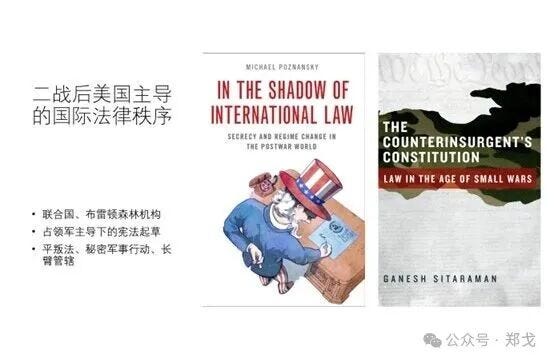
The figure shows a PowerPoint slide I have used in my Constitutional Law and Law and Development courses since 2017. My American doctoral student, 贲流, first alerted me to America’s Counterinsurgency Law. This is not a branch of law, but rather a theoretical description of U.S. “foreign-related rule of law.” U.S. domestic law contains many laws targeting other sovereign states and their regions. According to these laws, the legitimate governments of other sovereign states are sometimes labeled as “insurgents,” while at other times rebels in other countries may be designated as “insurgents,” thus revealing that the order disrupted by “insurgents” is not the domestic order of a specific sovereign state, but rather the U.S.-led global order.
The cunning of this legal logic lies in its creation of a “hybrid legal status”: it invokes certain rules of the law of armed conflict to justify the use of lethal force, while applying more flexible law enforcement standards in matters of jurisdiction, detention procedures, and target review. The 2012 revised edition of the U.S. Government Counterinsurgency Guide first blurred the line between “counterinsurgency” and “overseas stability operations,” redefining U.S. military support for foreign governments suppressing “insurgencies” as “law enforcement assistance.” Within this framework, the U.S. does not need to declare war on Venezuela or treat the Maduro government as a belligerent opponent; it only needs to temporarily designate specific individuals as “members of international criminal networks” through the “threat assessment” process in the President’s Daily Brief. Once this legal characterization is completed, the entire operation slips from the framework of international law into the jurisdiction of U.S. domestic criminal law. Maduro is no longer the head of a sovereign state, but a “fugitive felon,” a criminal suspect who can be globally pursued, extradited, and tried in U.S. courts.
The historical origins of this legal transformation can be traced back to the Piracy Suppression Act of 1819. This act authorized the U.S. President to empower naval officers to “arrest, seize, and deliver” pirates on the high seas, and modern legal interpretation has replaced the concept of “pirates” with “international terrorists” or “transnational criminal organization leaders,” and “high seas” with “ungoverned spaces.” In the 2011 al-Awlaki case, the U.S. government successfully invoked this logic to conduct a drone strike against a U.S. citizen in Yemen, on grounds that the operation constituted “law enforcement assistance” at the invitation of the Yemeni government, thus applying the “fleeing jurisdiction” rule. Although the D.C. Circuit Court of Appeals dismissed the case on grounds that plaintiffs lacked standing, it tacitly endorsed the government’s legal framework in its dicta—namely, that as long as an operation is packaged as counterterrorism pursuit against non-state actors, it need not trigger reporting obligations under the War Powers Resolution. This ruling essentially transformed overseas military operations into “law enforcement” under the domestic law framework, providing legal precedent for subsequent cross-border apprehension operations.
In the Maduro case, the four charges cited by the U.S. Department of Justice—“narco-terrorism” conspiracy, cocaine importation conspiracy, possession of machine guns and destructive devices, and conspiracy to possess machine guns and destructive devices—all constitute domestic criminal offenses under Title 18 and Title 21 of the U.S. Code. This means that the jurisdictional basis claimed by U.S. courts is not derived from any international treaty or UN authorization, but rather is purely a result of the unilateral expansion of “extraterritorial jurisdiction” through U.S. domestic legislation. According to the “effects doctrine” and “protective principle” developed in U.S. legal practice, as long as criminal conduct produces substantial effects on U.S. territory or citizens, or threatens U.S. security interests, U.S. courts may exercise jurisdiction regardless of the perpetrator’s nationality or location of the act. This jurisdictional claim received partial support from the Supreme Court in the 1990 United States v. Verdugo case, which explicitly stated that the Fourth Amendment does not apply to searches of foreign nationals abroad. Going further, the DOJ’s Office of Legal Counsel systematically articulated the domestic law transformation logic of “active self-defense” in an unpublished 2010 memorandum: transforming the right of self-defense from a single-incident response to “systematic elimination of persistent threat entities,” and analogizing it to police long-term crackdown operations against “ongoing criminal organizations.”
The operation of this legal architecture relies on a key conceptual transformation: redefining a sovereign state government as an “insurgent organization.” In traditional international law discourse, the standard for judging whether a regime has legitimacy is the “effective control principle”—as long as the regime can effectively control territory, maintain basic order, and fulfill international obligations, it should be recognized as the legitimate government of that country. However, America’s counterinsurgency law logic introduces a completely new standard: “whether it conforms to the legitimate norms of international order.” The ambiguity of this standard lies in the fact that the so-called “legitimate norms of international order” have no objective international law definition, but depend entirely on American political elites’ imagination of global order. In this imagination, the world is divided into “responsible stakeholders” and “rogue states,” the former observing international rules formulated under U.S. leadership, the latter constituting “insurgency” against this order. Once a regime is labeled a “rogue state,” it is no longer viewed as a legitimate member of the sovereign equality system, but is degraded to an insurgent force that needs to be “pacified.”
The danger of this legal discourse lies in its complete inversion of the basic logic of international law. In the Westphalian system, sovereignty is a legal status that does not change due to the nature or policies of a regime. A country can be morally condemned, diplomatically isolated, and economically sanctioned, but its sovereign status itself is inalienable. However, America’s counterinsurgency law logic transforms sovereignty into a privilege that can be granted or revoked, with standards determined entirely unilaterally by the United States. Venezuela is undoubtedly a sovereign state in the international law sense, Maduro was elected through constitutional procedures and re-elected multiple times as president, the regime is recognized with UN membership, and maintains diplomatic relations with the vast majority of countries worldwide. But in America’s legal narrative, these facts all become irrelevant. The Maduro government is characterized as a “criminal syndicate,” its rule over Venezuela described as “illegal occupation.” Therefore, the apprehension of Maduro is not a violation of a sovereign head of state, but rather a legitimate pursuit of a “transnational criminal organization leader.”
The legal consequences of this characterization are extremely far-reaching. Once Maduro is successfully arrested and transferred to U.S. jurisdiction, he will not enjoy any head of state immunity or prisoner of war treatment, but will be tried as an ordinary criminal defendant. U.S. courts will invoke the principle that “head of state immunity does not apply to international crimes,” but the problem is that the charges against Maduro are not war crimes, crimes against humanity, or genocide in the international law sense, but purely U.S. domestic criminal law offenses. This means U.S. courts are actually claiming: as long as U.S. domestic law defines certain conduct as criminal and determines that such conduct threatens U.S. interests, the U.S. can exercise criminal jurisdiction over anyone anywhere in the world—including sovereign heads of state. The absurdity of this claim lies in its rendering completely meaningless a series of fundamental principles in international law concerning sovereign immunity, non-interference in internal affairs, diplomatic relations, and so on. If every country could unilaterally define crimes and conduct global pursuits like the United States does, international society would completely regress to a jungle state.
The deeper problem lies in the structural isomorphism between this legal logic and the “counterinsurgency strategy” the U.S. promotes globally. The core of counterinsurgency theory is not destroying the enemy, but “winning hearts and minds,” i.e., isolating and dismantling the social foundation of insurgency by establishing legitimacy. In America’s strategic discourse, global order itself is understood as an ongoing counterinsurgency war, where the U.S. and its allies represent the “legitimate government,” while countries refusing to accept U.S.-led order are “insurgents.” Military intervention, economic sanctions, regime change, and judicial prosecution against these countries are all incorporated into the category of “full-spectrum counterinsurgency operations,” whose goal is not simply eliminating enemies, but winning international community support by establishing the appearance of legal procedures, thereby isolating target regimes. The Maduro case indictment is a typical manifestation of this strategy: the U.S. does not need to directly send troops to overthrow the Maduro regime, but only needs to characterize him as a criminal through judicial procedures, thereby legally negating the legitimacy of his rule and providing a “rule of law” veneer for subsequent regime change operations.
This operation of transforming international political conflicts into domestic criminal cases has a long tradition in U.S. legal practice. From the 1989 U.S. military invasion of Panama to arrest Noriega, to the trial of Saddam after the 2003 invasion of Iraq, to the wanted notices for Libya’s Gaddafi, Syria’s Assad and others, the U.S. has repeatedly demonstrated its capacity to package “regime change” as “law enforcement operations.” The key to this packaging lies in degrading target figures from political leaders to criminal offenders, thereby giving military intervention a certain “legal legitimacy.” In the Noriega case, one of the reasons for the U.S. invasion of Panama was “arresting a drug trafficker indicted by U.S. courts,” even though Noriega was then Panama’s de facto ruler. When U.S. courts heard this case, they explicitly refused to recognize Noriega’s head of state immunity, on grounds that his regime was “not recognized by the United States as a legitimate government.” This ruling created a dangerous precedent: a country can evade international law provisions on sovereign immunity by unilaterally refusing to recognize another country’s government legitimacy.
The special nature of the Maduro case lies in the fact that the Venezuelan government has not, like Noriega or Saddam in their time, been militarily defeated or experienced regime collapse. Maduro still firmly controls Venezuela’s state apparatus, and the country’s military, police, and judicial systems remain loyal to him. Arresting Maduro under these circumstances, whether through covert operations or extradition procedures, would necessarily constitute a serious violation of Venezuelan sovereignty. But in America’s legal narrative, this violation is reframed as “cross-border law enforcement cooperation.” The U.S. Department of Justice will most likely claim that Maduro’s arrest was accomplished with the cooperation of “the true representatives of the Venezuelan people”—i.e., the opposition government recognized by the U.S.—and therefore does not constitute a violation of Venezuelan sovereignty. The absurdity of this argument lies in its transformation of sovereignty from an objective legal fact to a subjective political judgment: only governments recognized by the United States possess sovereignty, while governments not recognized by the U.S., even if they actually control the state apparatus, are not viewed as sovereigns.
The support for this logic at the legal technical level comes from America’s selective application of “state succession” and “government recognition” theories. In international law, whether a new regime should be recognized as a legitimate government traditionally has two standards: the “effective control principle” and the “legitimacy principle.” The former emphasizes actual control capability, the latter emphasizes the legitimate source of rule. The U.S. flexibly chooses between these two standards in different situations: when a U.S.-supported regime has weak actual control, the U.S. invokes the “legitimacy principle” to maintain recognition; when a U.S.-opposed regime effectively controls territory but does not conform to American values, the U.S. invokes the “legitimacy principle” to refuse recognition. On the Venezuela issue, the U.S. has recognized opposition leader Guaidó as “interim president” since 2019, even though Guaidó has never actually controlled any Venezuelan territory or government institutions. This recognition is purely based on America’s unilateral interpretation of “democratic legitimacy,” completely ignoring basic international law rules on government recognition.
More noteworthy is America’s appropriation of “transitional justice” theory in this process. Transitional justice originally referred to dealing with historical legacy issues through trials, truth commissions, reparations and other mechanisms after regime change or conflict resolution, premised on the old regime having fallen or conflict having ended. But America’s counterinsurgency law logic advances transitional justice to the midst of ongoing conflict: while the Maduro regime has not yet fallen, it begins settling accounts through judicial procedures, with the purpose of accelerating regime change through legal means. The core of this “turbulent transition” lies in transitional justice no longer being a passive reaction after conflict ends, but rather becoming part of the conflict itself, an active tool used to undermine the legitimacy of hostile regimes, divide their supporters, and create legal grounds for military intervention or regime change. In this sense, the indictment of Maduro is not to achieve justice, but to achieve regime change; not law constraining politics, but law serving politics.
This instrumentalization of law has explicit theoretical support in America’s counterinsurgency manuals. The 2012 edition of the Counterinsurgency Guide emphasizes that law in counterinsurgency is not an external constraint, but rather “the nexus that links the populace to the political order,” and “the mechanism by which governments gain legitimacy and populations assume obligation.” The manual explicitly points out that counterinsurgency victory does not depend on how many enemies are eliminated, but on whether popular support can be won through law, governance, and public services. At the global level, this means the U.S. needs to shape the legitimacy of its actions through international legal procedures—even unilaterally initiated procedures—thereby defeating opponents in the “legitimacy competition.” The symbolic significance of indicting Maduro far exceeds its practical significance: even if Maduro is never extradited to the U.S. for trial, this indictment itself has already characterized him as a criminal at the legal discourse level, thereby undermining the Venezuelan government’s legitimacy in international society and providing countries supporting U.S. policy with a “legal basis” to refuse dealing with the Maduro government.
Another key element of this legal strategy is the dual manipulation of the concept of “legitimacy.” In American theoretical discourse, legitimacy is distinguished as “legal legitimacy” and “sociological legitimacy”: the former comes from procedural propriety, the latter from popular identification. In domestic counterinsurgency operations, both types of legitimacy need simultaneous maintenance, because relying solely on procedural propriety while losing popular support leads to strategic failure. But at the international level, the U.S. skillfully exploits the tension between these two types of legitimacy. When America’s actions conform to international law procedures, it emphasizes legal legitimacy; when America’s actions violate international law but might gain support from some countries or populations, it emphasizes sociological legitimacy. In the Maduro case, the indictment clearly lacks legal legitimacy in the international law sense—no UN authorization, no international law basis for universal jurisdiction, purely unilateral expansion of U.S. domestic law—but the U.S. attempts to gain sociological legitimacy by portraying the Maduro government as “dictatorial, corrupt, drug-trafficking,” thereby defending its actions in international public opinion.
The danger of this legitimacy manipulation lies in its creation of a “normalization of the state of exception.” In Schmitt’s political theology, the sovereign is defined as “he who decides on the exception.” Through its counterinsurgency law logic, the U.S. positions itself as the sovereign of global order: it can decide which countries are in “normal” status and thus subject to conventional international law rules, and which countries are in “exceptional” status and thus can be treated as insurgent organizations. This decision-making power requires no international procedure, no UN Security Council authorization, no International Court of Justice ruling, but purely depends on unilateral assessment by the U.S. executive branch. Once a country is characterized by the U.S. as a “rogue state” or “criminal regime,” all actions against that country—whether military strikes, economic blockades, or judicial prosecution—are automatically exempted from international law constraints, because these actions are redefined as “law enforcement” rather than “war,” “counterinsurgency” rather than “aggression.”
The most extreme manifestation of this legal logic is America’s creative use of the “enemy combatant” concept. In traditional laws of war, captured combatants are either prisoners of war and thus protected by the Geneva Conventions, or criminals and thus protected by criminal procedural law. But the U.S. created “enemy combatants” as a third category in the war on terror, enjoying neither POW treatment nor criminal defendant rights, and can be indefinitely detained without trial. The legal basis for this concept is precisely characterizing the war on terror as a hybrid state: both war and thus permitting use of lethal force and long-term detention, and law enforcement and thus not subject to laws of war constraints on POW treatment. The Maduro case follows the same logic: Maduro is neither a belligerent state head and thus does not enjoy wartime immunity, nor an ordinary foreign citizen and thus not protected by sovereign immunity, but rather a “criminal organization leader” who can be globally pursued like Bin Laden or al-Baghdadi.
From a more macro-historical perspective, America’s legal system represents a new type of imperial governance model. Traditional empires maintained their hegemony through direct territorial occupation and colonial rule, while the American empire achieves global governance through hegemony in legal discourse. It does not need to station governors in every country, but only needs to control interpretive authority over international legal discourse to decide which countries’ sovereignty should be respected and which can be ignored; which governments’ legitimacy should be recognized and which should be characterized as criminal syndicates. The subtlety of this imperial model lies in its retention of the form of sovereign equality while substantively establishing a hierarchical global order: countries accepting U.S. rules enjoy complete sovereignty, while countries challenging U.S. rules are degraded to “insurgents,” whose leaders can be globally wanted as criminals.
The maintenance of this order relies on a key legal fiction: the existence of an “international community” transcending national sovereignty, with the U.S. as the spokesman for this “international community’s” will. In American legal rhetoric, the indictment of Maduro is not a unilateral U.S. action, but the “international community’s” collective crackdown on “transnational crime.” This rhetorical strategy attempts to package America’s particular interests as universal interests, and America’s unilateral actions as multilateral cooperation. But the problem is that the so-called “international community” does not have a unified will, but is merely an anarchic system composed of states with vastly disparate power. The reason the U.S. can speak for the “international community” is not because it has received authorization from other countries, but purely because it possesses overwhelming military and economic power. This strength-based legal hegemony is fundamentally opposed to the Westphalian system’s principle of sovereign equality.
The deeper contradiction lies in the U.S. promoting “rule of law” and “democracy” globally on one hand, while practicing the most naked “might makes right” at the international level on the other. The U.S. demands that other countries respect judicial independence, observe procedural justice, and accept international law constraints, but can itself unilaterally decide which international law rules apply to itself, can refuse to join the International Criminal Court, and can authorize the President through the American Servicemembers’ Protection Act to use “all means necessary” to rescue any American detained by an international court. This double standard is particularly evident in the Maduro case: the U.S. demands Venezuela submit to U.S. court jurisdiction, but would never accept any international court’s jurisdiction over the U.S. President or senior officials. This asymmetry reveals the essence of American legal imperialism: law is not used to constrain the strong, but is a tool the strong use to constrain the weak.
From Venezuela’s perspective, the Maduro case represents the complete collapse of the sovereignty principle. If a country’s head of state can be globally wanted due to an indictment by a U.S. domestic court, what meaning does sovereignty have? If the U.S. can unilaterally decide which government is legitimate and which should be overthrown, what binding force does the UN Charter provision on non-interference in internal affairs have? If U.S. judicial jurisdiction can expand unlimitedly to anywhere in the world, how can other countries maintain their own legal order? These questions concern not only Venezuela, but all countries unwilling to completely submit to American will. Today the U.S. can indict Maduro on “drug trafficking” grounds, tomorrow it can indict leaders of other countries on “human rights violations” grounds, and the day after it can launch “law enforcement operations” against any regime it dislikes on grounds of “threatening U.S. security.”
The danger of this legal warfare lies not only in its violation of individual countries’ sovereignty, but more fundamentally in its undermining of the foundation of international law order. The survival of international law depends on countries’ mutual recognition and observance of basic rules, and the most core of these basic rules are sovereign equality, non-interference in internal affairs, and prohibition of threat or use of force. When the world’s most powerful country openly disregards these rules and rationalizes its violations through legal techniques, what reason do other countries have to continue observing these rules? America’s actions are actually encouraging all capable countries to follow suit: can China issue a global arrest warrant for Taiwan’s leader invoking the “Anti-Secession Law”? Can Russia initiate judicial prosecution against Ukraine’s president invoking the “protection of own citizens” principle? If every major power extends its domestic law jurisdiction globally like the United States, international society will fall into comprehensive legal warfare, with the ultimate result only being the return of jungle law.
The Maduro case is therefore not only a specific legal event, but also a symbolic turning point: it marks the U.S. having completely abandoned efforts to maintain international order through multilateral mechanisms, turning instead to relying on unilateral legal hegemony to advance its global strategy. The root of this shift lies in America’s relative power decline and the multipolarization trend of the international system. When the U.S. finds itself increasingly unable to obtain authorization for action through the UN Security Council or other multilateral mechanisms, it chooses to bypass these mechanisms and directly achieve its strategic objectives through its own legal system. This strategy may be effective in the short term, but in the long run will accelerate the disintegration of international law order and the fragmentation of global governance. When more and more countries realize that international law cannot protect them from great power violations, they can only seek self-preservation through developing military strength, establishing exclusive alliances, or conducting preemptive strikes to maintain their own security—precisely the choice of European countries before World War I, and the direct cause of catastrophic conflict.
Excellent analysis. From my humble Swiss perspective it one more reinforces my view, the China is the more reliable country and much more interested in global piece sustained by international rules of law.
Whew. That was beautiful. Very well written. Easy to comprehend.
In the imaginations of American elites, the only country with sovereignty is the United States, according to the United States. The only country fit to decide what is a country and what is not a country, is the United States.
American elites are digging a very deep hole for themselves.