

Due to time constraints, I couldn’t keep up with the podcast I started last year. I’ve decided to shift the format slightly by using this space to introduce you to my absolute favorite Chinese podcast of the year-A Conversation with Nie Huihua: Is a Government Job the Best Choice in an Economic Downturn?对话聂辉华:经济下行期,体制内是最优解吗? Professor Nie Huihua聂辉华 from Renmin University sits down with Zhiben Lun知本论- a podcast run by CITIC Press Group. Professor Nie is a Distinguished Professor at the School of Economics at Renmin University of China, specializing in organizational economics and the political economy of China. With a Ph.D. from Renmin University and postdoctoral training at Harvard University
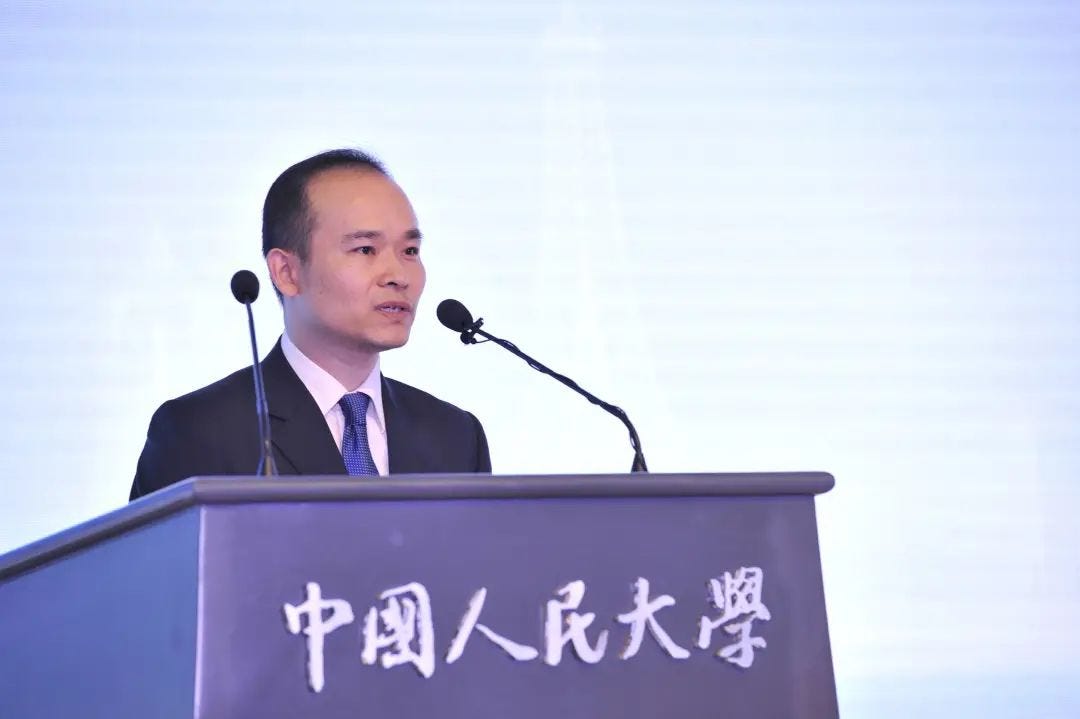
Compared to his academic achievements, I admire his outspoken style and profound grassroots understanding of China even more. His research is not confined to books and economic models but encompasses extensive field surveys and communication with local Chinese officials. He is also willing to publicly share his insights, maintaining an active presence on Bilibili, China’s equivalent of YouTube, where he has amassed over 730,000 subscribers-mostly Chinese youth.
This is a long conversation, so I’ll split it into two episodes. In this first episode, Professor Nie explains how China’s hierarchical city administrative structure influences resource distribution, career opportunities, and regional competitiveness, pointing out that higher-ranked cities receive more resources due to their political status, which creates an uneven playing field from the outset.
He also explores the “informal rules” that govern power at the county level and breaks down their implications, introducing his formula for understanding grassroots governance: Incomplete Contracts + Administrative Subcontracting = Unlimited Responsibility = Unlimited Power.
Furthermore, he examines why the land finance model has proven unsustainable, yet remains hard for some local governments to abandon, and discusses the roots of the local debt crisis and how performance metrics like “maintaining stability” and “attracting investment” shape officials’ behavior.
Professor Nie argues that to truly understand China’s grassroots, we must look at its incentive structures and historical-cultural continuity—economic development is one thing, but transforming governance logic takes far longer.
This first episode also touches on how individual destinies in China are woven into broader administrative structures, and why, for most people without strong connections, big cities may still offer a better path forward. We’ll explore that further in the next installment.
02:15 The Chinese “System Fascination”: Why Are Gen-Z Now Asking “How Much Power Does a County Party Secretary Have?”
04:00 Overqualified or Peaking Early? A Harvard Postdoc Becomes Deputy Director of a Subdistrict Office in Shenzhen — Unveiling the Hidden Administrative Rank of Local Governance.
06:35 The Land Beneath Your Feet Has a Hierarchy: How Your City Determines Your Access to Healthcare, Education, and Wealth.
09:22 The Truth About Resource Misallocation: Is the Prosperity of Beijing, Shanghai, Guangzhou, and Shenzhen Really Due to Higher Efficiency?
11:43 “County Brahmins”: Is Returning to One’s Hometown Really a Viable Fallback for the Average Person?
14:55 How Much Power Do Local Officials Really Have? “Incomplete Contracts + Political Subcontracting = Unlimited Responsibility = Unlimited Power.”
21:29 Why Are Local Governments “Addicted” to Land Finance? The Connection Between Official Performance Metrics and Promotion KPIs.
I also want to thank Professor Nie and host Sun Bingjie from Zhiben Lun for kindly authorizing and providing the Chinese transcript. As always, for those who want to challenge their Chinese listening, here’s the link to the original podcast. Below is the transcript I made.
Host Bing Jie:
Hello everyone, welcome to Zhiben Lun知本论, I’m Bingjie. Over the past few years, it seems that we’ve collectively lost our sense of direction about the future. Two narratives have become extremely popular: either seeking stability by joining the ‘involution’ for civil service exams, or escaping the megacities like Beijing, Shanghai, and Guangzhou to return to one’s hometown county and ‘lie flat’. Many say the ultimate destination in life is a state-sector job, but have you ever wondered what lies beyond that ‘iron rice bowl’?
Our guest on Zhiben Lun today is an economist renowned for speaking his mind, Professor Nie Huihua from Renmin University of China. He’s also a sharp commentator on Bilibili. He recently published a new book, The Operating Logic of Grassroots China基层中国的运行逻辑, where he uses the scalpel of economics to dissect the underlying code that governs resource allocation and influences everyone’s employment, wealth, and even destiny.
In this episode, we won’t just discuss macroeconomics; we’ll also talk about what constitutes true ‘risk-aversion’ for the individual in today’s China, and where one’s opportunities might lie. I’m very happy to have this chance to speak with Professor Nie. First, let’s welcome Professor Nie to say hello to our listeners.
Prof. Nie:
Alright, hello everyone, I’m Nie Huihua from Renmin University of China.
Host Bing Jie:
Several of your most popular videos on Bilibili are about grassroots governance and the system. In our impression, Bilibili’s user base is very young. The fact that a group of young people are listening to you talk about topics like ‘How much power does a county Party secretary have?’ was quite surprising to me at first.
Prof. Nie:
I think there might be a few reasons. One immediate reason is that many people want to take the civil service exam. The second is that many people come from grassroots backgrounds, but they haven’t truly lived and worked at that level. As an economist, the two questions I get asked the most are: first, how is the macroeconomic situation, and second, which stock to buy. I don’t actually specialize in either of those! Many people talk about macroeconomics, and many talk about stocks and financial management, but very few talk about China’s state governance, especially governance at the grassroots level.
I myself come from a rural background—a small-town slacker (小镇不做题家) from the countryside, you could say. When I was young, we didn’t have endless practice exams to do. I later tested into university. I have some familiarity with the grassroots level, and I have some feelings for it. At the same time, I’ve discovered that many young people today are actually quite detached from the realities of grassroots life. For example, in my class, when I ask how many students are from rural areas, maybe 10% raise their hands. When I ask how many have ever farmed land, not a single one has. Even if their household registration is rural, they grew up attending school in the county town or even the city, and know nothing about the countryside. So, they have this tenuous connection, a sense of mystery, but no real understanding. There are many people like this.
There’s a phenomenon: every year after the Spring Festival travel rush, we see so-called “hometown-return narratives”(返乡体文学) appear—many people writing about the decline of the villages, right? For instance, my fellow townsman Xiong Peiyun熊培云 has a line that resonates deeply: ‘Every hometown is falling.’ It feels like you can’t go back. But whether one should go back, or if it’s worth going back, is another question altogether.
Prof. Nie:
I realized many people actually don’t understand the situation at the grassroots, yet the vast majority of people live within its framework. Even people in Beijing, Shanghai, Guangzhou, and Shenzhen—strictly speaking, 99% of them live at the grassroots level. Because no matter how they live, the place they are in must belong to some community, some subdistrict. And that subdistrict or community is part of the grassroots. Here, by ‘grassroots,’ I mean departments at the county/district level and below. Of course, there are a tiny number of unique communities that might not be managed by a regular neighborhood committee or subdistrict—that’s a separate case, truly belonging to central or provincial organs. But otherwise, according to the principle of territorial management, almost all of us should belong to and live within the grassroots structure, though we may not all work directly within the grassroots system.
Prof. Nie:
I hadn’t initially realized that so many people lacked an understanding of grassroots issues until I encountered numerous such questions. Let me give an example: a few years ago, there was a discussion about a Harvard postdoctoral fellow, an associate professor at Nanjing University, who went to work as a deputy director of a subdistrict office(街道办事处) in Nanshan District, Shenzhen. Many felt this was a case of someone overqualified taking a much lower position, a waste of talent. But many people don’t understand the system. Why? Shenzhen is a sub-provincial-level city(副省级市). Its subdistrict offices, like those in direct-controlled municipalities, have a Division-Head level (正处级) administrative rank. In other words, a deputy director of such a subdistrict office is equivalent to a deputy county head. Think about it: how many people, upon graduation, can become a deputy county head? It’s starting at the peak! For many, the ceiling of their entire career is the deputy departmental level. So, you see, this was a case of widespread misunderstanding. That’s when I truly realized this is a fascinating phenomenon.
Then, on Bilibili, it turns out many followers seem quite interested in this kind of content. How to put it? Chinese people, especially men, have a complex relationship with power. First, most people might not like power, but they simultaneously yearn to possess it, yet don’t understand how it operates. It’s this subtle, delicate sentiment that makes everyone particularly keen to learn some knowledge about how the system operates. It’s very normal. We all wish to restrain power; we dislike power, but most of us don’t possess it, so we want to know how it runs. These feelings aren’t contradictory.
Host Bing Jie:
Because I’m from Shandong, people from Shandong might have a slightly different feeling when it comes to the ‘system’ compared to other provinces. I feel like we’ve been soaked in that environment since we were kids. While I was just listening to you talk about people’s detachment from the system, I was thinking about when this influence started for me. It begins to show in the drinking table culture of Shandong people. I don’t know if you’ve ever participated, but if there’s a Shandong-style banquet, they will definitely arrange the seating order for you.
Prof. Nie:
I know. In my book, The Operating Logic of Grassroots China基层中国的运行逻辑, there’s a chart about the relationship between the Party and the government in China, and I used Shandong Province as the example. Because Shandong is a place that particularly emphasizes civil service exams and one’s status within the system, so I used Shandong as an example.
Host Bing Jie:
Right. Since you’ve been talking about this system on Bilibili for a long time, including its modes of operation—what we’d call “popular science” videos in quotes—over all these years, what do you feel is, or has there been a contrast in, the biggest misconception people have about the system?
Prof. Nie:
I think for most people, the main issue is unfamiliarity with the rules of how the system operates. For example, many people think a community committee (shequ社区) is a government department, or that a village committee is a government department. These are misunderstandings. Many people think a subdistrict office (jiedao ban街道办) is no different from a neighborhood committee (juweihui居委会), not understanding the fundamental logic behind how they operate. I’d say this fundamental logic is the hierarchical system.
For instance, many people don’t understand that Chinese cities have a very complex hierarchy. You just mentioned that many in the audience are probably in first- or second-tier cities like Beijing, Shanghai, Guangzhou, Shenzhen. But in China, cities are divided into five levels. There are province-level municipalities directly under the central government(省部级的直辖市), 15 sub-provincial cities(副省级市), then ordinary provincial capital cities 省会(most provincial capitals are not sub-provincial cities). Many people simply don’t know this.
Prof. Nie:
Let me add: In some places, the level of the provincial capital city is actually lower than that of another city in the same province. For example, in Fujian, the provincial capital is Fuzhou, which is a department-level city (正厅级). But the city with the highest administrative level in Fujian is Xiamen, which is a sub-provincial city (副省级市). The average person has no idea about this, right?
Then there are ordinary prefecture-level cities(地级市) and county-level cities(县级市). What’s the relevance? Of course it matters. It involves your career choices, your children’s education, your investments. Because a lot of China’s resources are allocated from the top down according to this hierarchy. So if you live, study, or work in a high-level city, you can enjoy more medical resources, educational resources, and have more job opportunities.
There’s certainly a difference. Why does Shenzhen have such good infrastructure? Because Shenzhen is a sub-provincial city. Sub-provincial cities can deal directly with the central government on economic and fiscal matters; they don’t need to go through the provincial level. So Shenzhen has more fiscal surplus and greater autonomy. So if you don’t understand city levels, it’s hard to understand why Shenzhen has so much policy autonomy and fiscal surplus, right?
And the difference in healthcare and education is too obvious, right? If you’re in a sub-provincial city, you probably have quite a few 985 Project universities (like a US Ivy League) and major top-tier tertiary hospitals. If you’re in a prefecture-level city, you might have neither 985 universities nor major top-tier hospitals. So you see, the disparity is huge. I think these things actually have a significant impact on everyone’s life, study, work, employment, and investment.
Host Bing Jie:
You mentioned the hierarchical system between cities. Does this mean that in today’s China, an individual’s struggle often can’t overcome an administrative map? For example, if I was born in or chose a low-level city, it’s like being assigned a ceiling before I even start climbing up.
Prof. Nie:
Yes. I want to add something. We conducted a study before, trying to answer a question: Do those big cities develop well primarily because of their own high productivity levels, or because they possess innate hierarchical advantages—’the moon favors the nearer tower’近水楼台先得月? Our conclusion is that most of it should be attributed to hierarchy. That is, it’s because they had the higher level first, which allowed them to obtain more resources, that they then developed better.
Furthermore, we found that, by economic standards, many high-level cities do not fully utilize their resources; the degree of resource misallocation there might be even more severe. So in this sense, the competition between large cities and small cities in China is not entirely fair; they aren’t on the same starting line from the beginning.
It’s precisely in this sense that I somewhat disagree with simply lifting restrictions on the size of big cities. Because this isn’t a pure market economy phenomenon to begin with. You already have an advantage over others, and then you say, ‘Let’s open up competition’? How can you when you’re not even on the same starting line? For fair competition between cities, the prerequisite is fairness first, then competition. This has always been my view.
Host Bing Jie:
So, for most Chinese cities, it’s the hierarchical classification that determines the resources they can subsequently have and their level of development. Is there a possibility that some cities developed earlier in the initial accumulation process because they possessed certain innate resources, like so-called geographical advantages or mineral deposits, for example, and so during the classification, they were categorized as key development areas?
Prof. Nie:
You mean, some cities had abundant natural resources even before they were designated as key cities, right? That phenomenon exists, but there are also counterexamples. For instance, there’s a fascinating natural experiment: the provincial capital of Hebei was initially in Baoding保定, right? Later it was moved to Shijiazhuang石家庄. Changing the capital city made that city’s development trajectory completely different, purely because everything else remained the same—only the capital changed. Logically, Baoding was no longer the provincial capital, but its resource advantages should still be there, its geographical location unchanged. Yet, you see, it’s different. The impact is truly significant. I wouldn’t say it’s the only factor, but it is a decisive one. A collaborator of mine conducted research on the evolution of Chinese cities over thousands of years, and his conclusion was exactly the same as mine: many cities developed purely because they became political centers.
Therefore, they gained more opportunities for economic development. If they hadn’t, it would be completely different. Think about it: Southern China’s economy only began to develop significantly from the Southern Song Dynasty onward. Why? Because the Northern Song was defeated and moved south, establishing the Southern Song, shifting the economic center southward. If it weren’t for the Northern Song nobility and wealthy families bringing capital, resources, and talent south, the South might not have developed so quickly.
So, did the geographical advantages of the South change before that? No, right? And the Grand Canal 大运河 was also built later to connect the north-south artery. So, you see, even transportation conditions can change. Under China’s system, I believe political factors can even be said to still hold a dominant position. It’s not as many people understand—that cities were selected because they had good conditions first. It’s not that simple. I don’t rule out that phenomenon, but for cities, most of the time it’s the political rank that determines their economic development prospects, not their economic endowment that gets them selected as high-political-rank cities.
Host Bing Jie: Mm. Earlier we were discussing why we need to understand the operating logic of grassroots China. The first reason might be the direct need of those preparing for civil service exams, as they need to directly understand how this thing works. Another reason, I think, for the general public, is a relatively obvious trend in recent years. You’ll find that periodically, there’s this so-called trend or wave of ‘returning home’ from megacities like Beijing, Shanghai, Guangzhou, Shenzhen.(逃离北上广) Especially in recent years, with the high pressure and intense competition in those cities, people think, should I find a place to “lie flat”?躺平 Naturally, when thinking of lying flat, they consider these smaller places where the cost of living is lower. But upon arriving, they discover that because they don’t understand how these places operate, they find the workings of power there to be particularly opaque, “the water is too deep,” and they end up returning to the big cities. This touches on a hot internet term from recent years: “County Brahmins.”(县城婆罗门)
Prof. Nie:
Actually, this term borrows from India’s caste system. The Indian caste system essentially classifies people hierarchically, figuratively dividing a body into head, shoulders, waist, tail... we even say ‘head’ cities, ‘head’ enterprises now, which itself is an expression of hierarchy. I don’t think China’s counties have true ‘Brahmins.’ It’s just that within counties, there exist some large families who hold relatively stable power, and whose families continuously produce new officials at or above the deputy section-chief level. This phenomenon does exist.
Host Bing Jie:
That reality is quite harsh. We often say the big cities are too competitive, and we want to retreat to counties to find a utopia. But based on what you’re saying, the county is actually another, more hidden, more exclusive world(江湖). For those without background or skill in navigating relationships, does a so-called fallback option even exist?
Prof. Nie:
I agree. I have a summary: The higher the city level, the bigger the city, the more important formal institutions are. The lower the city level, the more grassroots, the more important informal rules are. So, the more you are in a big city, you find that since formal rules are at play, you don’t need as many informal rules. And what ordinary people lack is precisely social capital—those connections. So, to some extent, people without connections are indeed more suited to strive in big cities, right? This fits the norm. But even in other countries, it’s actually similar. Because the smaller the place, the less population mobility, it inevitably tends more towards an acquaintance society. Acquaintance societies necessarily rely more on informal rules. This is true worldwide; China is no exception.
Host Bing Jie:
So, the more downward, lower-tier the region, like counties, or down to township-level leaders, people feel their power is very great.
Prof. Nie:
This “very great power” actually refers to relative power. Logically, a county Party secretary(县委书记, often the top of the county) is only at the Division-Head level. In Beijing, there are too many Division-Head-level officials, right? It’s about his relative power. Although his statutory power might not be much greater than a department head’s, because the lower you go, the more important the informal becomes. And what governs this informality? Often, it’s the informal institutions derived from the influence of power. So, these two are matched. In big cities, because formal institutions are relatively well-developed, the informal part is constrained.
So, even if you hold the same Division-Head level power, in a big city it lacks that amplification and derivative effect, while at the grassroots it has amplification and derivative effects, making a county Party secretary’s power as a Division-Head level official appear greater. If it weren’t for these informal institutions, or if contracts at the grassroots weren’t more incomplete, the county Party secretary wouldn’t have such great power.
When I teach power theory, I clearly tell everyone, when is power useful? Power is only useful in a world of incomplete contracts. If the world operated on complete contracts—meaning everything is clearly stipulated—power would be useless, right? So why does power seem so useful at the grassroots? It’s precisely because grassroots institutions are imperfect, grassroots contracts are incomplete. That’s the reason.
Host Bing Jie: It involves the factor of transparency
Prof. Nie: ...non-transparency? Non-transparency is one aspect, but it’s more complex than just transparency. Let me put it this way: The lower you go to the grassroots, the more gray areas exist. Mm. Because if you’re dealing with gray areas, the freedom or discretion of power is greater. That is, the less clearly something is defined, the greater the role of power. The more clearly something is defined, the smaller the role of power. So, grassroots power itself isn’t inherently greater than upper-level power; it’s just that the environment it faces is different, causing its power to be amplified and generate many derivative values. That’s the reason.
Host Bing Jie:
Regarding this grassroots power, like that of local grassroots officials, the extent of their authority—do you think it can continue to be ‘cashed in’? Always...
Prof. Nie:
I have a formula: Incomplete Contracts + Administrative Subcontracting System = Unlimited Responsibility = Unlimited Rights. First, as I just mentioned, the lower you go, the more imperfect the system, it’s an incomplete contract. But China precisely implements territorial management. What is territorial management? To a certain extent, it’s a political subcontracting system. You, as the principal official of a locality, are responsible for everything that happens there. This is political contracting. The higher-ups only care about results. So, incomplete contracts plus political contracting must equal unlimited responsibility—you have to manage everything. Rights and responsibilities must correspond, otherwise things are unsustainable because it violates incentive principles. Okay, now I have unlimited responsibility. In reality, this will inevitably give rise to unlimited rights. Because since you make me responsible for everything, then I have to manage everything. Naturally, the power is great, right? This is the root cause.
Solving this problem isn’t impossible. The way is to turn our government officials into limited liability. But for this concept to be accepted by Chinese people requires a long process. Since ancient times, we have believed the government has unlimited responsibility. No matter what happens, we ultimately must go to the government; we call for the ‘upright official’(青天大老爷). So, this in the short term cannot be changed. It’s also a cultural factor. With all these factors combined, the power of a principal local official at the grassroots, it’s truly... it’s no exaggeration to say it can be cashed in boundlessly. With such great power, relatively little supervision, and an imperfect system, of course abuse of power easily exists. It has no...
Host Bing Jie: ...boundaries of constraint?
Prof. Nie: Difficult. As I said, he has unlimited responsibility. The constraints you mention have always existed, but how much effect they have is hard to say. Mm. And you know, Chinese people also have a traditional culture called ‘In urgent situations, follow expediency’.事急从权 As long as I have an emergency, a special reason, I can make an exception. That makes constraining power very difficult. And grassroots problems are often changing rapidly, often very complex, which makes ordinary supervision mechanisms hard to be effective. For example, during natural disasters, can these restraint mechanisms work? Very difficult. This is also related to our traditional agrarian society. Why do I strongly relate this to the past? Because if you don’t understand the governance logic of the past few thousand years, you find it hard to understand today’s governance structure. It comes down in one continuous line. We shouldn’t harbor the illusion that by reading some books, understanding Western checks-and-balances systems, knowing the rule of law is important, we can quickly turn China’s grassroots into a modern place. It’s not that easy.
Host Bing Jie:
Why is the Chinese government’s sence of presence so strong? I was recently reading a book about the evolving logic of ancient Chinese thought and culture, which also mentioned this point. China’s system, its mode of governance, is not just a political issue; it’s also determined by the underlying cultural-psychological structure. This thing cannot be changed in the short term.
Prof. Nie:
Right. So in this sense, more knowledge dissemination is needed. Different social strata need to exchange ideas. China also needs to exchange with other countries. We cannot think that because we can solve stranglehold problems economically, we can then stop cultural and intellectual exchanges with the outside world. These are two completely different levels of problems. What I’m particularly worried about now is many people feel China’s economy is strong enough, we can sit as equals with the world, and from now on we don’t care much about exchanging with others anymore. This is very dangerous. Economic aspects are hard things, relatively easier to catch up on. But the cultural-level things I just mentioned are things that are hard to change even over thousands of years. Everyone must have clear recognition and sufficient psychological preparedness about this. Pessimistically speaking, even 100 years from now, informal institutions in China’s grassroots will likely still play a considerable role.
Host Bing Jie:
The so-called ’Brahmins’ will still exist and persist for a long time. We just talked about how a local official’s power, under this mode of operation, may have no boundaries. But he also indeed faces practical problems, for example, he also faces assessments from above—the ‘Three Big Mountains’ of stability maintenance, investment attraction, and debt resolution. Especially in recent years, the pressure for investment attraction might be greater. You probably have many opportunities to exchange with county-level leading officials. Can you also sense this pressure?
Prof. Nie:
There are some differences between regions, but in most places, stability maintenance and investment attraction are the two biggest pressures. For some economically strong counties, development pressure is greater. For populous counties with less affluent economies, stability maintenance pressure is greater. Not all county-level regions face development as the number one assessment indicator. It’s because some places have a weak economic foundation to begin with; developing the economy mainly relies on the affluent places. In such areas, stability maintenance pressure is quite significant. Especially starting a few years ago—about ten years ago—some of my students researched this; roughly over 100 counties no longer use GDP as the most important assessment indicator.
Host Bing Jie:
From the pattern in the ranking of these ‘Three Big Mountains,’ what kind of grassroots governance logic can we discern?
Prof. Nie:
As the era of high-speed economic growth ends, many lower-level administrative units like townships and counties are increasingly bearing less responsibility for development. Why? First, they can hardly compete with prefectural/city districts. Second, population is concentrating in city districts; populations in many counties and townships are gradually decreasing. So their role is increasingly to provide basic public service guarantees and maintain social stability. This involves both economic and demographic factors. This was unthinkable before. In the past, even townships had investment attraction targets. Now when I go to townships for research, basically there are none, because townships basically lack the capacity to build high-quality industrial parks; they also can’t compete with counties and cities.
Host Bing Jie:
From an economic perspective, having recently gone through this real estate transition and entered the current downturn cycle, everyone is very worried about the prospects of the local economy. The core issue still stems from land finance.
Prof. Nie:
Land finance is definitely the most direct reason. In the past peak period, land conveyance fees even accounted for 90% of fiscal revenue in many places. Later, because the real estate industry was restricted, and local governments hadn’t found new sources of revenue, industries highly reliant on real estate immediately became strapped for cash. That’s the main reason. There are other reasons too. For example, because of the trade war, many export-oriented cities saw reduced revenue.
Third, because the overall economy is slowing, the pie is shrinking. Coupled with population movement, which is unfavorable for counties, all this leads to the county’s fiscal capacity gradually drying up. This is indeed a huge challenge. In many places, the salaries of civil servants or those within the system, including teachers and doctors, might be guaranteed, but bonuses and performance pay aren’t necessarily guaranteed. This is a widespread fiscal predicament, quite a serious problem. Such a situation has rarely been encountered; even during the large-scale SOE reforms of 98-99, it wasn’t this difficult.
Host Bing Jie:
The problems caused by land finance—high housing prices and resource misallocation—had already emerged before it truly ended. But why did this model continue to persist?
Prof. Nie: You ask a good question. Put another way, if someone bought a house in 2000 or even 2021, and I asked this person, ‘Do you believe housing prices will fall?’ They absolutely would not believe it. Because people think linearly. Or even if you believe they might fall—economic principles tell us nothing in the world only rises without falling—it’s useless. Because people can’t see when it will fall, right? People think linearly: the past five years it rose, why wouldn’t the next five? I know it can’t rise forever, but I don’t believe it will stop so quickly.
So you see, by similar logic, even if local governments see this, they won’t change their behavior. Why? The tenure of each local official is very short. For example, provincial officials are generally around 3 years, municipal officials 2.8 years, county officials used to be less than 3 years, maybe slightly longer now. With such a short tenure, even if fiscal capacity will dry up in 10 years, will they care? What they care about is how to increase fiscal revenue and boost GDP during their term, so they can get promoted, right? That’s their primary concern. So, to put it harshly, everyone has a bit of a motive to drink poison to quench thirst饮鸩止渴 or drain the pond to get all the fish涸泽而渔. But you can’t say it’s all bad. Because without competition among local governments, China’s economy couldn’t have developed this fast. It’s widely acknowledged that one important reason for China’s decades of high-speed growth is competition among local governments. So it’s two sides of the same coin. You can’t just say you want the positive side and not the negative. That’s impossible.
Host Bing Jie:
Behind this is a key driving force: the assessment of these leading officials’ political achievements, which leads them to adopt this method, using land finance as a lever. It’s not purely an economic problem.
Prof. Nie:
Right. To understand grassroots governance, we must understand incentives, officials’ incentives. This is very important. Actually, since the 16th Party Congress, the central government has wanted to adjust, because the government can’t remain a pure developmental government like the past; it should gradually transform into a service-oriented government. This is inevitable for social development. It’s just that during this process, we happened to encounter an economic downturn. Theoretically, conducting reforms during an economic upswing is best. Why? Reform costs are low, and economic conditions are good. Unfortunately, during the economic downturn, several factors have converged, making this process protracted and relatively painful.
Host Bing Jie:
One consequence of land finance is high local debt. Now, many discussions view this local debt as a gray rhino and worry about how this local debt saga will ultimately conclude.
Prof. Nie:
I think it might drag on for a while, digest for a while, and then some emergency measures might be adopted. Otherwise, dragging it out benefits no one. I’ve also asked many grassroots officials. Many suggest, ‘Can the central government buy it out in one go?’ That’s one line of thinking. But I particularly emphasize a precondition: the precondition for a one-time buyout must be an accountability mechanism, must have supporting mechanisms. For example, during a financial crisis, if the government bails out the market, you can’t have the executives still receiving bonuses and salaries afterward. No, if the government takes over the enterprise, the executives must be replaced. Otherwise, you’d think you could do it again next time. So the precondition for a government buyout is that unless you have sound mechanisms to prevent dynamic moral hazard problems—so they won’t incur debt again, or won’t do so recklessly—otherwise, this bottom can’t be covered. This is soft budget constraint; this won’t work.
So I think the more likely scenario is the central government first bears part, localities slowly digest part. If that still doesn’t work, some suggest imitating how the four major asset management companies took over the non-performing debt of the four major banks. That’s one method. Commercial matters are easier to handle this way. But a government is a level of administrative unit, a political contracting system. How can you buy it out? It’s not like a bank, right? If Bank of China performs poorly, I can have ICBC merge or take it over. Can you have one local government take over another? Not very likely. So you can’t completely apply economic principles to the political realm. So I think this is rather difficult. This tests the wisdom of national governance.
More to read:

This is extremely good and useful. Thank you for posting it.