

This week I want to introduce a new article from one of China’s top social scientists, Zhou Li’an.
Zhou is a professor of applied economics at Peking University’s Guanghua School of Management, where he also directs the Faculty of Economics and Management. He’s best known for his work on local government competition and the “promotion tournament” system (晋升锦标赛) among officials; it’s a theory that explains how the incentives facing local officials have shaped China’s economic growth and regional development. Zhou argued that China should not be seen as a simple, uniform single economy. Instead, competition and industrial shifts between provinces are key to understanding how China’s growth model actually works.
In this latest article, The Impossible Trinity of Governance, Zhou lays out what he calls the “impossible trinity” in Chinese governance, including rigid targets, rigid rule enforcement, and limited resources.
He argues these three things can’t all exist together without causing problems; the way they were combined explains a lot about how Chinese local governance actually functions.
When targets are fixed and resources are limited, enforcement inevitably becomes flexible. This is why informal rules and “gray zones” are common in China’s grassroots governance.
When rules are strict but resources fall short, the process would drift away from the original goal. Following procedure becomes more important than getting real results.
When both targets and rules are rigid, officials are pushed to find workarounds, including expanding budgets on their own, adding hidden spending, or shifting risk elsewhere.
And when all three pressures hit at once, organizations tend to break down in predictable ways, including fake data, local officials start to avoid responsibility while over-mobilizing resources, and risks spill over into other areas. So Zhou believes the real question in governance isn’t how to have everything at once. It’s how to balance trade-offs between these three forces.
Zhou also offers a fresh way to think about two trends often criticized in China: local government financing platforms and the expansion of state-owned enterprises. He believes those problems emerge because local governments and SOEs face heavy tasks but lack the formal resources to meet their goals. So they’re pushed to pull resources from markets and society outside their normal scope. This is how financing platforms and SOE expansion happen. He believes the fix isn’t to strip away all discretion, nor is it full marketization. It’s about fine-tuning the balance and adjusting dynamically, rather than swinging hard in either direction. Zhou argues that understanding this balancing act is the key to understanding the logic behind every governance reform happening in China today.
At the end of the article, Zhou adds a comparison between Chinese and Western governance. He says the real difference between the two systems isn’t about how centralized or decentralized power is. It’s about how each system handles this same “impossible trinity.” Western systems tend to divide power through clear institutional boundaries, spreading the “impossible” tension across different sectors so no single part bears it all. China, by contrast, relies on a continuous chain of hierarchical authority to keep a closed loop of responsibility. Tension gets managed by constantly pushing responsibility down the chain, layer by layer, to control uncertainty at each level.
Below is the full article I made with the help of AI; First published in the Chinese Journal of Sociology(2026 Ep.3). The English version is not authorized or reviewed by Professor Zhou.
Zhou Li’an: The Impossible Trinity of Governance
Abstract: Building on the study of administrative subcontracting (行政发包制), this research enriches and develops the middle-range theory of the “impossible trinity of governance.” It argues that within any hierarchical principal-agent structure, three conditions—rigid governance targets, rigid budget allocation, and rigid rule constraints—cannot all hold simultaneously. Organizations must make structural trade-offs among the three. Based on this, the paper reconstructs the comparative logic of three typical governance forms: administrative subcontracting, Weberian rational bureaucracy, and modern corporate governance. It proposes a set of testable propositions to explain the endogenous mechanisms behind numerous governance phenomena, including the expansion of informal institutions, selective enforcement, campaign-style governance, ambiguous subcontracting, and organizational distortion. The paper further analyzes the implicit conditions under which the “impossible trinity” holds (technology, organizational absorptive capacity, agent behavior, risk externalization, and legitimacy resources) and possible pathways to break through these constraints (technological progress, extraordinary mobilization, and organizational restructuring). From the perspective of ex ante versus ex post uncertainty management, it reveals the fundamental difference between administrative subcontracting and Weberian rational bureaucracy. It concludes that under structural conditions of rigid targets, resource constraints, dispersed information, and risk spillover, China’s state governance has formed a hybrid institutional structure—bureaucracy as the institutional “chassis,” subcontracting as the governance “engine,” and external “contractors” as supplements—thereby maintaining the feasibility and continuity of governance under seemingly impossible conditions.
Introduction
Organizational governance research has long confronted a recurring but never fully resolved theoretical puzzle: governance principles widely regarded as “desirable” in practice—rigid and challenging performance targets, uniform and strict rule constraints, and disciplined budget and resource control—often cannot hold together at the same time. When organizations try to simultaneously strengthen target accountability, rule compliance, and resource discipline, the outcome is rarely greater efficiency or better order. Instead, it often produces formalism, strategic compliance, the expansion of informal institutions, and even systemic failure.
This phenomenon appears across many types of organizations. In the public sector, pushing for compliance reform alongside performance evaluation and fiscal discipline often triggers overload and hidden implementation at the grassroots level. For example, in recent years, as governance responsibilities have shifted downward, higher-level governments have simultaneously tightened both target accountability and oversight of lower-level governments, causing grassroots overload (Lü Dewen, 2022). In large corporations, when compliance regulation and performance pressure intensify without corresponding resource investment, data manipulation and metric gaming tend to follow (Roychowdhury, 2006; Kedia and Philippon, 2009). Historically, bureaucratic states facing limited resources while maintaining high-intensity governance targets have generally relied on informal rules and flexible operations. Many studies of local government in the Qing dynasty found that when the imperial court set rigid quotas for grain and tax remittance under extremely limited budgets, local officials had no choice but to rely on “hidden rules” and gray or even illegal income sources such as surcharge fees to keep the government running (Ch’ü T’ung-tsu, 2003; Zelin, 2005; Wei Guangqi, 2010). These are not occasional deviations in specific contexts, but structural patterns that recur across organizations and institutional environments.
Existing social science theories offer many explanations. New institutional economics emphasizes that institutional arrangements are second-best solutions formed under transaction costs, incomplete information, and incomplete contracts, rather than optimal outcomes (Williamson, 1975, 1985). Principal-agent theory systematically analyzes how incentives and monitoring can mitigate moral hazard and adverse selection under information asymmetry (Akerlof, 1970; Jensen and Meckling, 1976; Holmstrom, 1979; Milgrom and Roberts, 1992; Laffont and Tirole, 1993). Organizational sociology further points out that a “decoupling” often exists between formal structure and actual operation, with organizations using ritualized compliance to respond to external institutional pressure (Meyer and Rowan, 1977; DiMaggio and Powell, 1983). Each of these studies reveals one facet of governance failure, but none answers a more fundamental question: why do governance principles that logically support one another end up in systematic conflict when implemented together? In other words, why do these “good governance principles” become infeasible when pursued simultaneously?
This paper argues that governance dilemmas are not mainly caused by poor incentive design, weak rule enforcement, or flawed organizational culture, but are rooted in a more basic structural constraint. Specifically, in any hierarchical principal-agent relationship, organizational governance is simultaneously constrained by three core factors: target constraints on outcomes, resource constraints on inputs, and rule constraints on behavior. The core claim of this study is that these three constraints cannot all be made rigid at the same time. When two of them are tightly locked in, the third must remain flexible—otherwise, governance becomes structurally infeasible.
Based on this judgment, this paper seeks to further enrich and develop the middle-range theory of the “impossible trinity of governance” (Zhou Li’an, 2024), systematically mapping the feasibility boundaries of organizational governance, deriving the theoretical propositions behind it, exploring the organizational conditions on which the “impossible trinity” depends and its potential implications for organizational innovation, and on this basis, re-examining the core differences between administrative subcontracting and Weberian rational bureaucracy.
The theory of the “impossible trinity of governance” does not attempt to answer which governance model is superior. Instead, it focuses on a more realistic question: under different combinations of constraints, which governance arrangements are feasible, and which will inevitably trigger strategic responses and governance distortion? Under this framework, the paper offers a new interpretation of several classic governance forms. Administrative subcontracting, Weberian rational bureaucracy, and modern corporate governance are not simply different historical stages or better-or-worse institutional choices, but stable responses to different combinations of constraints within the “impossible trinity”: administrative subcontracting relaxes rule constraints to maintain rigid targets and resource constraints, thereby ensuring deliverable outcomes under conditions of resource scarcity; Weberian rational bureaucracy trades target flexibility for rule and budget discipline, relying on procedural legitimacy; modern corporate governance allows flexible resource investment so that strict rules and high-intensity targets can coexist. In this way, the “impossible trinity” brings governance models scattered across different disciplines and empirical fields into a unified analytical framework.
Building on this theoretical framework, the paper further proposes a set of testable propositions and reveals the underlying mechanisms behind several important empirical phenomena. First, when rigid targets and resource constraints combine, rule enforcement inevitably becomes flexible—explaining the widespread expansion of informal institutions, selective enforcement, and “gray zones” in grassroots governance. Second, when rigid rules and resource constraints combine, governance targets tend to weaken or be redefined, manifesting as organizational behavior where “procedure replaces performance.” Third, when rigid targets and rigid rules coexist, resource flexibility inevitably rises, showing up as budget expansion, hidden investment, and risk transfer. Fourth, when all three constraints are forced to be rigid simultaneously, organizations exhibit systematic “abnormal responses” such as data distortion, responsibility avoidance, over-mobilization, and risk spillover. Through these propositions, the paper redefines governance phenomena long viewed as “deviations” or “exceptions” as rational equilibrium outcomes under structural constraints.
Building on this, the paper further extends the explanatory boundaries of the theory. On one hand, by introducing the concept of “low-tension equilibrium,” it shows that governance systems can also form stable equilibria in low-risk domains by simultaneously lowering the intensity of targets, resources, and rules—thus breaking away from the single-path assumption of “high-intensity governance.” Phenomena widely found in Chinese state governance—such as administrative outsourcing (e.g., gentry contracting for local public goods) and “ambiguous subcontracting” in contemporary social governance—can be reinterpreted within the category of “low-tension equilibrium” (Huang Xiaochun, 2015; Zhou Li’an, 2016, 2022). On the other hand, the paper systematically analyzes the implicit conditions under which the “impossible trinity” holds—including technological constraints, organizational absorptive capacity, boundaries of agent behavior, risk feedback mechanisms, and legitimacy resource structures—and proposes three possible “breakthrough paths”: technological progress, extraordinary mobilization, and organizational restructuring. This analysis shows that the “impossible trinity” is not a static constraint, but a dynamic one that continuously reconfigures as institutional conditions and technological environments evolve.
The paper reinterprets administrative subcontracting and Weberian rational bureaucracy from the perspective of “ex ante versus ex post uncertainty management.” The former absorbs uncertainty at the outcome stage through responsibility binding and incentive mechanisms; the latter compresses uncertainty through the ex ante allocation of rules and resources. The two are not simply stages in a historical progression, but two governance technologies pointing in opposite directions, both equally modern. This perspective shows that the deeper root of the “impossible trinity” lies in the inherent tension between different uncertainty management technologies.
Finally, the paper argues that under structural conditions of rigid targets, resource constraints, dispersed information, and risk spillover, China’s state governance has formed a hybrid institutional structure with its own internal logic: bureaucracy serves as the institutional “chassis,” the subcontracting mechanism as the governance “engine,” and external actors outside government—platform companies, state-owned enterprises, social organizations, and special status groups—serve as external “contractors” absorbing pressures from outside the formal system. This structure is by no means transitional or temporary, but a stable institutional equilibrium formed under the constraints of the “impossible trinity,” explaining China’s governance system’s capacity for sustained operation under the coexistence of long-term resource constraints and high target pressure.
The empirical significance of this study lies in providing a unified explanatory framework for understanding a range of complex phenomena that have long troubled governance practice. For example, the administrative subcontracting mechanisms, extra-budgetary resource mobilization (such as land finance, financing platforms, and the expansion of off-payroll staff), and informal institutional operations widely found in Chinese organizational governance can be understood as stable equilibria under the combination of “rigid targets—resource constraints.” The widely discussed phenomenon of campaign-style governance (Feng Shizheng, 2011; Zhou Xueguang, 2012) is an institutional response that compresses rules to achieve short-term targets when target rigidity increases and resources are hard to expand. Similarly, in modern corporations, when organizations simultaneously strengthen performance targets and compliance rules, resource expansion and rising costs often become necessary conditions for maintaining equilibrium. As Ren Zhengfei summarized Huawei’s strategic success, in order to “breach a section of the city wall,” one must launch a “saturation attack” (discussed in detail later). But if the conditions for resource expansion are not met, this may instead evolve into distorted organizational behaviors such as data falsification, performance manipulation, and formalistic compliance.
More importantly, the theoretical insight of this paper is that it redefines “governance failure” from a normative deviation into a structural outcome, thereby offering a more realistic analytical framework for institutional design. Rather than pursuing high targets, strict rules, and tight budgets simultaneously within a single institution, it is better to clarify the combinations of constraints and trade-off logics appropriate to different governance contexts, and to improve overall governance capacity through layered configuration and structural reorganization. Thus, the governance question is no longer about how to achieve all three at once, but about which feasible combination to choose under which conditions.
The theoretical contributions of this paper are threefold. First, it elevates resource constraints to a core governance variable as important as incentives and rules. Political science, sociology, and economics increasingly emphasize the concept of “state capacity,” viewing a state’s resource extraction and fiscal capacity as key drivers of economic development and modernization (Tilly, 1975; Mann, 1986; Besley and Persson, 2011). But principal-agent theory, the theory of the firm, and transaction cost theory in economics have long overlooked the critical role of budget constraints in organizational design (such as property rights systems and firm boundaries) (Jensen and Meckling, 1976; Williamson, 1985; Hart, 1995). This study emphasizes that resource and budget constraints are a crucial component of the structural tension governance faces. Second, this paper provides a middle-range analytical framework that spans public governance, corporate management, and historical institutional analysis. This framework not only provides a unified analytical foundation and comparative dimension for organizational models across different social science fields (such as administrative subcontracting, Weberian rational bureaucracy, and modern corporate governance), but also connects many seemingly scattered and independent governance phenomena (such as campaign-style governance, ambiguous subcontracting, administrative outsourcing to society, expansion of off-payroll staff, and informal operations), treating them as different “members” of the same “family” under the “impossible trinity of governance,” and revealing their shared “family background.” Third, it redefines informal institutions and various governance “distortions” from normative deviations into structural equilibrium outcomes, offering a new theoretical perspective for understanding how complex organizations maintain operation under “infeasible conditions.” For a long time, Weberian rational bureaucracy has served as the ideal benchmark in domestic academic circles for analyzing state governance issues, used to identify and define various “gaps” and “deviations” in Chinese governance practice (such as campaign-style governance, informal operations, and extra-budgetary systems), and to judge them from a normative standpoint. This study seeks to emphasize that these so-called governance “deviations,” just like Weberian rational bureaucracy, are all institutional responses to the same triangular structural tension, each with its own conditions and logic of choice, with no inherent superiority or inferiority between them.
The remainder of this paper is structured as follows: Part Two defines the core concept of the “impossible trinity of governance” and its theoretical foundations, then analyzes how three typical governance forms respond to this structural constraint; Part Three proposes and elaborates a set of testable propositions; Part Four discusses the implicit conditions and breakthrough mechanisms of this framework; Part Five deepens the theoretical content from the perspective of uncertainty management; Part Six explains the deep reasons why China’s state governance leans closer to the administrative subcontracting corner of the “impossible trinity”; Part Seven is the conclusion.
The Impossible Trinity of Governance: A General Proposition in Organizational Governance
Studies of grassroots governance in the Qing dynasty repeatedly reveal a governance phenomenon that appears empirical yet is highly universal: on one hand, the imperial court imposed extremely rigid governance targets on local officials—fixed quotas for grain and tax remittance, and unlimited responsibility for local security and public affairs. On the other hand, the formal governance resources allocated by the court to local governments were extremely limited—neither the fiscal budget nor staffing was sufficient to meet the governance demands implied by these targets. At the same time, the court continuously issued large numbers of laws, regulations, and institutional texts, attempting to constrain local officials’ behavior with detailed rules. This governance model produced a long-standing and highly stable institutional phenomenon: formal rules became “dead letters” in many key matters, on-budget and off-budget operations ran in parallel, formal and informal institutions coexisted, and local governance relied heavily on gray practices, hidden rules, and flexible operations (Ch’ü T’ung-tsu, 2003; Wei Guangqi, 2009; Bradly Reed, 2021; Zhou Li’an, 2024). A similar phenomenon can be widely observed in contemporary grassroots governance in China: on one hand, rigid targets and tasks are handed down from higher levels; on the other hand, grassroots governments face severe shortfalls in their on-budget funds. To complete their tasks, grassroots officials must raise funds through extra-budgetary channels and are forced to adopt informal methods or “selectively” implement higher-level policies (Zhou Xueguang, 2005; Ouyang Jing, 2011).
These empirical facts are highly relevant to the phenomena of state governance that administrative subcontracting seeks to explain (Zhou Li’an, 2014, 2016, 2017). This raises a fundamental question: is there a more general structural tension among governance targets, governance resources, and rule constraints? Is the “flexibility” or even “failure” of rules seen under administrative subcontracting the result of institutional backwardness, moral hazard, or implementation deviation—or does it stem from a deeper governance logic that holds universally across organizations?
It is with this question in mind that Zhou Li’an (2024) sought to distill and extend, from the analysis of administrative subcontracting, a more general theoretical proposition—the “impossible trinity of governance.” This proposition states that within any hierarchical principal-agent structure, rigid governance targets, rigid budget allocation, and rigid rule constraints (see Figure 1) cannot all hold at once. This is not an empirical generalization or a “tendency,” but a structural constraint with organizational necessity. Its core logic can be stated as follows: a principal cannot simultaneously require an agent to strictly follow pre-established rules and procedures, accept a fixed and non-negotiable amount of governance resources (such as budget funds and staffing), and complete a challenging governance target under high political or performance pressure.
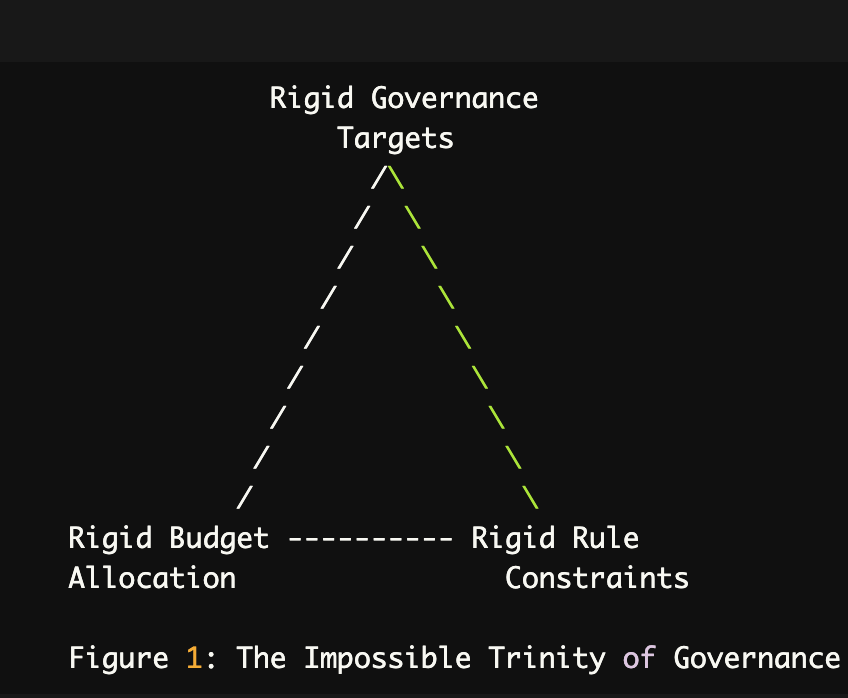
Put simply, the principal can demand “both this and that,” but not “this, that, and the other.” In actual operation, only two of the three rigid requirements can hold simultaneously; the third must remain open and flexible. From this, we can see that the “impossible trinity of governance” is not a value judgment, but a fundamental constraint on how hierarchical organizations avoid systemic failure. Under this framework, differences among governance forms lie not in whether one is “more advanced,” but in which two rigid requirements they choose, and which third requirement they leave flexible.
Administrative subcontracting corresponds to the combination of “rigid governance targets + rigid (limited) budget resources + flexible rule constraints.” Under this model, the principal (central government) hands down clear and non-negotiable governance targets to the agent (local officials)—as seen in the “pressure-type system” (Rong Jingben et al., 1998) and “target responsibility system” (Wang Hansheng and Wang Yiming, 2009)—while strictly limiting budget and staffing. Under these conditions, if rules remained absolutely rigid, the agent would be structurally unable to complete the task. Therefore, rules must “leave room”: formal rules are selectively enforced, and informal institutions, hidden rules, and gray operating space become necessary supplements for maintaining governance (Wang Hansheng et al., 1997). From this perspective, the failure of rules under administrative subcontracting is not governance failure, but an institutional response to the “impossible trinity.”
Weberian rational bureaucracy corresponds to the combination of “rigid rule constraints + rigid budget resources + flexible governance targets.” In this governance model, the core of the organization lies not in achieving a specific challenging performance target, but in acting according to established rules, procedures, and legal-rational principles. Budget and staffing are clearly defined in advance and rarely adjusted afterward, but the agent’s discretion is tightly compressed. Governance legitimacy comes mainly from procedural correctness rather than the quality of outcomes—phrases like “spend only as much as the budget allows” and “due diligence exempts liability” reflect this principle in practice. Precisely for this reason, in a purely Weberian rational bureaucracy, principals tend to avoid imposing overly rigid performance targets on agents, because forcibly introducing target pressure easily triggers rule distortion, responsibility avoidance, or formalism.
Modern corporate governance corresponds to the combination of “rigid governance targets + rigid rule constraints + flexible governance resources.” In corporate governance, the principal (shareholders or the board) often sets clear and binding performance targets for the agent (management), while also requiring strict compliance with rules and audit requirements. Under these conditions, the budget cannot be rigid: resource allocation must remain highly flexible, adjusted according to the business environment, project risk, and progress toward targets. If a company maintains a rigid budget cap while also enforcing strict rules and high performance targets, the result is usually not greater efficiency, but target distortion or risk transfer.
The transformation of the Qing dynasty’s customs administration offers a highly persuasive historical experiment for the “impossible trinity of governance” (Wright, 1993; Zhou Li’an, 2024). Before the Englishman Robert Hart became Inspector General of Customs in 1863, the Qing customs administration was a typical example of administrative subcontracting: tax farming and lump-sum budgeting operated between superior and subordinate levels, with local customs offices remitting fixed quotas to the court; formal fiscal appropriations were minimal, and officials and staff survived on commissions; although the court issued regulations, they were largely unenforced. The key to Hart’s reform was not “anti-corruption” or “introducing modern management techniques,” but a fundamental rearrangement of the “impossible trinity”: completely abolishing tax farming and implementing full collection of duties owed; establishing a comprehensive budgeting and accounting system to eliminate off-budget income and spending; and requiring the court to give up its remittance targets for customs revenue while significantly increasing budget appropriations. The Office of Foreign Affairs ultimately agreed to Hart’s request to remove remittance targets and provide generous budget funding, and as a result, Qing customs shifted from administrative subcontracting toward something close to a Weberian rational bureaucracy. Rules could be genuinely enforced after the transformation not because officials became more moral or more aware, but because the “impossible trinity” had been reconfigured.
The “impossible trinity of governance” offers a new analytical perspective for understanding how organizational forms shift under different conditions. Take a company as an example: as it develops from a startup into an industry giant, it often goes through several changes in management style. In the early startup stage, companies usually focus on challenging business targets, but due to financing difficulties, budgets and staffing are extremely limited, so there is less attention to building and following internal rules and procedures, and performance evaluation tends to favor “results over process.” At this stage, organizational governance more closely resembles administrative subcontracting. As the company grows and its financial strength increases, the importance of enforcing internal rules and procedures rises, and the coordination between setting business targets and determining budget size also strengthens. When a company reaches a dominant, monopoly-like position in its industry, internal rules and procedures take center stage, and the relative importance of setting business targets declines—its governance model may then approach the rational bureaucracy typical of government. This example also shows that administrative subcontracting and Weberian rational bureaucracy as governance models are not necessarily tied to government or public organizations, but can also be organizational forms adopted in corporate governance.
Thus, the theory of the “impossible trinity of governance” aims to move beyond treating administrative subcontracting or Weberian rational bureaucracy as single ideal types, situating them instead within a more general governance theory framework. The reason administrative subcontracting recurs throughout Chinese history and present-day reality is precisely that it represents a stable combination that satisfies the “impossible trinity” under specific constraints (discussed in detail later). The “impossible trinity of governance” offers a unified perspective spanning public governance, corporate governance, and historical institutional analysis: it does not judge which governance model is “more advanced,” but reveals what institutional trade-offs different organizational forms must make under different constraint conditions. In this sense, administrative subcontracting is no longer just a Chinese experience, but becomes a key entry point for understanding how complex organizations achieve “feasible operation” under seemingly impossible conditions.
Testable Propositions and Empirical Corollaries
The core value of the “impossible trinity of governance” lies not in offering conceptual comparisons or institutional classifications, but in providing a series of theoretical corollaries that can be tested through empirical research. These corollaries do not presuppose which governance form is superior; instead, they point out that when an organization strengthens two of the three governance constraints, the third will necessarily undergo systematic adjustment. This structural relationship can be translated into a series of observable, comparable empirical propositions.
Proposition 1: The combination of rigid targets and rigid budgets leads to increased rule flexibility
When governance targets are highly rigid and budget and staffing are strictly constrained, the flexibility of rule enforcement within the organization inevitably rises, manifesting as the expansion of informal institutions, increased selective enforcement, and the instrumental use of procedural rules. Its empirical implication is: when performance indicators are clearly quantified and accountability pressure rises significantly, while budgets and staffing cannot expand correspondingly, we can observe the following: formal regulations being “flexibly interpreted” in key matters; frequent temporary arrangements, verbal directives, and gray operations; increased administrative outsourcing across organizational boundaries, project-based operations, and off-payroll staffing; and a widening gap between compliance documentation and actual implementation. This proposition can be used to examine phenomena such as administrative subcontracting, campaign-style governance, and the failure of grassroots burden-reduction efforts.
For a long time, campaign-style governance has often been understood as an abnormal tool used after the failure of routine governance, or attributed to normative deviations such as a tradition of political mobilization or insufficient governance modernization (Feng Shizheng, 2011; Zhou Xueguang, 2012). However, this understanding overlooks a more structural fact: in real governance contexts, governments often face simultaneous pressures from highly rigid targets, limited governance resources, and continuously strengthening institutionalized procedures—three forces that are structurally difficult to maximize at once. This study proposes that placing campaign-style governance within the analytical framework of the “impossible trinity of governance” helps reinterpret it as an institutional response endogenous to modern governance structures, rather than an accidental result of governance disorder.
Under conditions where governance targets cannot be relaxed and resource allocation cannot expand in the short term, procedural constraints often become the only dimension with room for adjustment. It is precisely within this constraint structure that campaign-style governance—through extraordinary mobilization, cross-departmental integration, and the concentrated release of accountability pressure—strategically compresses existing procedures, boundaries, and routine rules to achieve targets within a short period. This process does not represent a wholesale rejection of institutions and rules, but rather a temporary substitute for procedural governance mechanisms: when routine institutions cannot bear target pressure within a given time and resource constraints, campaign-style governance, as a “time-compressing governance mechanism,” temporarily takes over governance functions to maintain the overall operability of the governance system.
Through this analysis of governance types, this study frees administrative subcontracting and campaign-style governance from the binary opposition of “normal versus abnormal,” instead understanding them as different institutional equilibria formed by the governance system under the constraint of the “impossible trinity,” thereby providing a unified analytical framework for comparing the conditions, operating logic, and mutual transformation of different governance mechanisms. From this perspective, campaign-style governance is not simply the opposite of administrative rationality or the rule of law, but a short-term equilibrium formed by the governance system under the constraint of the “impossible trinity.” It shares an internal consistency with mechanisms such as administrative subcontracting, local government financing platforms, the expansion of off-payroll staff (Ye Jing, 2016), and “administrative outsourcing to society” (Huang Xiaochun and Zhou Li’an, 2017)—all reflecting a shared logic in which, as target rigidity rises while institutional supply and resource expansion are constrained, governance pressure shifts toward unconventional tools and beyond institutional boundaries. Therefore, campaign-style governance is no longer merely an “exceptional state,” but a key entry point for understanding the structural tensions and adjustment paths of contemporary governance.
Proposition 2: The combination of rigid rules and rigid budgets leads to increased target flexibility
When rules and procedural constraints are highly rigid and budget and staffing face hard limits, the organization’s governance targets tend to become vague or adjustable, manifesting as the weakening, delay, or replacement of performance targets by procedural legitimacy. Its empirical implication is: in organizational environments emphasizing rule of law, compliance audits, and process control, if the budget cannot be flexibly adjusted, we often see the following: performance targets redefined as “completed according to procedure” (for example, Hart’s principle of “full collection” in customs); target deadlines extended or broken into staged compliance tasks; decision-making becoming more conservative, with increased risk-avoidance behavior; and outcome evaluation weakening while process evaluation strengthens. This proposition applies to analyzing efficiency losses, delayed responses, and formalism within Weberian rational bureaucracy, as well as “responsibility-avoidance” behavior where “procedure replaces performance.”
Within the “impossible trinity,” Weberian rational bureaucracy clearly prioritizes the predictability of process. Its budget is typically allocated in advance and, once approved, is difficult to adjust—hence its strong rigidity. In Western countries, government budgets must be approved by the legislature, and in principle, no additional funds are granted after approval. Since democratic government budgets are comprehensive—meaning government departments have no extra-budgetary sources of income beyond legislature-approved appropriations—the budget approval process must, as much as possible, determine in advance the budget amount that matches each department’s function. Of course, this process is also heavily influenced by the state’s fiscal extraction capacity and overall government revenue and expenditure conditions.
However, the cost of this institutional arrangement is that when an organization faces highly complex, multi-objective, and rapidly changing tasks, achieving challenging targets or ensuring the deliverability of final outcomes is often not prioritized institutionally. When formal rules cannot cover every real-world situation and there is little room for discretion or incentive mechanisms, organizations are more likely to prioritize compliance over efficiency, resulting in a situation with complete procedures but insufficient performance. Moreover, because Weberian rational bureaucracy follows a “limited liability” logic of accountability, it often exhibits the practical characteristic of “spending only as much as the budget allows.” Once a major external shock occurs or budget allocation proves insufficient, performance must be sacrificed, because strict rule constraints represent a bottom line that cannot be breached. Therefore, Weberian rational bureaucracy essentially trades the deliverability of outcomes for the stability of process execution and the predictability of agent behavior.
Proposition 3: The combination of rigid targets and rigid rules leads to increased budget flexibility
When governance targets and rule constraints remain highly rigid at the same time, the organization must maintain feasibility by increasing resource flexibility, manifesting as budget expansion, additional resources, external financing, or a systematic rise in hidden investment. Its empirical implication is: when an organization requires both the completion of clear, high-intensity performance targets and strict compliance with rules and audit requirements, if the task can still be completed, it is usually accompanied by: additional budget allocations, special appropriations, or capital injections; overtime, overwork, and hidden labor input; risk transfer through insurance, outsourcing, or financial instruments; and rising costs while both rules and performance are maintained. This proposition is especially applicable to modern corporate governance, large-scale project campaigns, and certain high-intensity public policies.
Unlike state governance, a key feature of corporate governance is that governance targets are highly singular and quantifiable (profit, shareholder value), and resources are mainly raised in advance through market mechanisms (such as capital markets and debt financing). This allows corporate governance to adopt highly results-oriented incentive mechanisms (such as performance pay, stock options, and profit-sharing) under relatively predictable resource conditions, thereby achieving high-intensity targets. Within the “impossible trinity,” corporate governance prioritizes the deliverability of outcomes (i.e., achieving set targets). If a company simultaneously insists on strict internal and external compliance requirements and emphasizes the binding force of internal rules, it must ensure sufficient and predictable resources.
This is exactly what Ren Zhengfei often describes as Huawei’s strategic characteristic—launching a “saturation attack” toward a single breach point in the wall. This phrase contains three layers of meaning: first, breaching the “wall” is a non-negotiable strategic target; second, Huawei strictly enforces a set of internal rules and process management, and this requirement is equally non-negotiable; third, in order to “breach the wall,” the company can invest resources without restraint, investing as much as needed to carry out the “saturation attack.” This shows that corporate governance is an institutional form that uses market-based resource supply to “pay for” the combination of “strong incentives—strict rules—strong results orientation.”
In fact, major Chinese projects carried out through the “whole-nation system” and “concentrating resources to accomplish major tasks” (such as the “Two Bombs, One Satellite” program) share similar features: first, the target must be achieved; second, project implementation must follow internal financial, project, and technical rules and systems; third, to achieve the target, comprehensive resource mobilization and extraordinary support can be deployed to guarantee investment.
Proposition 4: “Parallel occupation of all three vertices of the trinity” leads to systemic failure
All else being equal, when an organization simultaneously imposes rigid requirements on governance targets, governance resources, and rule constraints, systemic failure becomes unavoidable. Its manifestation is not a single deviation, but a set of predictable “abnormal responses.”
The core meaning of the “impossible trinity of governance” is that any governance system can only form a relatively stable institutional equilibrium inside the trinity or near one vertex—it cannot occupy all three vertices at once. In public governance, when a principal tries to force “parallel occupation of the trinity”—that is, simultaneously demanding rigid targets, rigid budgets, and rigid rules—the organization will inevitably exhibit a series of “abnormal responses.” For example, regarding governance targets, we may see data falsification, window-dressing (Fang et al., 2023), multi-target distortion (sacrificing other targets), or outright abandonment (such as “lying flat” and giving up); regarding governance resources, we may see staff overworking themselves to exhaustion, the recruitment of large numbers of off-payroll personnel, and large-scale diversion of funds from other purposes (”robbing Peter to pay Paul”); regarding rule constraints, we may see formalism, bureaucratism, and passive responsibility-avoidance replacing proactive action (Tian Xianhong and Zhou Zhan, 2024). In addition, governance risks may spill over toward the organization’s periphery or externally, such as accelerated administrative outsourcing, project-based operations, and shadow operations (Huang Xiaochun and Zhou Li’an, 2017); in the long run, organizational trust and capacity may erode. This proposition provides a structural explanation for why certain governance reforms, despite being correctly directed, produce distorted results.
The above analysis shows that public governance has general, foundational organizational logic and “iron laws.” Violating these logics and laws produces the series of “abnormal responses” described above, leading to organizational friction, behavioral disorder, and resource waste—the severity of which depends on how forcefully “parallel trinity occupation” is imposed.
It should be noted that the “impossible trinity of governance” does not mean that governance targets, resource constraints, and procedural constraints cannot coexist at all—rather, it emphasizes that they are difficult to maximize simultaneously within the same organizational form. This framework, therefore, is not limited to explaining modern governance dilemmas characterized by highly rigid targets and concentrated governance pressure; it can equally explain stable governance forms where targets, resources, and rules are all configured at low intensity. In certain low-risk governance domains—especially in the provision of local public goods and routine affairs—governance systems do not attempt to strictly quantify or fully cover targets, nor do they rely on highly centralized fiscal and organizational resources, nor do they emphasize formalized, procedural governance rules. Instead, by simultaneously “de-rigidifying” all three elements, they form a low-conflict, sustainable institutional equilibrium. For example, in Chinese history, the court’s practice of subcontracting local public goods to local gentry shared common features: governance targets (such as road building, public security, disaster relief, and moral education) were defined loosely and flexibly; resource supply was typically non-fiscal and non-budgetary, relying mainly on local self-financing and social mobilization; and rule constraints could not take the form of bureaucratic procedures, relying instead on social custom, moral norms, and status order for soft regulation (Zhou Li’an, 2024).
“Low-tension equilibrium” governance typically appears in domains with lower governance risk, limited accountability pressure, and targets that are hard to quantify precisely. In this context, governance targets are intentionally kept loose and vague; the state does not try to achieve governance outcomes through strict evaluation or comprehensive coverage, but instead delegates responsibility for specific public affairs to local actors. Resource allocation does not center on fiscal budgets and formal staffing, but relies on local self-financing, social mobilization, and reputational incentives. Rule constraints appear more as customs, status order, and moral responsibility rather than formalized procedures. This governance combination systematically avoids the structural tension revealed by the “impossible trinity” by simultaneously lowering the intensity of constraints on targets, resources, and rules. This organizational form can be understood as an institutional equilibrium formed inside the trinity rather than at its boundary. Compared with governance paths that seek to comprehensively strengthen targets, budget control, and procedural constraints all at once, this “moderate on all three fronts” configuration is actually more conducive to maintaining long-term governance stability in low-risk, low-accountability-pressure contexts.
Proposition 5: The simultaneous downscaling of governance targets, budget constraints, and rule constraints forms a low-tension equilibrium
Table 1 constructs a typology of administrative subcontracting based on the “impossible trinity of governance,” used to compare the combinations of targets, budget control, and procedural constraints across different governance contexts and their corresponding institutional forms. These types do not represent a ranking of governance models by efficiency or modernity—they simply reflect the institutional equilibria each achieves under specific constraint conditions. When the rigidity of governance targets, budget constraints, and procedural requirements cannot all be maximized at once, governance systems tend to select and switch between different institutional tools by configuring the three elements differently. Among these, “low-tension equilibrium” governance systematically avoids the structural tension revealed by the “impossible trinity” by simultaneously lowering the institutional intensity of targets, resources, and rules; its stability comes from social embeddedness rather than administrative mobilization. “Steady-state subcontracting” governance centers on the administrative lump-sum system, easing resource and information constraints through responsibility decomposition and layered subcontracting while maintaining certain procedures and boundaries. “High-pressure acceleration” governance, under conditions of highly rigid targets and limited deadlines, forms short-term governance capacity by compressing procedures and concentrating resources—this corresponds to the campaign-style governance discussed earlier. Based on this discussion, we can derive the following proposition: the simultaneous downscaling of governance targets, budget constraints, and rule constraints forms a low-tension equilibrium.
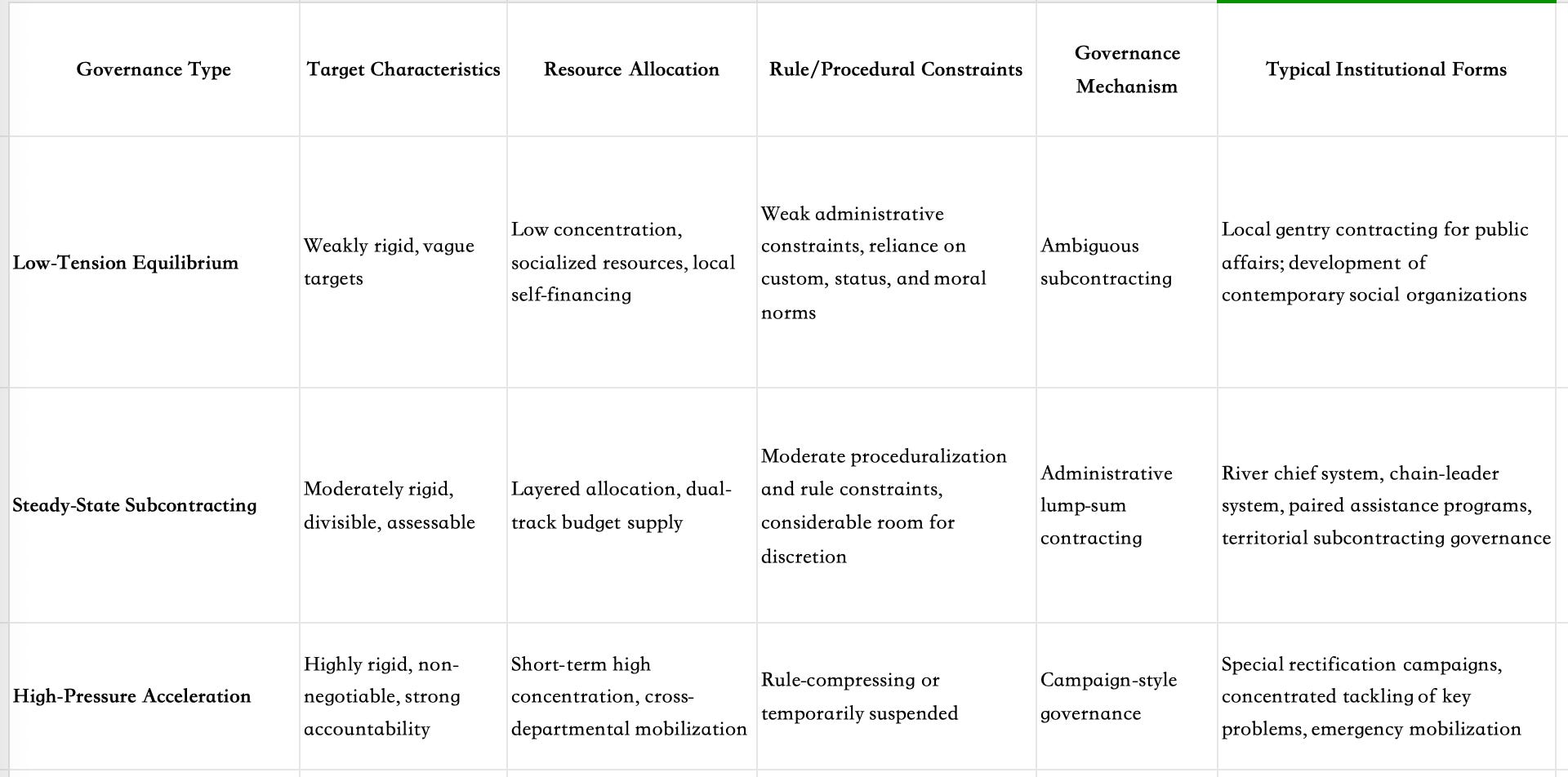
Proposition 5 provides a theoretical basis for understanding why the state actively maintains low-pressure administrative outsourcing models in certain governance domains. As noted earlier, during the Ming and Qing dynasties, the imperial court delegated part of local public goods provision to local gentry, and this arrangement operated as follows: task targets were vague, accountability was weak, and incentives relied mainly on intrinsic motivation (centered on moral norms and status identity) rather than material rewards and punishments. This mechanism avoided the potential governance risks caused by behavioral distortion from strong incentives. Huang Xiaochun (2015), in his study of the relationship between contemporary Chinese government and social organizations, identified a similar mechanism, calling it “ambiguous subcontracting.” Its basic logic is as follows: higher-level authorities set relatively vague targets for the development of social organizations, and inspection and approval procedures remain low-intensity. Against this backdrop, grassroots governments face both high innovation risk (because it is hard to accurately grasp higher-level intentions) and a lack of predictable fiscal or promotion incentives, leading them to adopt conservative response strategies. In Huang Xiaochun’s (2015) framework, the core features of ambiguous subcontracting include imprecise task boundaries, hard-to-quantify responsibility standards, and flexible room for performance evaluation—creating strategic ambiguity between superior and subordinate levels. This offers a key organizational mechanism for understanding “low-tension equilibrium” governance.
Table 1 clearly shows that under the structural constraints of the “impossible trinity of governance,” administrative subcontracting mechanisms do not appear as isolated, disconnected institutional types, but form a continuous spectrum. From ambiguous subcontracting to steady-state subcontracting to high-pressure subcontracting, the change is not a shift in fundamental institutional nature, but the result of gradually increasing task clarity, resource concentration, and accountability intensity, driven by rising governance tension. Ambiguous subcontracting sits at the low end of the tension spectrum, characterized by flexible task boundaries and wide room for interpreting responsibility. Steady-state subcontracting occupies the middle range, maintaining relatively stable accountability relationships through project-based operations and layered evaluation. High-pressure subcontracting sits at the high end of the tension spectrum, characterized by rigid targets and compressed procedures, serving the need for short-term, concentrated mobilization. The continuous distribution of subcontracting mechanisms shows that administrative subcontracting is not a single institutional form, but a structural organizational technology that adjusts as governance pressure, resource allocation, and procedural constraints combine differently. This analysis helps break through the linear narrative that understands modern governance as a single evolutionary path, offering a unified analytical perspective for comparing the institutional logic and evolutionary conditions of different governance models.
Implicit Conditions and Breakthrough Mechanisms of the “Impossible Trinity of Governance”
What the “impossible trinity of governance” reveals is a structural tension that emerges under specific institutional frameworks and technological conditions—it does not represent an absolute impossibility of institutional evolution. Its core proposition can be summarized as follows: under routine governance conditions, target rigidity, rule density, and resource constraints cannot maintain a strong, parallel state for long. However, the validity of this proposition depends on several implicit institutional premises. Only when these premises hold does the “impossible trinity” appear as a stable structural constraint; once the relevant conditions undergo structural change, the trinity’s tension may be compressed, reshaped, or even transformed into a source of institutional innovation.
Implicit Conditions of the “Impossible Trinity of Governance”
1. The assumption of stable technological conditions
The trinity structure implicitly assumes that information collection, behavioral monitoring, and organizational coordination technologies have not undergone fundamental leaps. In institutional environments with high information and monitoring costs, increasing target rigidity and rule density often brings significant implementation burdens, creating inherent tension with resource constraints. But when digital governance, data platforms, and algorithm-assisted decision-making significantly lower information processing and monitoring costs, some of this tension may be absorbed by technology. For example, platform systems based on real-time data feedback and performance monitoring can strengthen institutional enforcement without significantly increasing staffing. This shows that the “geometry” of the trinity is not fixed, but partly depends on the evolution of the technological foundation. While technological change cannot fully dissolve the tension, it may drive structural adjustments in how it is distributed.
2. The assumption of relatively stable organizational form
The second implicit premise of the trinity is that an organization’s structure of authority and responsibility, hierarchical system, coordination mechanisms, and information communication remain relatively stable. Internal tension only becomes apparent when target rigidity continues to strengthen while the organizational structure and operating mechanisms remain largely stable, preventing organizational absorptive capacity from keeping pace. If the organizational model undergoes major innovation (such as platform-based structures, network organizations, or cross-departmental coordination mechanisms), the boundaries of absorptive capacity may be redefined. In other words, the trinity theory assumes the organizational model is in a relatively stable state.
3. The assumption of normal agent behavior
The trinity theory also includes a basic assumption about agent behavior: under routine incentive structures, individuals have a limit to their willingness to invest effort and take on risk (i.e., agents are generally averse to work and risk). Under this premise, strengthening governance targets and rule compliance inevitably requires increasing incentive intensity or compressing institutional flexibility. However, it should be noted that under specific historical circumstances—such as wartime mobilization, major disaster response, or large-scale social construction—agents may display strong mission-driven behavior and exceptional dedication, significantly compressing institutional tension in the short term. This kind of “extraordinary mobilization” is not caused by a fundamental change in institutional structure, but reflects ethical guidance and political mobilization temporarily substituting for resource investment. Therefore, the trinity’s tension is essentially a proposition about long-term equilibrium, not an absolute description of an instantaneous state.
4. The assumption that risk cannot be externalized indefinitely
The trinity theory also implicitly assumes that risk will eventually flow back to the organizational core. If governance risk can be externalized for a long time through debt expansion, extra-budgetary arrangements, or institutional outsourcing, the emergence of tension may be temporarily obscured. However, within a closed-loop responsibility structure—where the risks caused by organizational behavior must ultimately be borne by the organization’s principal—risk externalized in the short term will flow back to the core system, forcing it to bear the consequences of organizational disorder.
5. The assumption of limited legitimacy resources
Finally, the “impossible trinity” theory implicitly assumes that reserves of social legitimacy are limited. Here, “legitimacy resources” do not refer to an abstract notion of “public sentiment,” but to a set of political capital that can be mobilized, consumed, and replenished, used to make society accept a certain “forced parallel” combination within the “impossible trinity” (such as high targets, strong rules, and low resources). It includes at least three sources (which can be thought of as three “legitimacy accounts”): first, performance legitimacy—whether results can be delivered (growth, public security, public services, crisis response, etc.); second, procedural/legal legitimacy—whether rules are predictable, perceived as fair, and allow for appeal and correction; third, social identity/value legitimacy—shared community narratives, mission-driven mobilization, national symbols, and identity. These accounts can substitute for one another at different stages: strong performance can “offset” imperfect procedures; strong procedures can tolerate short-term performance fluctuations; strong identity mobilization can temporarily compress resources and welfare. But this substitution faces diminishing marginal returns (for example, the “appeal” of mobilization slogans declines with repeated use) and the problem of cross-period overdraft. When legitimacy resources are abundant, society may tolerate high-intensity targets and dense rules, but having legitimacy resources does not mean an unlimited supply. When society’s tolerance threshold drops, tension will become visible more quickly.
Breakthrough Mechanisms of the “Impossible Trinity”
The “impossible trinity of governance” may be reconfigured when the following conditions change. Its breakthrough mechanisms mainly take three forms:
First, technological breakthrough. Using digital, intelligent, and platform-based governance tools to significantly reduce information asymmetry and monitoring costs can allow high rule density and high target rigidity to coexist even when resources grow only slowly. The essence of this breakthrough path is substituting technological elements for some organizational resources, but its sustainability depends on the maintenance cost of the technological system and how well technology fits with the institution.
Second, extraordinary mobilization. Temporarily expanding the boundaries of agent behavior through political mobilization, value appeals, and mission-driven leadership can allow high-intensity targets and rules to coexist temporarily even under resource shortages. This path tends to be stage-specific and context-dependent. If the gains from mobilization are not converted into institutional arrangements in time, once the mobilization fades, it may trigger implementation fatigue or the buildup of hidden risks.
Third, organizational restructuring. Innovating organizational forms—such as platform-based coordination mechanisms, cross-departmental integration, and redesigned responsibility structures—can improve institutional absorptive capacity, rebalancing the trinity’s tension within a more flexible and diverse institutional framework. Compared with the first two paths, breakthroughs through organizational restructuring have greater sustainability, and their success depends on whether the closed-loop responsibility system and risk distribution mechanism can be effectively reconstructed.
It is worth emphasizing that the “impossible trinity of governance” is not only a constraint on institutional operation, but can also become a source of pressure for institutional innovation. When the trinity’s pattern is forcibly maintained in parallel, the institutional system generally faces two possible outcomes: institutional shock caused by risk accumulation and re-concentration of responsibility, or institutional innovation at the technological and organizational level. Therefore, the trinity’s tension has a “dual consequence”: it can lead to institutional imbalance, but it can also serve as an important catalyst for institutional upgrading. However, it must be made clear that so-called “breakthrough” does not mean the complete elimination of tension, but a systematic shift in how tension is configured. The “impossible trinity of governance” cannot be fundamentally dissolved, but it can be continuously reshaped through technological integration, organizational restructuring, and mobilization mechanisms.
Therefore, the “impossible trinity of governance” should not be simply understood as a static proposition of institutional impossibility, but should be seen as an analytical framework reflecting long-term structural constraints that hold under specific implicit conditions. As the technological foundation, organizational form, behavioral ethics, and legitimacy resources evolve, the trinity’s tension will be compressed, delayed, or transformed. This perspective gives the trinity theory multiple functions—explanatory, generative, and predictive: it can explain why forced parallelism often leads to organizational disorder, risk feedback, and institutional shock, and it can also explain why, at certain historical junctures, institutional pressure instead gives rise to governance innovation and structural breakthroughs.
Ex Ante or Ex Post Uncertainty: Revisiting the Difference Between Administrative Subcontracting and Weberian Rational Bureaucracy
The previous section compared the differences between administrative subcontracting and Weberian rational bureaucracy in terms of governance mechanisms and basic features. Next, we shift perspective to examine the management technologies of ex ante versus ex post uncertainty, revealing a deeper and more fundamental difference between the two. We will argue that administrative subcontracting mainly emphasizes the capacity and flexibility to respond to ex post uncertainty, while Weberian rational bureaucracy tends to pursue ex ante certainty and controllability. However, there is a tension between maximizing the capacity to respond to ex post uncertainty and maximizing ex ante certainty—the two are difficult to achieve simultaneously. It is precisely this tension that forms the endogenous basis of the “impossible trinity of governance.”
From traditional to contemporary China, we can glimpse a fundamental operating logic embedded in “great unity” state governance: governance is not supported by an ample and sufficient supply of resources, but is instead driven by state power itself. Its core lies not in pre-allocating abundant and stable fiscal and organizational resources, but in using state power as a lever—centered on governance tasks and outcomes, with regime stability as the highest goal—to mobilize governance resources across multiple levels, actors, and types, thereby achieving effective integration of a vast territory and complex society.
Specifically, this governance logic manifests in at least three nested institutional mechanisms. First, governance responsibility is set through state power and decomposed and subcontracted in a hierarchical manner. The central government does not directly handle specific governance affairs, but converts governance targets into divisible responsibility packages, pushing them down the administrative hierarchy level by level, with each “contractor” responsible for concrete implementation. Second, state power is used to leverage broadly defined fiscal resources, diversifying and socializing resource mobilization. Unlike the modern budgetary state, which is premised on “giving money in advance,” a defining feature of administrative subcontracting is precisely “no money given, only policy.” Higher-level governments transfer financing responsibility and resource mobilization responsibility to “contractors” by granting or tacitly allowing a certain amount of policy space. Local governments and other contracting entities can thus raise resources outside the formal budget—through land transfers, fees, commercial activities, social mobilization, and even administrative outsourcing—to complete assigned governance tasks. The dual-budget system, extra-institutional finance, and administrative outsourcing are institutional forms generated under this logic. Third, state power grants “contractors” multiple and highly flexible incentive mechanisms. These incentives are not limited to monetary compensation, but comprehensively use administrative decentralization, performance evaluation, political promotion, revenue-sharing, and policy preferences to tightly bind governance performance to the contractor’s political future, organizational status, and economic gains.
This underlying logic exists not only within the central-local relationship inside the administrative system, but also extends, with varying intensity and form, to the relationship between the state and society. Whether it is administrative in-house subcontracting to local governments, or administrative outsourcing to gentry, merchants, and other social actors, the core is the same: using power authorization and responsibility transfer to externalize, disperse, and socialize governance costs that would otherwise fall directly on the central government (Zhou Li’an, 2016, 2022).
In sum, administrative subcontracting does not pursue high predictability in the grassroots governance process; instead, it concentrates certainty on the highest governing target itself—for example, regime stability, tax and grain remittance, or the completion of key governance indicators. As long as the final result is guaranteed, the sources of resources, methods of execution, and even institutional boundaries during the process can remain highly flexible. In sharp contrast, the governance logic of Weberian rational bureaucracy is built on an entirely different institutional premise: it centers on legal-rational principles, rules, and procedures, ensuring certainty and predictability in organizational behavior by limiting the agent’s discretion. To achieve this, bureaucracy must rely on relatively stable and ex ante predictable budgets and resource allocation, allowing organizational members to fulfill their duties under clear rules and guaranteed resources. This institutional arrangement aligns closely with the economic structure of industrial capitalism: whether it is large-scale fixed-asset investment or long-term production planning, both must be built on predictable returns and a stable institutional environment (Weber, 2010).
This is precisely where the two systems diverge fundamentally in their governance rationality: Weberian rational bureaucracy eliminates uncertainty through the ex ante allocation of rules and resources, while administrative subcontracting absorbs uncertainty through the ex post binding of power, responsibility, and incentives. From a more abstract institutional perspective, administrative subcontracting and Weberian rational bureaucracy are not successive forms of the same governance logic across different historical stages, but two “uncertainty management technologies” that point in opposite directions while being equally modern. Their fundamental difference does not lie in whether they pursue efficiency or rationality, but in where uncertainty is placed within the governance process—before or after the fact.
Weberian rational bureaucracy is a typical mechanism for absorbing ex ante uncertainty, with its institutional design aimed at eliminating or compressing uncertainty as much as possible before governance action takes place. This goal is achieved through a coordinated set of institutional arrangements: clear legal authorization, stable organizational boundaries, standardized procedural rules, clearly defined responsibilities, and matching ex ante budget allocation. By institutionalizing behavior patterns, decision-making authority, and resource use in advance, bureaucracy attempts to convert organizational members’ room for judgment into predictable rule-following, ensuring continuity over time and replicability across space in governance behavior. However, this technology for managing ex ante uncertainty relies heavily on two preconditions: the governance task itself has relatively stable targets and clear boundaries, and the organization can obtain relatively sufficient and predictable resource support before taking action. Once these two conditions become difficult to meet, bureaucracy easily falls into the dilemma of “sufficient rules but weak action”—showing up as complete procedures but poor performance, and even evolving into formalism.
In sharp contrast to Weberian rational bureaucracy, administrative subcontracting is a typical mechanism for absorbing ex post uncertainty. It does not attempt to exhaust all possible contingencies before action, nor does it try to eliminate information asymmetry through detailed rules. Instead, it consciously leaves uncertainty within the governance process, absorbing it at the outcome stage through accountability, performance evaluation, and incentive constraints. Under this institutional arrangement, the governance target itself is set as highly certain, while the path to achieving it, the sources of resources, and specific methods remain highly flexible. It is in this sense that administrative subcontracting, as an operating mechanism that leverages power logic to drive governance, is characterized by keeping as much certainty as possible with the subcontracting party—for example, setting challenging task targets, guaranteeing fiscal remittance and the subcontracting party’s share of tax revenue, and using personalized accountability to compel completion—while “pushing down” and transferring uncertainty to the “contracting party”: the “contractor” must not only bear execution responsibility, but also independently cope with risks such as insufficient information, resource scarcity, and environmental change. State power does not rely entirely on ex ante rules to control behavior, but disciplines choices more through ex post accountability, political evaluation, and the fulfillment of incentives. Governance order thus no longer depends mainly on the consistency of rules, but on the deliverability of results.
Placing the two side by side, we can see a clear structural symmetry: Weberian rational bureaucracy mainly absorbs uncertainty through the ex ante allocation of rules and resources, while administrative subcontracting mainly absorbs uncertainty through the ex post binding of responsibility and incentives. The former pursues predictability of process, trying to eliminate discretion; the latter pursues the achievability of results, maximizing the use of discretion. This difference also means that the two uncertainty management technologies each have clear boundaries of applicability. Ex ante technology has clear advantages under conditions of a stable governance environment, sufficient fiscal capacity, and solid rule-of-law foundations; in contexts where governance tasks are highly complex, information is highly dispersed, resource constraints are significant, and target priorities are clear, ex post technology tends to be more adaptive and better at mobilization. In this sense, administrative subcontracting is not a “low-end version” of Weberian rational bureaucracy, but an alternative governance technology formed by rearranging uncertainty under specific constraint conditions.
From the perspective of the “impossible trinity of governance,” we can gain a deeper understanding of the essential difference and inherent tension between Weberian rational bureaucracy and administrative subcontracting. We can imagine that, within the same organizational level, if one tries to maximize ex ante certainty—for example, through a complete rule system or strictly locked-in budget size—this will inevitably compress the agent’s discretion, thereby weakening its capacity to absorb ex post uncertainty. Conversely, if one tries to maximize ex post responsibility binding—for example, by imposing high-intensity accountability pressure or rigid performance targets—the “contracting party” must be given ample discretion and flexible response space, which comes at the cost of process predictability. This shows that the same organizational level cannot simultaneously minimize and maximize discretion. In other words, we cannot pursue maximum ex ante certainty while also expecting the organization to have full flexibility to cope with ex post uncertainty—the two are like fish and bear’s paw, impossible to have both. By distinguishing between ex ante and ex post uncertainty, we can reveal, from a new perspective, the deeper structural tension hidden behind the “impossible trinity of governance.”
The “impossible trinity of governance” discussed earlier treats the modern corporation as one possible institutional equilibrium under structural governance tension. This naturally raises an interesting question: how does the modern corporation, as one corner of the trinity, handle ex ante and ex post uncertainty? And how does this relate to the “impossible trinity of governance”?
Unlike Weberian rational bureaucracy and administrative subcontracting, the modern corporation shows a distinctive hybrid characteristic in its governance logic: on one hand, it sets and pursues challenging organizational targets, transferring ex post uncertainty to internal agents through “pressure” mechanisms; on the other hand, it emphasizes compliance systems and rule-based procedures, striving to lock in uncertainty in advance. This practice—seemingly pursuing both maximum ex ante certainty and maximum capacity to respond to ex post uncertainty at the same time—appears to break the constraint of the “impossible trinity of governance.” However, just as Ren Zhengfei’s “saturation attack” suggests, reconciling the two does not rely on a clever balance of institutional design, but on sufficient and predictable resource investment. Conversely, if budget resource supply is insufficient, the company must either downgrade performance targets (reducing the transfer and pushing-down of ex post uncertainty) or breach compliance and procedural constraints (weakening the locking-in of ex ante certainty)—and may even need to do both to keep functioning.
Viewed this way, budget and fiscal supply capacity form the key variable determining an organization’s ability to cope with both ex ante and ex post uncertainty. It is precisely on this dimension that the modern corporation and government organizations under Weberian rational bureaucracy show a fundamental difference. Modern corporations, especially large ones, can raise substantial funds from financial institutions and capital markets based on their profit prospects, giving their budget supply capacity significant flexibility (this is also the theoretical basis for why “traditional theory of the firm” and principal-agent models in economics generally assume firms do not face budget constraints). Government organization budgets, by contrast, generally require approval from the legislature or higher-level departments before taking effect, and once set, are difficult to adjust flexibly, leaving little room for elastic response. Moreover, the sufficiency of government budgets depends on the state’s resource extraction capacity, which is tied to complex factors such as public expenditure and tax systems, tax collection technology, and public willingness to pay taxes—in most cases, funds cannot be “allocated on demand,” and tight budgets are the norm.
Therefore, from a governance perspective, differences in budget constraint flexibility split modern corporations and bureaucratic governments into two distinct governance institutional forms. As an ideal type, Weberian rational bureaucracy groups modern bureaucratic departments and modern corporations together under the category of rational, matter-of-fact organizational forms without strict distinction (Weber, 2010). But this study, based on the “impossible trinity of governance” theory, reveals a structural divergence between the two in terms of resource constraints and uncertainty management mechanisms, offering an important supplement and correction to the Weberian paradigm.
From this perspective, the relationship between administrative subcontracting and Weberian rational bureaucracy cannot simply be understood as a linear substitution—it is instead an institutional division of labor and coexisting tension centered on how uncertainty is placed. Understanding this has important theoretical significance for further discussing the institutional combinations, structural conflicts, and inherent limits of different governance models.
Why Does China’s State Governance Naturally Lean Closer to Administrative Subcontracting?
The reason China’s state governance structurally “naturally” leans closer to the administrative subcontracting pole of the trinity is not simply due to historical inertia or a cultural preference for a particular governance style, but because a set of structural constraints continually push the governance pattern toward an equilibrium point characterized by “prioritizing the deliverability of results, yielding on process predictability, and institutionally tolerating resource uncertainty.” In other words, Chinese local governance is forced to choose its position within the “impossible trinity”: under the pressure of multiple targets and resource constraints, it tends to absorb uncertainty through ex post mechanisms rather than eliminating it through an ex ante system of rules.
First, the high rigidity of governance targets. Chinese state governance has long relied on performance legitimacy to sustain its operation (Yang Hongxing and Zhao Dingxin, 2013). In the imperial era, “national peace and social stability” (maintaining regime stability and social order) was placed at the highest priority, reflected in top-down, tier-by-tier targets for tax and grain remittance and social security. After 1949, catching up economically, industrialization, and modernization became the state’s priority governance targets. Politically transmitted targets, cascading down through the hierarchy, carry rigid constraints, giving overwhelming weight to “delivering results.” In contemporary Chinese local governance, there exists a category of strongly binding “bottom-line targets” and “key performance targets,” covering matters such as stability, security, the implementation of major tasks, higher-level evaluation indicators, and staged campaigns. Such targets usually have two features: first, they must be completed—failure is not allowed, and the political cost of failure is far greater than the institutional cost of procedural deviation; second, they are time-sensitive, often accompanied by deadlines, windows of opportunity, and a campaign-style rhythm. When governance targets show “rigid priority,” institutional rationality naturally tends to concentrate certainty on “whether it gets done,” rather than “whether it was done according to standard procedure.” Thus, an administrative subcontracting model—centered on results, allowing flexible paths, and relying on ex post accountability—becomes a more feasible organizational solution.
Second, the structural tension between fiscal capacity and administrative responsibility. As a super-large country, China has always faced urgent pressure to raise fiscal resources. The usual response strategy is to prioritize securing central government fiscal revenue, while the budget resources of local governments at all levels—especially grassroots governments—remain highly uncertain, with formal budget allocations generally tight and insufficient. The coexistence of expanding tasks and resource constraints forces local governments to internalize “resource-raising” as an organic part of their governance mechanism. Since the reform and opening-up period, local governments have long shouldered heavy responsibilities for public services, infrastructure, industrial development, and risk management, while on-budget revenue and formal borrowing capacity have struggled to keep pace. In recent years in particular, budget constraints have tightened, debt regulation has strengthened, and land and real estate cycles have fluctuated more sharply—meaning local governments’ governance challenge is often not “how to spend according to procedure,” but “where the money will come from.” This situation directly pushes governance toward the logic of administrative subcontracting: higher levels hand down targets mainly in the form of policies, indicators, and tasks, while local governments, operating within the authorized and tacitly allowed space of “no money given, only policy,” self-finance through financing platforms, state-owned enterprises, project funds, and social mobilization. Resource uncertainty is institutionally “pushed down” to the “contracting party.” Thus, administrative subcontracting is not a substitute for bureaucracy, but an institutional response to the structural contradiction between “resource gaps” and “rigid tasks.”
Third, the high degree of dispersion in the information structure. For a country as vast in territory and population as China, the high localization of governance information makes it difficult for ex ante rules to exhaust the heterogeneity and variability across regions, forcing reliance on ex post outcomes to offset information asymmetry. China’s vast territory and significant regional differences mean that governance objects and contexts show high heterogeneity and dynamic change, making it difficult for the central government to cover local governments’ specific situations with uniform rules. Even when rules are formulated, they often fall into the dilemma of being overly detailed yet disconnected from reality. Under this structure, trying to eliminate uncertainty through ex ante means faces a dilemma: the more detailed the rules, the more likely they are to become distorted; the coarser the rules, the weaker their binding force. The advantage of administrative subcontracting lies precisely in acknowledging that information rests with local governments, allowing them to use discretion to adapt to circumstances, with higher-level governments correcting deviations afterward through evaluation, inspection, and accountability mechanisms. In short, the more dispersed the information, the harder it is to regulate in advance, and the more governance must rely on ex post evaluation and adjustment. In a multi-level local government system, information asymmetry and strategic interaction between levels make this logic even more complex.
Fourth, the spillover nature of risk governance and bailout expectations. In areas such as stability, security, finance, public health, and the handling of extreme events, the spillover effects of governance failure are extremely strong. Facing high-risk issues, higher-level authorities often care more about “whether the conflict is resolved locally” than “whether standard procedures were strictly followed.” This reinforces two institutional tendencies: for local governments, it is better for the process to be “unconventional” as long as the outcome is “accident-free”; for higher-level authorities, control is strengthened after the fact through supervision, accountability, and special inspections. This shows that “ex post technology” more easily becomes the default choice—the existence of major risks makes “results-oriented plus ex post correction” a safer political strategy.
In sum, the reason China’s state governance structurally “naturally” leans closer to administrative subcontracting is that it has long operated under a specific set of structural constraints: target rigidity driven by performance legitimacy (must be completed), resource constraints faced by governing a large country (tight budgets), dispersed information (hard to regulate in advance), and risk spillover (reliance on ex post control). Under this set of conditions, the most feasible equilibrium is not to “eliminate uncertainty in advance,” but to “retain uncertainty within the process” and then absorb it at the outcome stage through responsibility, incentives, and accountability—this is precisely the position administrative subcontracting occupies within the “impossible trinity of governance.”
From an overall institutional perspective, China’s state governance is not dominated by a single governance model, but takes the form of a stable, internally logical hybrid institutional structure: bureaucracy as the institutional “chassis,” the subcontracting-contracting mechanism as the governance “engine,” and numerous non-government organizational forms as the external “contractors” and buffer zones outside the formal institution. This institutional combination is by no means a stopgap measure or a transitional form of reform, but a structural equilibrium formed under the constraint of the “impossible trinity.”
First, as the “chassis,” bureaucracy provides governance with a minimum level of institutional stability and legitimacy boundaries. The formal organizational system of local government, budget procedures, staffing management, audit oversight, and legal responsibility together form an institutional framework indispensable to governance operation. The function of the bureaucratic “chassis” is not to solve all governance problems, but to maintain basic organizational order and the legitimacy of authority, define acceptable and unacceptable institutional boundaries, and provide institutional interfaces for accountability, oversight, and re-centralization. In other words, the core responsibility of bureaucracy is not to complete every task, but to ensure the system does not spiral out of control.
Second, as the “engine,” the subcontracting-contracting mechanism provides local governance with continuous mobilization capacity and a results orientation. In contexts where targets are highly rigid, tasks are dense and overlapping, and resources cannot be fully allocated in advance, relying solely on the ex ante logic of bureaucracy is insufficient to sustain governance operation. Administrative subcontracting thus becomes the key driving mechanism pushing governance forward: higher levels transmit governance pressure down through task decomposition, indicator-setting, and responsibility enforcement; local governments gain the motivation to “must complete” tasks through performance evaluation, political incentives, and responsibility binding; uncertainty is consciously retained at the implementation level and absorbed through ex post mechanisms. In this structure, administrative subcontracting does not replace bureaucracy, but embeds itself within it, functionally compensating for the boundaries of its capacity.
Finally, as external “contractors,” quasi-governmental organizations and social organizations outside the government absorb governance pressure that the bureaucratic system cannot accommodate. When budget constraints tighten, borrowing channels are restricted, and procedural oversight intensifies, the resources, flexibility, and risk tolerance local governments need to complete governance tasks often exceed the institutional capacity of the formal administrative system. The platform companies, state-owned enterprises, and other quasi-public organizations that emerged after the tax-sharing reform play the role of external institutional “contractors” in this context: organizationally, they operate between government and market, controlled by local governments while possessing market-based financing and operating capabilities; functionally, they take on high-investment, high-risk, high-uncertainty tasks such as infrastructure construction, industrial investment, and public services; institutionally, they become a key vehicle through which administrative subcontracting extends beyond the organization. As a result, governance costs and risks that should originally fall directly on the government are systematically transferred, dispersed, and outsourced.
Placing the three together within a single analytical framework, we can identify a clear division of labor: the bureaucratic “chassis” is responsible for rules, legitimacy, and minimum order; the subcontracting “engine” is responsible for mobilization, pressure transmission, and delivering results; and the external “contractor” is responsible for resource mobilization, risk absorption, and institutional flexibility. It is precisely through this combination that Chinese local governance is able to keep operating under conditions of high uncertainty, significant resource constraints, and rigid target requirements.
This also explains a commonly misunderstood phenomenon: the financialization of local government platforms, the expansion of state-owned enterprises, and the involvement of public institutions in commercial activities are not simply “government overreach” or “market distortion,” but the institutional result of administrative subcontracting spilling over from the budgetary state and bureaucratic governance boundaries to the outside of the organization. Therefore, the core problem of Chinese local governance is not “whether to return to pure bureaucracy” or “whether to fully marketize,” but how to recalibrate the internal boundaries of this institutional combination—in which areas the bureaucratic “chassis” should be strengthened, in which tasks the subcontracting “engine” should be allowed to run, and under which conditions the external “contractor” needs to be functionally scaled back and risk-isolated. This question is precisely the core thread for understanding the logic behind contemporary Chinese governance reform.
Conclusion
Every civilization must answer a fundamental question: how to maintain the continuity of order under conditions of limited resources, irremovable risk, and continuously expanding targets? What the “impossible trinity of governance” reveals is precisely the structural expression of this question: under routine institutional and technological conditions, target rigidity, rule density, and resource constraints cannot be forced into parallel alignment for long. This means that the governance logic of any civilization can only allocate resources between constraints and expectations—it cannot achieve cost-free, comprehensive expansion.
This paper develops and refines the theory of the “impossible trinity of governance,” providing a unified analytical language and explanatory framework for several seemingly scattered and independent governance forms and phenomena. Different governance organizations—such as administrative subcontracting, Weberian rational bureaucracy, and modern corporate governance—are institutional equilibria that emerge under different structural pressures within the target-budget-rule combination. This helps us move beyond the constraints of “Western-centrism.” As our analysis shows, administrative subcontracting and Weberian rational bureaucracy are not different stages within a single evolutionary sequence, nor is there a normative superiority of one over the other—rather, they are stable responses to different combinations of constraints within the “impossible trinity,” reflecting different trade-offs in uncertainty management technology.
This study reveals a deeper and more general organizational logic of public governance that existing literature has not noticed. An important insight of the “impossible trinity of governance” theory is that, just as we must respect the laws of nature and economics, organizational designers and leaders must also respect the inherent “laws” of organizational governance. Public governance, too, has general, foundational organizational logic and “iron laws”—if these logics are violated through sheer willfulness, a series of “abnormal responses” will result, leading to organizational friction, behavioral disorder, and resource waste. At the same time, facing the “impossible trinity of governance,” an important strategic judgment and choice for organizational leaders is to assess the situation according to the specific stage of organizational development, decide which two corners to hold firm and which one to leave open, and adjust accordingly over time.
From the perspective of this study, administrative subcontracting is far more than an institutional arrangement—it constitutes a civilizational-level choice of governance pathway. Relying on the continuity of hierarchical power, it redistributes uncertainty along the organizational chain through boundary embedding and responsibility pushing-down, so that power is neither fully centralized nor fully devolved. The so-called “third realm” between state and society (Huang Zongzhi, 2003) is not an institutional gap between state and society, but a responsibility buffer structure formed by civilization under long-term resource constraints: it both relieves governance pressure and maintains the continuity of power; it both generates risk and reserves a channel for risk to flow back. The “impossible trinity of governance” thus transcends the level of institutional technique and becomes an expression of how a civilizational form responds to structural tension. At certain historical moments, technological innovation, organizational restructuring, or high-intensity mobilization may temporarily compress this tension, making targets, rules, and resources appear to run in parallel. However, this “forced parallelism” either transforms into a new institutional structure, or falls into crisis or is readjusted as risk flows back. The way civilizations endure lies not in eliminating tension, but in repeatedly reconstructing it.
If the “impossible trinity of governance” reveals a structural constraint that every complex society must face, then the differences among civilizations lie not in whether this tension exists, but in how it is organized, distributed, and reconstructed. In other words, the divergence in civilizational governance rationality is reflected in how institutions respond to the contradiction between limited resources and expanding targets.
The formation of modern Western governance order is built on the logic of boundary separation: state, market, and society are institutionally distinguished, with different domains bearing different risks and responsibilities. Government does not set binding targets; target expansion is mainly absorbed through market mechanisms and social self-governance; rule density is constrained through the rule of law and contract systems; and resource constraints are balanced through fiscal institutions and representative politics. Western governments emphasize “limited liability”—so under federalism, local governments that become insolvent can file for bankruptcy reorganization, and companies and individuals whose businesses fail can also file for bankruptcy. By clearly defining the boundaries of rights and obligations for all parties, the “social contract” between government and market, state and citizens, and the contracts between private actors clearly allocate and separate risk and responsibility. Under this logic, “outsourcing,” “cooperation,” and “network governance” are often interpreted as the decentralization and multi-centering of state capacity, an institutional optimization of bureaucracy’s resource constraints. This approach handles the trinity’s tension by dispersing pressure across multiple structural units through institutionalized decentralization, limited liability, and domain separation.
By contrast, Chinese governance rationality has long formed under a different set of structural conditions: the continuity of hierarchical power is highly stable, and there is a lack of clear organizational boundaries between government and market, state and society (Zhou Li’an, 2016). In this structure, target rigidity often takes priority over boundary separation, and the state must maintain order stability under conditions of limited resources. Therefore, governance pressure is not cut apart through institutional decentralization, but embedded, spilled over, and returned through administrative subcontracting at organizational boundaries. The so-called “third realm” is not the institutional recognition of an independent domain, but a product of the extension of the responsibility chain; compared with administrative in-house subcontracting, administrative outsourcing does not mean the retreat of state power, but merely a shift in the form of control.
Therefore, the core difference between the two civilizations’ governance rationalities does not lie in the degree of “centralization” versus “decentralization,” but in how each configures the trinity’s tension. Western governance principles tend to absorb tension through institutional separation, dispersing impossibility across multiple domains; Chinese governance rationality maintains a closed loop of responsibility through the continuity of hierarchical power, cyclically regulating tension through boundary embedding. The former emphasizes clarity of institutional boundaries, trying to reduce governance uncertainty through rule certainty; the latter emphasizes the continuity of the power chain, relying on pushing responsibility downward and risk feedback to manage uncertainty. However, neither governance logic can escape the constraint of the “impossible trinity of governance.” Technological leaps, organizational innovation, or political mobilization may temporarily compress tension, but in the long run, the contradiction between resource constraints and target expansion always persists. The stability of different civilizations lies not in whether they can eliminate this contradiction, but in whether they have formed a sustainable mechanism for reconstructing tension.
Therefore, what administrative subcontracting and the “impossible trinity of governance” offer is not a special explanation for any single country, but a comparative framework of universal significance: it allows us to understand, within the same structural coordinate system, how different civilizations organize power, distribute responsibility, and manage risk. The difference among civilizations lies not in whether they face impossibility, but in how they institutionally bear and reconstruct it.