

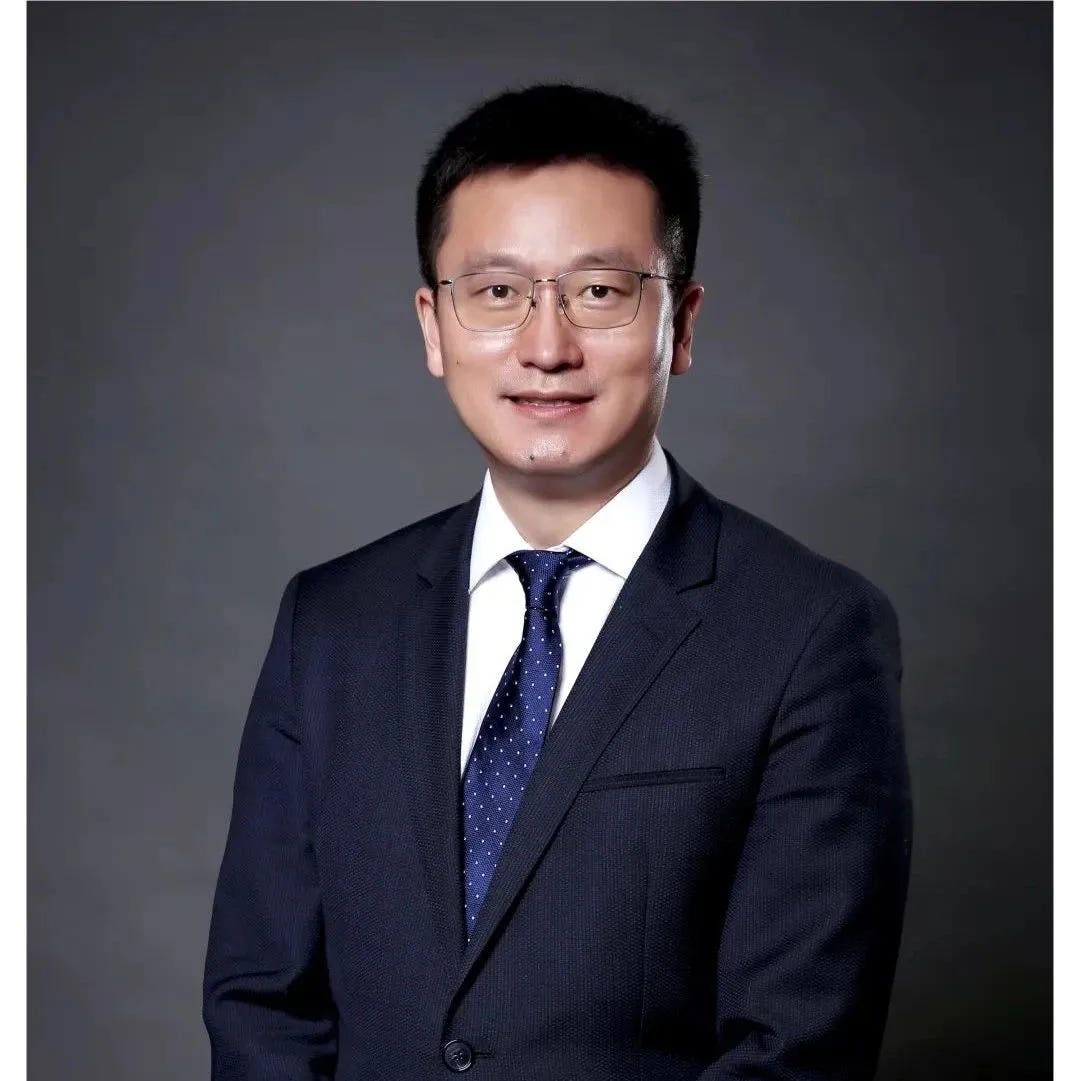
Zhang Ming is one of my favorite Chinese economists. As one of the policy advisors, he can explain complex terms in plain language, helping people without a full economic background, such as me, grasp the ideas. For today’s episode, I want to share Zhang Ming’s latest piece on local debt relief. He believes that at the current stage, two major systemic risks, real estate and local government debt, are intertwined with each other, dragging down economic growth. The debt problem depends not only on the total amount of debt (the numerator), but also on economic development (the denominator). You can’t just focus on lowering the numerator—you also need to find ways to raise the denominator, resolving debt more through economic growth. He recommends easing debt-resolution oversight in the short term, and then tightening it again once the economy recovers.
Zhang is the Deputy Director and Research Fellow at the Institute of Finance and Banking at the Chinese Academy of Social Sciences(CASS). CASS is a ministry-level state research institution under the State Council.
His views have also made me more convinced of the importance of a rebalancing of relations between the central and local governments. What is commonly called the rebalancing of China usually refers to economic shifts, including a shift from investment to consumption and from growth driven by real estate and infrastructure to more sustainable sources of growth. The underlying issue is the set of mechanisms governing local government behavior that sustained the previous growth model.
In the past, local governments bore substantial responsibilities for public services, infrastructure construction, and economic development. They faced incentives to promote growth and attract investment, both of which were tied to the promotion prospects of local leaders—the officials holding the top posts. This is what Zhou Li’an calls the “promotion tournament among local officials.” Local governments drove investment through land sales, financing platforms, and borrowing. Real estate development, in turn, provided land-sale revenues and financing support, creating a mutually reinforcing cycle of economic growth.
Now that real estate development has reached a stage of aggregate oversupply, this cycle has weakened. Yet local governments’ public service responsibilities have not diminished. As a result, they have begun cutting expenditure—which is why there is an emphasis on ensuring basic livelihoods, salary payments, and normal government operations(三保)—delaying payments to businesses—the State Council’s executive meeting in August again made specific arrangements to clear overdue payments to enterprises—and, under fiscal pressure, engaging in practices that damage the business environment, such as “distant-water fishing” and profit-driven law enforcement. These practices further depress business investment and household consumption. Meanwhile, in today’s China, people can move freely, except in Beijing and a few other cities, and local governments lack institutional incentives to invest in “investing in people.”
In his article, Zhang Ming identifies two directions for rebalancing. One is to devolve fiscal powers, giving local governments relatively stable sources of revenue commensurate with their responsibilities and reducing their reliance on land finance and disguised borrowing. The other is for the central government to assume more expenditure responsibilities, taking on a greater share of both responsibility and funding for public services that are national in scope, span multiple regions, or require uniform guarantees. He recommends that the central government assume greater expenditure responsibilities related to population mobility and “investing in people,” and that purely public-benefit projects be financed through central government bond issuance, with local counterpart funding requirements avoided wherever possible.
Below is the English version of the article I made with the help of AI, The original version was first published on China Macroeconomy Forum
Chinese ver link: https://mp.weixin.qq.com/s/wDK4ITQzX3MIBxNa6F3nnA
Zhang Ming: Resolving Debt Requires Countercyclical Thinking—Examining Local Government Debt from Three Perspectives: Domestic Demand, Existing Debt, and New Borrowing
The biggest problem currently troubling China’s economy is insufficient aggregate demand. Growth in household consumption and business investment is relatively weak, while only exports are growing rapidly. But as the external environment changes, the sustainability of export growth will face uncertainty. Against this backdrop, how to boost domestic demand as soon as possible is a major challenge for current macroeconomic policy.
From a macro-financial perspective, I will discuss three issues: the relationship between local government debt and insufficient domestic demand; how to resolve the existing debt stock; and reforms to the fiscal and taxation system and to investment and financing arrangements for new borrowing going forward.
The problems arising from real estate and local government debt, two major systemic risks, and the way they interact are important causes of China’s current lack of domestic demand. This also highlights the need to further address the local government debt problem.
I. Local Government Debt Suppresses Domestic Demand Growth Through Four Channels
1. Directly squeezing infrastructure investment, as interest payments and principal repayments crowd out construction funds
If local government debt is high, and funds are mainly used to pay interest, repay principal, and meet the “three guarantees”—basic livelihood needs, salary payments, and normal government operations—the amount available for infrastructure investment will certainly decline.
This year, infrastructure investment growth has clearly been stronger at the beginning and weaker later on. It exceeded 10% in the first quarter, fell significantly in the second and third quarters, and has now turned negative.
2. Mutually reinforcing problems with real estate, as declining land-sale revenues aggravate the imbalance between revenue and expenditure
There is a close interaction between the real estate problem and the local government debt problem.
Following this year’s new real estate policies introduced on August 28, the housing presale system has come to an end. This will undoubtedly affect land-sale revenues for some time to come.
If land-sale revenues decline further, this will once again aggravate the difficulties between local government revenue and expenditure. Both real estate investment and infrastructure investment will be affected in the next stage.
3. The accounts-receivable chain: without resolving local government debt, clearing payment arrears will be difficult to improve fundamentally
The local government debt problem is closely related to the problem of corporate accounts receivable. Local governments owe payments not only to private enterprises, but also to central state-owned enterprises, local state-owned enterprises, and financing platform companies.
Without a fundamental resolution of the local government debt problem, it will be very difficult to fully resolve the accounts-receivable problem. Local governments can only “take money out of the left pocket and put it into the right pocket.” As the relevant oversight is strengthened, limited funds are used first to repay arrears owed to private enterprises, while arrears owed to local state-owned enterprises and financing platforms may become more serious.
Accounts receivable are on the revenue side of businesses. They affect household income and business investment, while declining household income in turn affects consumption. This problem therefore actually weighs on both consumption and investment.
4. Affecting the business environment, and in turn affecting business operations and investment plans
If the local government debt problem is not properly addressed, it may affect the local business environment.
In recent years, some improper practices have emerged, including cross-jurisdictional law enforcement and even so-called “distant-water fishing.” At their core are difficulties in local government revenue and expenditure and high levels of local government debt.
If these practices that damage the business environment continue, they will affect businesses’ future production and operations, as well as their next round of investment plans.
II. Resolving the Existing Debt Stock: Distinguishing Genuine from Nominal Commercial Debt, and Giving Debt Oversight a Countercyclical Character
1. Important progress has been made in debt resolution, but only part of the problem has been addressed
In recent years, important progress has been made in resolving implicit debt within the Ministry of Finance’s statistical scope and in transforming local government financing platforms.
The new “6+4+2” debt-swap program has continued to be implemented. It has indeed helped local governments reduce the burden of their existing debt. Local governments’ overall borrowing costs have fallen, and debt maturities have been extended.
But it cannot be denied that what we have resolved may still be only the part of the debt iceberg above the water. The part below the water has not yet been fundamentally addressed.
2. Conducting a new round of audits to distinguish “genuine commercial” debt from “nominally commercial” debt
Take the commercial debt of local government financing platforms as an example. Part of it is still not genuinely commercial debt, but debt raised through platform companies by local governments to provide public goods and undertake infrastructure investment.
Although it has not been included in implicit debt, there remain numerous connections between local governments and these debts. Since this portion of debt is not commercial in substance, it is quite difficult to resolve it through commercial means.
My suggestion is to conduct a new round of audits of this debt, distinguishing genuinely commercial debt from “nominally commercial debt” incurred to provide public goods.
For debt arising from the provision of public goods, local governments, platform companies, and financial institutions could first negotiate a certain degree of debt restructuring. With medium- and long-term sustainable growth in mind, local financial institutions should accept, to an appropriate extent, lower interest rates and longer maturities on existing debt, so as to safeguard the principal.
After reducing debt costs through restructuring, a new round of debt swaps could then be carried out for this debt.
As for the remaining debt, if it is indeed commercial and generates reasonably good returns, it can certainly be resolved through market-based means.
3. Resolving debt through development: not only reducing the numerator, but also expanding the denominator
Debt resolution is a dynamic process. We cannot merely reduce the numerator; we must also find ways to increase the denominator, relying more on economic growth to absorb debt.
Of the many episodes of debt resolution in world history, few have been achieved through debtors repaying their debts in actual cash. Instead, they have relied on growth to reduce debt burdens, on growth to enable debt maturities to be extended repeatedly, and on asset appreciation to offset debt.
We must therefore recognize that rigid debt resolution may affect economic growth. Ultimately, constrained growth in the denominator may keep the debt burden high and, in extreme circumstances, may even make it worse.
Debt oversight should have more of a countercyclical character. When domestic demand is insufficient and economic growth faces downward pressure, debt oversight can be subject to dynamic fine-tuning. Stricter oversight can be applied once the economy recovers and domestic demand strengthens. This is consistent with the countercyclical nature of macroprudential regulation.
Procyclical oversight does reduce the numerator to some extent, but it may reduce the denominator to an even greater extent. The result is that the debt ratio becomes higher rather than lower.
4. Preventing moral hazard through reforms governing new borrowing, and creating conditions for greater central government resources to resolve existing debt
The central government has been very cautious about debt resolution, mainly because it wants to guard against moral hazard on the part of local governments.
It is concerned that, if the central government increases its leverage to resolve the debt this time, local governments may then undertake another round of borrowing, causing the debt problem to become increasingly entrenched.
Therefore, to enable the central government to make up its mind to resolve local government debt, reforms addressing both the existing debt stock and new borrowing must proceed together.
Only after reforms governing new borrowing have effectively prevented moral hazard can the central government commit more resources to resolving the existing debt stock.
III. Reforms Governing New Borrowing: From Rebalancing Fiscal Powers and Responsibilities and Adjusting Performance Assessment Indicators to Financing Projects by Category
1. The fundamental solution lies in rebalancing fiscal powers and responsibilities between central and local governments
The fundamental solution going forward lies in rebalancing fiscal powers and responsibilities between central and local governments. Either the central government should devolve more fiscal powers, or it should assume more responsibilities.
Considering that labor mobility will increase and people will move more frequently, it is worth considering whether some expenditure responsibilities centered on people, or some responsibilities related to “investing in people,” could be shifted upward to the central government.
2. The key to changing the logic of local government behavior is to adjust the performance evaluation mechanism for local officials
To change the logic of local government behavior, the most important thing is to change the performance evaluation mechanism for local government officials.
As the emphasis on high-quality development continues to strengthen and thematic education on a sound view of performance advances, changing this mechanism would be in keeping with the direction of developments.
On the one hand, we must move away from an exclusive focus on growth and GDP. On the other hand, we must also avoid an assessment mechanism that is too complex, covers every aspect, and leaves local officials unable to identify the principal issues.
Several important and clearly defined components should be established, with their order of priority and relative importance made explicit, so as to provide a unified “baton” for guiding action.
New debt can become an important assessment indicator. We should look not only at the total amount of debt, but also at where the debt is directed, the benefits it produces, and its social impact. Debt indicators can be assessed together with GDP growth indicators.
3. Matching financing sources to project characteristics and advancing reform of local government investment and financing
Local government investment projects should be classified more clearly. Different types of projects should be matched with different financing channels. Only in this way can we fundamentally prevent local government debt problems from recurring.
Purely public-benefit projects provide public goods. They generate little revenue of their own but have substantial overall benefits. They are not suitable for market-based financing, nor are they suitable for financing through special-purpose local government bonds. They would best be financed through central government bond issuance, and local counterpart funding should be avoided as far as possible.
Projects that are partly public-benefit and partly commercial can be financed through policy banks or new policy-based financial instruments. These new policy-based financial instruments occupy a position between policy banks and commercial banks and are more suitable for some projects with a stronger commercial orientation.
Only fully commercial projects can be financed through commercial banks as well as through project bond issuance and public–private partnerships, or PPPs. These are the projects that should provide the main arena for market-based financing and PPPs.
4. Private capital can genuinely participate as an investor in commercial projects
Private enterprises can participate in the construction of the purely public-benefit and partly public-benefit, partly commercial projects mentioned above. But it is relatively difficult for them to participate purely as investors.
For fully commercial projects, private enterprises can participate not only in construction but also as investors—that is, through what is known as PPP.
Only by adopting differentiated approaches to future local infrastructure projects, and particularly by finding financing that precisely matches the projects’ characteristics, can we prevent local government debt from rising again through new borrowing and resolve the problem at its root.