

Today I want to introduce economist Xu Gao’s latest article. Xu Gao (徐高), the Chief Economist at BOC International.
As some of my readers remember, I translated his article:

In which he used a critique of Ray Dalio’s debt theories to argue that a country’s real debt constraint is its production capacity, and that China needs to correct its deleveraging mindset. His new article carries that argument forward.
In the latest article, he argues that a country's debt level cannot be judged by its size alone. What matters is the balance between the supply of savings and the demand for them in the form of debt. The large volume of savings China lends to the rest of the world, together with its extremely high bond prices (and extremely low bond yields), both show that savings are in excess. Given this reality, China’s debt may be large in scale, but the problem is not that there is too much of it. There is too little.
For the Chinese economy, the “best option” is to adjust the income distribution structure and raise the household sector’s share of national income, thereby driving the transition to consumption-led growth. But while this best option remains in progress, if China suppresses debt and cuts investment (that is, rejects the “second-best option”), a severe shortfall in demand will force the economy into the “worst option” of eliminating capacity. Firms going bankrupt, workers losing their jobs, and the destruction of productive capacity are a far more serious waste of resources than low-efficiency investment. Given the current income distribution structure, China can only choose the lesser of two evils between the second-best and the worst options. Cutting debt has adverse consequences of its own, so the side effects of debt cannot be discussed in isolation.
Below is the English translation I made with the help of AI. Dr. Xu has kindly allowed me to translate his piece into English.
China’s Problem Is Too Little Debt, Not Too Much — and What It Takes to Understand Macroeconomics
China’s debt was once a hotly debated topic. Some people, seeing that China’s debt is large in scale and that the return on the investment it finances is low, concluded that China already has too much debt and should cut its scale and reduce debt risk. On this, as early as June 2023 the author wrote an article, “The Understanding of China’s Debt Needs a Comprehensive Correction,” which set out the errors of this school of thought [1]. In that article the author said: given China’s economic situation of insufficient demand and excess savings, China’s debt risk is not large; China needs to add leverage, and it is the government that should add leverage first. In February 2023, the author also wrote “Comparing Debt to Opium Is Wildly Wrong,” sharply refuting the mistaken view, current at the time, that likened debt to “opium.” Over the past few years, China’s economy has weakened steadily under the pressure of deleveraging, which has provided further evidence for the views the author put forward back then.
Regrettably, however, the evidence from both theory and reality has still not fully dispelled the misunderstandings about China’s debt. Recently, the erroneous “debt as opium” argument has revived, showing once again the need to set the record straight. For this reason, the author has no choice but to write again and go over the old question of China’s debt one more time. It is necessary to reiterate: in a China with insufficient demand, debt risk is not large. In the present situation, China’s debt is not too much, but too little. China’s economy needs to actively add leverage in order to expand domestic demand and end the state of “strong supply and weak demand.”
To explain clearly why China needs more debt, we must first talk about the threshold for understanding the macroeconomy. Some people on the market who fly the banner of “economist” have in fact not crossed this threshold, so they often misread China’s economy and sometimes put forward views that are wildly wrong. Only by crossing this threshold can one correctly understand China’s debt problem. This article therefore first explains where this threshold lies and how to cross it, laying the foundation for the analysis that follows.
1. Correctly understanding the macroeconomy has a threshold that is not low
In many people’s eyes, analyzing the macroeconomy is not difficult. It requires no advanced theory, and everyday experience is enough. After all, everyone lives within the macroeconomy and has first-hand experience of it. On something as familiar to everyone as the macroeconomy, it seems anyone can say a few words and offer an opinion.
In reality, however, the threshold for correctly understanding the macroeconomy is not low, and most people do not truly understand the logic by which it operates. The public’s views on the macroeconomy, even some familiar pieces of common sense, are often specious. This is because people observing the macroeconomy in daily life usually see only one corner and not the whole. With such partial experience alone, it is very hard to truly understand the overall operating logic of the macroeconomy.
To understand the macroeconomy correctly, one needs to cross the threshold of macro thinking. Put plainly, when analyzing macro questions one cannot look only one step ahead, but must think several steps further. Put more academically, one must regard the macroeconomy as an organic whole whose parts are interconnected and influence one another. One must take into account the first-order, second-order, third-order and even higher-order interactions among macro events, and analyze them with the idea of general equilibrium. Only then can one correctly understand how the macroeconomy operates.
Comparing a micro-level firm with a national government shows the difference between micro and macro. Normally, a firm’s size is negligible relative to the economic environment it is in. Hence the effect of the firm’s behavior on its environment is also so weak as to be negligible. So when studying a firm, one can treat the state of the economic environment as a precondition unaffected by the firm, and under that premise study how the firm adjusts its decisions as the environment changes. In other words, when studying a micro-level firm, one need only consider the logical thread of the economic environment affecting the firm’s behavior, and need not consider the effect of the firm’s behavior on the economic environment (this thread can be ignored because its effect is so weak).
When the economic environment is bad, market demand for a firm’s products falls, and the firm’s revenue declines, the firm ought to cut spending and reduce costs. Doing so protects the firm’s profits and makes it easier for the firm to get through the market winter of sluggish demand.
When market demand is sluggish and a firm’s revenue is falling, increasing spending usually does not end well for the firm. For example, a firm could raise its employees’ pay, hoping that they will then buy more of the firm’s own products and so lift market demand for them. But even at a very large firm, employees are only a very small part of the customer base for its products. Even if the employees really did buy more of the firm’s products after the raise, this would not change the overall sluggishness of market demand and would not lift the firm’s revenue. So raising employees’ pay only pushes up the firm’s costs without increasing its revenue, and thus depresses its profits and raises its risk of going under.
This simple example shows that, because a firm is far smaller than the economic environment it is in, analyzing a firm does not require considering the causal chain by which the firm’s spending feeds back, through the economic environment, to its revenue. One need only consider the one-way causal relationship of revenue affecting spending. Analysis of micro-level individuals is relatively simple, because only this first-order, one-way causality needs to be considered.
But if the micro-analytical logic of the firm is copied wholesale onto the analysis of a national government, it is not necessarily correct. The government is large enough that the effect of its behavior on the economic environment cannot be ignored. In the macroeconomy, government spending is one of the important sources of private-sector income. When the macroeconomy grows sluggishly because of insufficient aggregate demand, the government’s fiscal revenue often falls along with it. If the government then cuts fiscal spending because its revenue has fallen, private income and willingness to spend will suffer further, and the problem of insufficient demand will become more serious. So, facing insufficient demand, the government’s correct response is not to cut spending as a firm would, but on the contrary to expand fiscal spending, using it to lift private income and spending and bring the economy out of the trap of insufficient demand.
As increased fiscal spending drives the economy to improve, the government’s fiscal revenue may also rise with it, producing a situation in which “the more the government spends, the more money it has.” This counterintuitive phenomenon arises because government spending affects the macroeconomic environment, which in turn acts back on government revenue, forming a causal chain running from government spending to government revenue.
Here we can see the fundamental difference between micro analysis and macro analysis. When analyzing micro-level agents, one need only consider the causal link from income to spending, not the causal chain from spending to income, since the latter is too weak and can be ignored. But when analyzing macroeconomic agents (such as a national government), neither of the two causal chains, from income to spending and from spending to income, can be ignored. Both must be considered at once. This example tells us that macroeconomic analysis must take into account many causal chains that are ignored in micro analysis. Once they are taken into account, the conclusions may be very different.
Ordinary people find it hard to understand the operating logic of the macroeconomy because in daily life they generally do not encounter causal relationships like spending determining income. Their understanding of the macroeconomy is therefore incomplete. When studying a national government, the logic that government revenue affects government spending, of course, holds. But the logic that government spending affects government revenue holds at the same time and cannot be ignored. Those who think only of the former and disregard the latter will find it hard to grasp accurately the overall relationship between government revenue and spending, and so will easily misunderstand the government’s spending policies.
One point must be added: that understanding the macroeconomy has a threshold does not mean that what ordinary people feel from the economy is false. Even for someone who knows nothing of macroeconomics, their feelings are real. Whether one has crossed the threshold affects only whether one can find the true causes behind those feelings. The task of the macro analyst is therefore not to deny the public’s feelings, but to explain clearly the deeper causes behind them.
2. Mainstream Western macroeconomics, which trains microeconomists
Because it is hard to understand the macroeconomy correctly from everyday experience alone, studying economic theory becomes a key step in crossing the threshold. The trouble is that the current mainstream macroeconomics originating in the West, especially the United States (the New Neoclassical Synthesis paradigm), is to a large extent microeconomics dressed in macro clothing. Those who study this theory without reflection often fail to grasp the difference between macro and micro, and so are prone to misread the macroeconomy. Worse still, some people learn a little theory and believe they hold the pearl of wisdom in their hands, and may instead fall into an even more serious “obstruction of knowledge,” blinded by what they think they know.
The macroeconomy is an organic whole whose parts are interconnected and influence one another, so macro analysis is necessarily holistic. Any macro phenomenon must be set against the backdrop of the entire macroeconomy before it can be properly understood. The very same thing, placed in different macro backgrounds, may be understood in completely different ways.
Which of supply and demand is the binding constraint on the economy’s operation is the first question in the macro background to consider. Market transactions are completed jointly by the supply side and the demand side, and the operation of the macroeconomy is likewise jointly determined by supply and demand. Sorting out which of the two is the binding constraint on economic development is the first question macro analysis must settle. A binding constraint on the demand side (insufficient demand, excess supply) and a binding constraint on the supply side (insufficient supply, excess demand) are two entirely different states. The same phenomenon (the scale of debt, for instance) will carry very different meanings in these two states.
When the macroeconomy is operating in a state of insufficient demand, the phenomenon of the government having “more money the more it spends” can occur. Insufficient demand means that there is spare capacity in the economy that cannot start up because it cannot find buyers. In this case, simply putting the idle capacity to use is enough to meet the purchasing demand brought by the government’s incremental spending. Once idle capacity starts up, it creates new output and brings new income. In this way, an expansion of government spending lifts total output and total income together, and government revenue rises accordingly.
But when the economy is in a state of sufficient demand and fully utilized capacity, an expansion of government spending crowds out private spending and so cannot make the economy better, and the phenomenon of more spending bringing more money no longer appears. This is because, when there is no spare capacity left in the economy to mobilize, the only way to meet the purchasing demand brought by new government spending is for capacity already in operation to put down the work in hand and serve the government instead. Since capacity is only so much, if the government uses more, the private sector can only use a little less. In this situation an increase in government spending “crowds out” private spending. Here, an expansion of government spending cannot raise total output and total income, and government revenue will not rise either. So when demand is sufficient, it is no longer the case that the government has “more money the more it spends.”
Therefore, the first step in macroeconomic analysis should be to discern the relationship between aggregate demand and aggregate supply in the economy, and to determine whether the economy is in a state of insufficient demand. Current mainstream Western macroeconomics was born and matured in the United States over the last half century, and mostly reflects the economic conditions of the United States in that period. During this time, the United States was for a long time in a state of insufficient supply and excess demand, with the binding constraint on economic growth lying in supply rather than demand. Correspondingly, current mainstream Western macroeconomics took insufficient supply as the foundation of its theory, and built a macroeconomics that describes and analyzes the state of insufficient supply. This theoretical system holds that insufficient demand appears only in the short run, and that the only constraint on long-run economic growth is supply capacity.
When the macroeconomy operates under a supply constraint, macro analysis resembles micro analysis. This is because, when the macroeconomy is bound by supply capacity, the economy is already running at the maximum output level physically possible, and further expansion of demand cannot increase output any more. In this case, however large the government is, increasing spending to stimulate demand cannot raise output (government spending crowds out private spending), and naturally cannot in turn raise government revenue. In this state, the causal influence from government spending to government revenue is minuscule and can be ignored. So when the economy is in a state of insufficient supply, analyzing the government is like analyzing a micro-level firm: one need only consider the causal chain from income to spending, and can ignore the reverse causal influence (from spending to income).
Only when the macroeconomy operates under a demand constraint does macro analysis differ sharply from micro analysis. When the economy has not hit the physical constraint of capacity, an expansion of demand can bring an increase in output. In this case, the government can create demand by expanding spending, and as if by magic make the whole economy’s output increase and conditions improve. The key reason the economy operates so differently in the two states of insufficient supply and insufficient demand is that macro policy can create demand out of thin air, but cannot create supply capacity out of thin air.
Once mainstream Western macroeconomics wrote “demand is sufficient in the long run” into the foundation of its theoretical edifice as an important assumption, macroeconomic analysis became microeconomic in character. When the theoretical line of sight is focused on the supply constraint, the possibility that interaction among sectors triggers changes in demand, which in turn drive changes in output, is excluded from the theoretical framework. Macro analysis then resembles the analysis of a micro-level firm and loses the distinctive flavor of macroeconomic analysis.
Another factor aggravating this trend is the construction of “micro foundations” that mainstream Western macroeconomics has undertaken in its methodology over the past few decades. This requires that any macro analysis be built on the basis of micro analysis, reducing macro phenomena to the behavior of micro-level agents such as households and firms. Although this methodology has its advantages, it has also to a large extent reduced macroeconomics to microeconomics.
The key assumption that demand will not be insufficient in the long run, together with the methodological requirement that macro analysis have micro foundations, has turned current mainstream Western macroeconomics almost into a macro application of microeconomics. This macro theoretical paradigm suits Western countries with excess demand and insufficient supply, but does not suit China, with its long-term insufficient demand and excess supply.
This microeconomic turn in analysis is a problem only of the current mainstream Western macroeconomic paradigm, not of macroeconomics itself. Keynes, the founding father of macroeconomics, grounded his entire theoretical system on the premise of long-term insufficient demand. Of course, that Keynes developed such a theory was inseparable from the economic environment he lived in. The Great Depression of 1929 plunged the entire Western world into severe insufficient demand, and Keynesian theory arose in response. But as the problem of insufficient demand in Western countries eased over the last forty-odd years, macroeconomics turned into the present microeconomic mainstream paradigm.
The problem, however, is that in the eastward spread of Western economics over the last twenty or thirty years, China’s domestic economics profession absorbed the mainstream Western macroeconomic paradigm without sufficient reflection. Many people paid no attention to the implicit assumptions and scope of application of this paradigm, and blindly accepted its conclusions. A considerable number of economics scholars have not realized that the theory they use to analyze China’s economy is in fact not fully applicable to it. Analysts who blindly believe in this theory remain micro analysts in their bones. They do not truly understand the difference between macro and micro, and so have not crossed the threshold for understanding the macroeconomy.
Macro analysts with a reflective spirit, who seek truth from facts, will first recognize the premises and scope of application of the theoretical tools they use, and then choose different analytical tools for different economic conditions, thereby correctly grasping the operating logic of the macroeconomy. Conversely, those who lack the necessary reflection, who treat the theory they have learned as a universally valid truth and apply it everywhere regardless of the specific situation, will become people with a hammer in hand to whom everything looks like a nail.
Yet there are now plenty of such people to whom “everything looks like a nail.” Some economists like to advertise themselves as belonging to such-and-such a school, and sneer at other schools whose views differ from their own. This attitude is itself a sign of not understanding the macroeconomy. Whether it is the Keynesian school, which studies how the economy operates under insufficient demand, or the Austrian school, which has more faith in market efficiency and emphasizes supply, or any other school, each is only one tool in the toolbox of macroeconomics, and each is a crystallization of the wisdom left by those who came before. It is simply that analyzing different economic conditions calls for the appropriate tool. Those who blindly believe in or blindly oppose one school’s views without regard to the specific situation commit the error of “dogmatism,” and have not truly crossed the threshold of macro analysis. If someone told us he was a Newtonian physicist, or an Einsteinian physicist, we ought to tell him: “You are merely a physics enthusiast who has misunderstood physics.” To those so-called economists who advertise their school affiliation, we should respond in similar fashion.
3. China at present does not have too much debt, but too little
After so much groundwork, let us now come to the main question of this article: is China’s debt too much or too little?
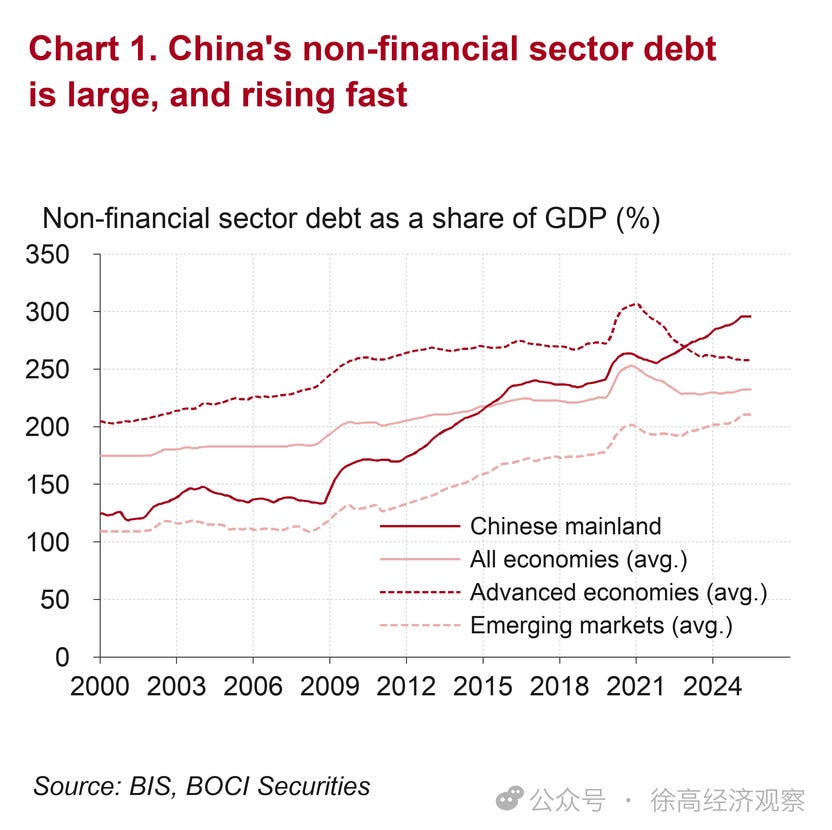
Judging from the data on debt scale alone, China’s debt seems to be too much. According to estimates by the Bank for International Settlements, by the end of the first quarter of this year the total debt of China’s non-financial sector (households, non-financial corporations and government) had already exceeded three times China’s GDP. This debt-to-GDP ratio is higher not only than the world average but also than the average for developed countries. Moreover, China’s debt is not only large but also rising quickly. From the outbreak of the subprime crisis in 2008 to the present, the debt of China’s non-financial sector as a share of GDP has more than doubled. (Figure 1)
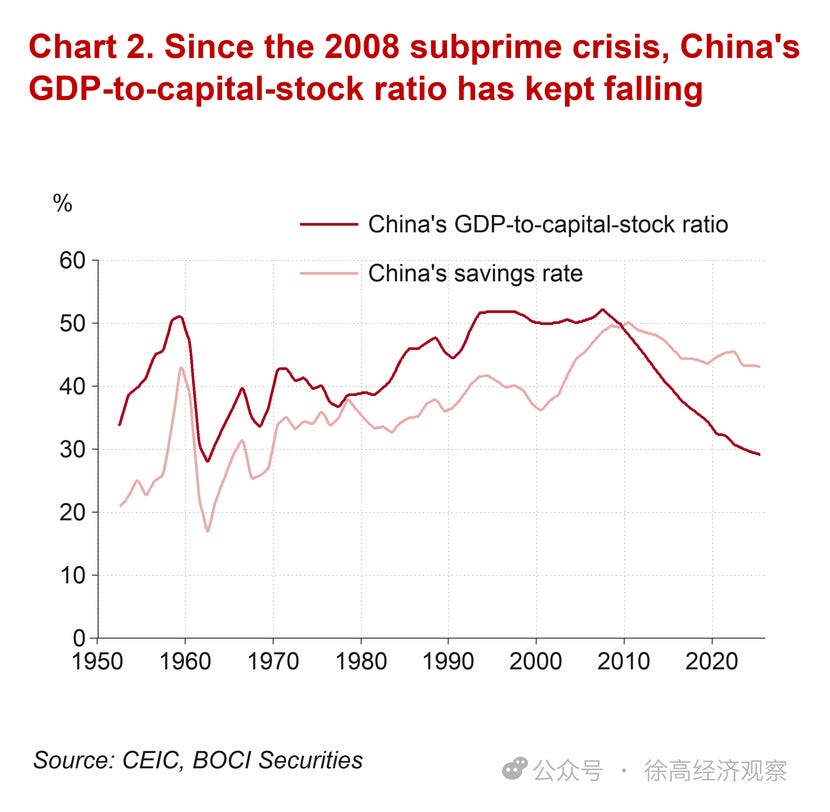
The return on the investment that China’s debt finances is not encouraging either. Bear in mind that borrowed debt must be repaid. And most of China’s debt corresponds to investment projects supported by debt-type financing. China’s real GDP growth rate fell all the way from 14.2% in 2007 to 5.0% in 2025. Over the same period, the ratio of GDP to the capital stock (a ratio proportional to the return on investment) also declined markedly, and by 2025 had fallen to its lowest level since reform and opening up. On the basis of the data on both scale and returns, it seems not hard to conclude that China has too much debt. This is the very ground on which many people hold that China has too much debt and that debt expansion needs to be restrained. (Figure 2)
The view that China has too much debt is a misunderstanding of China’s debt problem. Here we first answer the challenge concerning the scale of debt: China’s debt being so large, does that mean there is too much of it?
In a market economy, to judge whether there is too much or too little of something, one cannot look only at its size, but must look at the balance of its supply and demand. Debt is a form of financing, and necessarily has a borrower and a lender. In the process of borrowing and lending, savings are transferred from the lender (the creditor) to the borrower (the debtor). In debt financing, debt is the demand for savings, and savings are the supply of funds for debt. To judge whether a country’s debt is too much or too little, and whether its debt risk is high or low, one must look at the supply-demand balance between that country’s savings and its debt. An approach that assesses debt risk by the scale of debt alone, without considering the scale of savings, is methodologically meaningless.
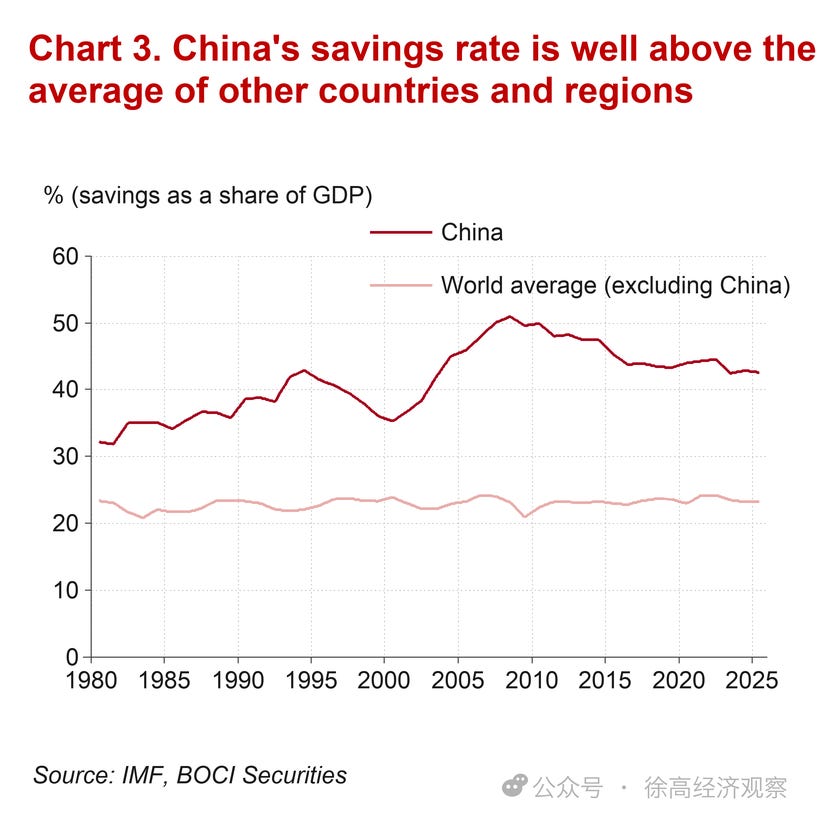
China is a country where the scale of debt is very large and the scale of savings is also very large. In 2025, China’s savings rate was 43%, roughly twice the average savings rate of other countries and regions in the same period. China’s high savings rate and its insufficient consumption are two sides of the same coin, both rooted in an income distribution structure in which the household sector’s share of income is on the low side (see Section 2 of the author’s June 2023 article “The Understanding of China’s Debt Needs a Comprehensive Correction”). Two pieces of evidence show that, in the supply-demand balance between China’s savings and its debt, savings are in excess. (Figure 3)
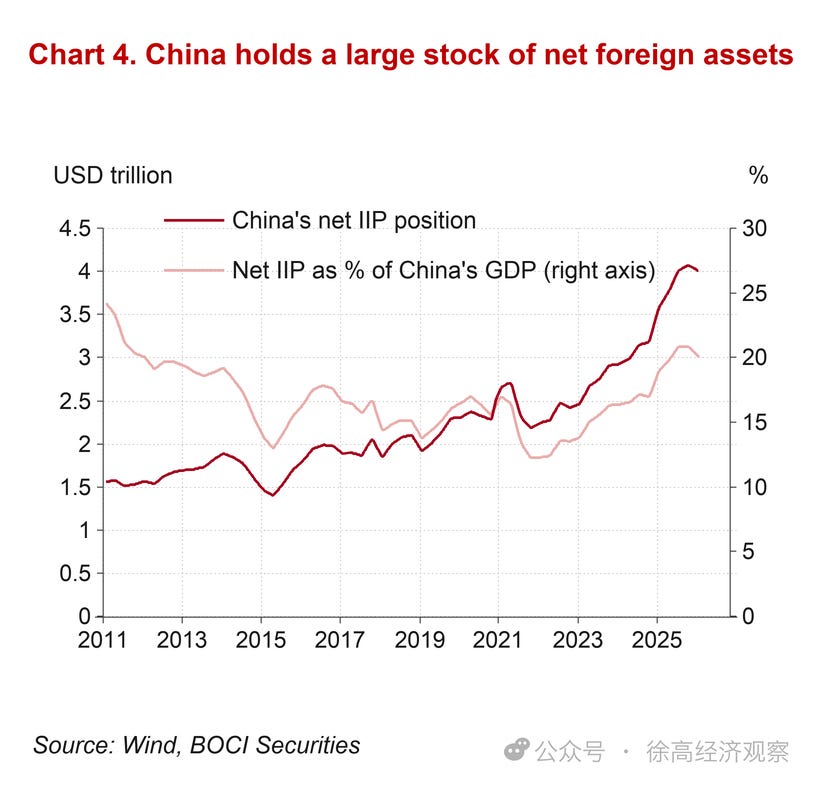
The first piece of evidence is the large amount of savings China lends abroad. Data from the international investment position show that at the end of 2025 China’s net foreign assets (the foreign assets China holds minus China’s external debt) had reached USD 4.1 trillion, equivalent to 21% of China’s GDP that year. If anyone thinks China’s domestic debt is already too much, they should not forget that China has also lent such a large amount of savings to foreign countries. (Figure 4)
The second piece of evidence is China’s extremely high bond prices (extremely low bond yields). Prices reflect supply and demand, and bond prices reflect the supply of and demand for debt. At present, China’s bond price index has risen to its highest in nearly 20 years, while bond yields, which move inversely to it, have fallen to their lowest in 20 years. High bond prices show that buyers abound: bonds have no trouble selling at all, and demand outstrips supply. If a country really had too much debt and high risk, bond prices should be very low and yields very high. For example, when the European debt crisis broke out in 2011, the government bond prices of the peripheral European countries with higher debt risk (such as Greece, Italy and Spain) all plunged, and their bond yields rose sharply. This is clearly not China’s situation today. (Figure 5)
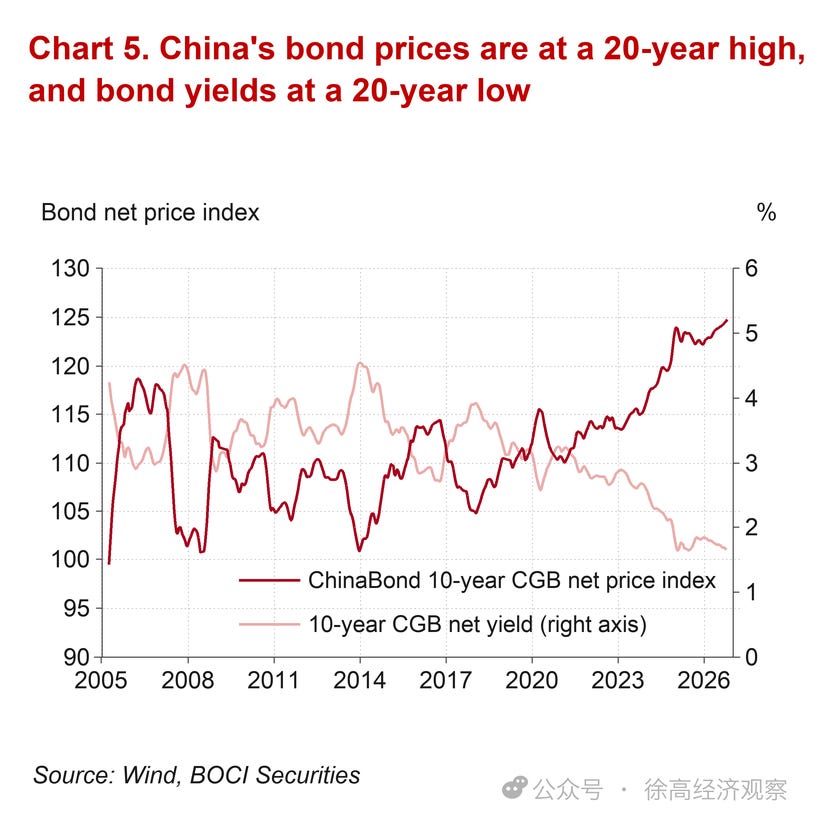
The funds supplied by China’s savings exceed the amount of funds absorbed by debt. Given this reality, although the scale of China’s debt is very high, its debt is in fact not too much, but too little. In recent years, the advance of domestic deleveraging measures has increased the downward pressure on China’s economy and raised the risk of the economy losing stability. So long as the constraint that the income distribution pattern places on consumption growth remains, and so long as China remains a country with excess savings, it needs to keep expanding debt financing and channel more savings into domestic investment projects, thereby expanding domestic demand and stabilizing economic growth.
4. Increasing debt is the optimal choice under the constraints on China’s economy
Next we respond to the challenge that the return on debt is on the low side. Open the financial statements of a great many investment projects (infrastructure projects especially) and one finds that China’s return on investment is clearly on the low side. Many people therefore ask: if borrowed money is not used efficiently, why borrow so much? Some also cite this phenomenon as evidence that China has too much debt.
To answer the question of the low returns corresponding to debt, one must first get the accounting of investment returns right. In judging the returns on these investment projects, one cannot look only at whether the project itself makes money at the micro level, but must also count the social benefits the project contributes to the locality and the country. If one stares only at the project’s micro-level books and leaves out the society-level account, one will underestimate the return on investment of many projects, infrastructure projects in particular. Take building a subway in a city: selling tickets actually earns little money, because a subway must consider its public-welfare nature and fares are generally not set very high. So if one opens the books of subway projects in the major cities, the financial return of the project itself usually does not look good. Many subway projects even need continuing government subsidies in order to operate. But this does not mean that subways should not be built. Through its “not making money,” a subway project subsidizes the broad mass of the people. The convenience and welfare people gain from convenient subway transport should also be counted in the return on the subway project.
In addition, when considering the question of return on investment, one must also take into account the constraints the macroeconomy faces and seek the “constrained optimum.” For China’s economy, the “best strategy” is to adjust the structure of income distribution and raise the household sector’s share of the economy’s total income, thereby advancing the transition to consumption. This would lower China’s savings rate and raise China’s consumption, reducing at the source the scale of debt generated. This is the “optimal” way out for China’s economy. But the adjustment of income distribution can hardly make substantive progress in the short term. With China’s savings still at a high level and its financing structure dominated by debt-type financing, borrowing more and putting savings to use is the urgent task. And with household income relatively low, households’ willingness to borrow will not be very strong. In this case, using debt to put savings into investment is China’s “constrained optimum” under real-world constraints, that is, the “middle strategy” available to China. To neither adjust the structure of income distribution nor refrain from suppressing debt and investment will not make the economy improve. It will only make the pattern of strong supply and weak demand deteriorate further, leading in the end to the “worst strategy” of large-scale business failures and large-scale unemployment of workers. (See Sections 7, 8 and 9 of the author’s January 2025 article “The Logic of and Way Forward for China’s Economy” [3])
Some may ask: is borrowing to make inefficient investments not a waste of resources? The answer is yes, of course it is a waste of resources. But the next question is: if we do not borrow to invest, will resources then not be wasted? The answer to that is no. While the “best strategy” of the transition to consumption has not yet been made to work, if debt is still to be suppressed and investment cut (not taking the “middle strategy”), China’s economy will, because of severely insufficient demand, be forced toward the “worst strategy” of eliminating capacity. Firms going under, workers losing their jobs and capacity being destroyed are a more serious waste of resources than making inefficient investments. Under the constraint of this income distribution structure, we can only choose the lesser of two evils between the “middle strategy” and the “worst strategy.” To talk idly of the side effects of debt, without considering the constraints China’s economy now faces and without thinking of the adverse consequences that cutting debt would bring, is an easy mistake to make.
5. Before analyzing the macroeconomy, please first cross the threshold
The macroeconomy is familiar to everyone, yet most people do not understand it. The public’s feelings about the macroeconomy are of course real, but the views drawn from everyday experience may not capture the true causes behind those feelings. Policy ideas formed on the basis of such views often fail to achieve their aims, and sometimes even go in the opposite direction from the one intended.
For lack of macro thinking, many people see only the side effects that debt brings. They do not see debt’s contribution to economic stability, nor the necessity of the rise in China’s debt scale against the background of high savings. Many popular mistaken views arise from this. A few years ago there even emerged the absurd view that likened debt to opium, which raised eyebrows.
At such a time, professionals are needed who will use their expertise to see clearly the various constraints on the economy’s operation, explain clearly the reasoning behind how China’s economy operates, and analyze thoroughly the pros and cons of the various policy options, thereby guiding the market consensus toward the correct direction. Any economic analyst who flies the professional banner needs to recognize how heavy the responsibility on their shoulders is and to keep improving their understanding of the macroeconomy, and must never play to the gallery.
The macroeconomy of a China with insufficient demand operates by mechanisms very different from people’s micro-level life experience. In such circumstances, speaking in line with the public’s mood and the public’s views may easily win online traffic, but it misleads market opinion and is by no means a blessing for the country. Anyone who attempts to talk seriously about China’s macroeconomy and to analyze China’s debt problem must first do their homework, and first cross the threshold of correctly understanding the macroeconomy.