

China has just released its official readout of the Xi–Trump talks. Here are my main takes.
Strategic Stability
This is largely a continuation of the consensus reached in Beijing, with four additional formulations outlining the path forward:
在务实合作中互利共赢,在良性竞争中彼此成就,在求同存异中妥处分歧,在累积互信中构筑和平。
achieve mutual benefit and win-win results in practical cooperation, contribute to each other’s success through healthy competition, properly manage differences as they seek greater common ground, and build peace through greater mutual trust
The emphasis is on the potential benefits of competition for both countries. It also acknowledges that bilateral differences will persist, while stressing the importance of building mutual trust through the process of addressing them.
AI Dialogue
AI dialogue is the largest addition to the agenda. On AI safety, the Chinese perspective differs from that of U.S. tech CEOs advocating a slowdown in AI development: China tends to view AI risks more as engineering problems that can be addressed through human intervention.
For now, the two sides’ priorities and interests do not align, making substantive progress on specific issues difficult in the near term.
Moreover, both Beijing and Washington currently see AI as a strategic domain of bilateral competition. Any near-term cooperation is therefore likely to remain limited—for example, a mechanism for notifying each other of major AI risks.
Trade Truce
In an interview with Fox News on Wednesday, U.S. Treasury Secretary Scott Bessent said the two countries had agreed to extend their trade truce, previously set to expire in November, by another two months. Beijing has yet to confirm the extension. Bessent led this week’s trade negotiations with China.
Some interpret the short extension as a sign that negotiations are not going well. My reading is different: with opportunities remaining for the two leaders to meet again this year, the extension may be intended to leave room for another announcement at a subsequent meeting. The length of an extension is not necessary a reliable indicator of progress in the negotiations.
The summit readout did not mention the investment or trade councils. However, China’s separate readout of the economic and trade consultations described the discussions as “candid, in-depth, and highly constructive.” I read “highly constructive” (富有建设性) as a more positive assessment than the standard “constructive” (建设性).
Others:
During his 2023 visit to the United States, when Biden was in office, Xi announced a plan to invite 50,000 young Americans to China for exchanges and study over the following five years. That target had already been met by May 2026. This time, Xi announced plans to invite 100,000 young Americans over the next five years. Now let’s see whether Trump counts this as another achievement that puts him ahead of Biden.
Below is the Chinese version of the readouts:
Honorable President Donald J. Trump and Mrs. Melania Trump,
Ladies and Gentlemen,
Dear Friends,
I’m very glad to pay a state visit to your beautiful country, the United States of America. Thank you, President Trump and Mrs. Trump, for the warm hospitality you have extended to me and my wife. On behalf of the 1.4 billion and more Chinese people, I wish to begin by extending sincere greetings to the American people and warm congratulations on the 250th anniversary of the American independence.
Both China and the United States are great countries, and both the Chinese and American peoples are great peoples. I am visiting the United States at President Trump’s invitation to carry on our friendship, expand cooperation, and promote the well-being of both our peoples.
Facing the changes in our world, in our times, and of historical significance today, China and the United States, as two major countries, shoulder a historic responsibility of advancing human development and progress.
Mr. President, during your visit to China this year, we agreed to build a constructive China-U.S. relationship of strategic stability, and this is widely welcomed by the people of our two countries and the international community. I am ready to work with you to steer the giant ship of China-U.S. relationship on a steady course toward the future.
—We should strengthen communication. China and the United States are different in national conditions, but through candid, in-depth and continued dialogue, our two countries can understand each other better, seek common ground while shelving differences, and build up mutual trust. President Trump and I have respect for each other. We have built personal rapport and stayed in touch. We encourage our government departments, such as those in charge of foreign affairs, economic matters, financial cooperation, law enforcement and people-to-people exchanges, to catch up on strengthening contact, and we support our legislative bodies in increasing exchanges.
—We should cooperate with sincerity. The interests of China and the United States are deeply intertwined, and there is plenty of room for us to work together. China-U.S. cooperation may not solve every problem in the world. But, without our cooperation, it would be hard to solve many of the world’s problems. China keeps its door wide open, welcomes American companies wanting to invest and do business there. We hope Chinese companies are treated fairly here in the United States. Working together, we can lengthen the list of cooperation, and shorten the list of issues. Both China and the United States are leading nations in artificial intelligence. We have both the capability and responsibility to develop and manage AI for good, and ensure that the development of AI is always under human control and serves the well-being of the people. On counternarcotics and law enforcement, the Chinese side is willing to strengthen cooperation with the United States. Our two sides may also increase direct flights to facilitate two-way travel and trade.
—We should coexist in peace. As I have said many times, China and the United States, as two major countries, stand to gain from cooperation and will both lose in confrontation. We do not need to avoid mentioning competition, but our competition should be a healthy one and should be kept within bounds. It should be a race of catching up with one another, not a wrestle in which one either wins or loses. China and the United States must hold the line of no conflict and no confrontation between us, and we can certainly find the right path for our two great countries to get along on this planet we both call home. Our two militaries should maintain regular dialogue, and improve mechanisms for crisis communication and prevention. The Thucydides Trap can be overcome.
Ladies and Gentlemen,
Dear Friends,
During the Second World War, Chinese and Americans fought shoulder to shoulder against fascist aggression. Chinese people have never forgotten that part of history, nor have the American people. The hope of the China-U.S. relationship lies in our people, and its future lies with the young. I am glad to announce an invitation for 100,000 young Americans to visit China for exchanges and study in the coming five years.
The giant panda has been an envoy of friendship between the Chinese and Americans. Here, I have a piece of good news. In a few days, two pandas, Ping Ping and Fu Shuang, will come to their new home in Zoo Atlanta and meet with the American people.
Ladies and Gentlemen,
Dear Friends,
Achieving the great rejuvenation of the Chinese nation and making America great again can go hand in hand. Let us meet the people’s expectation and show our historical initiative. Let us keep advancing the cause of friendship between our two peoples and work together to build a better world!
Thank you.
On the morning of September 24, local time, U.S. President Donald J. Trump hosted a grand ceremony at the White House to warmly welcome Chinese President Xi Jinping on his state visit to the United States.
Against the pleasant September hues in Washington, Chinese and American national flags fluttered in the breeze. Upon arrival at the White House by limousine, President Xi Jinping and Madame Peng Liyuan were warmly greeted by President Trump and Mrs. Melania Trump at the drop-off area. The two presidents and their wives posed for photos together.
Accompanied by President and Mrs. Trump, President Xi and Madame Peng walked into the White House where they signed the guest book.
Amid resounding military music, the two presidents proceeded to the Cross Hall. The military band played the national anthems of China and the United States.
After the national anthems, President Xi and President Trump each delivered remarks.
President Xi extended sincere greetings to the American people and warm congratulations on the 250th anniversary of American independence on behalf of the 1.4 billion and more Chinese people.
President Xi noted that he was visiting the United States at President Trump’s invitation to carry on friendship, expand cooperation, and promote the well-being of the peoples of the two countries. Facing the changes in the world, of the times, and of historical significance today, China and the United States, as two major countries, shoulder a historic responsibility of advancing human development and progress. During President Trump’s visit to China earlier this year, the two sides agreed to build a constructive China-U.S. relationship of strategic stability, and this is widely welcomed by the people of the two countries and the international community. President Xi said he was ready to work with President Trump to steer the giant ship of China-U.S. relationship on a steady course toward the future.
President Xi emphasized that China and the United States should strengthen communication. The two countries are different in national conditions, but through candid, in-depth and continued dialogue, they can understand each other better, seek common ground while shelving differences, and build up mutual trust. China and the United States should cooperate with sincerity. The interests of the two countries are deeply intertwined, and there is plenty of room for them to work together. China-U.S. cooperation may not solve every problem in the world. But, without the cooperation between the two countries, it would be hard to solve many of the world’s problems. Both China and the United States are leading nations in artificial intelligence, with both the capability and responsibility to develop and manage AI for good, and to ensure that the development of AI is always under human control and serves the well-being of the people. China and the United States should coexist in peace. As two major countries, they stand to gain from cooperation and will both lose in confrontation. China and the United States must hold the line of no conflict and no confrontation between the two countries. The Thucydides Trap can be overcome.
President Xi noted that Chinese and Americans fought shoulder to shoulder against fascist aggression. Chinese people have never forgotten that part of history, nor have the American people. The hope of the China-U.S. relationship lies in the people, and its future lies with the young. In the coming five years, the Chinese side will invite 100,000 young Americans to visit China for exchanges and study. The giant panda has been an envoy of friendship between the Chinese and American peoples. Two pandas, Ping Ping and Fu Shuang, will soon come to their new home in Zoo Atlanta and meet the American people.
President Xi emphasized that achieving the great rejuvenation of the Chinese nation and making America great again can go hand in hand. He called on the two sides to meet the people’s expectation, show historical initiative, keep advancing the cause of China-U.S. friendship and work together to build a better world.
President Trump extended warm welcome to President Xi on this historic state visit to the United States, and said that he has forged a great friendship with President Xi which is built on mutual respect and the vital interests of the peoples of both countries. The United States and China reached across the ocean centuries ago to trade and to learn. President Xi arrived at an important moment for America, the 250th anniversary of independence. The two sides will continue their cooperation and contribute to a better world. He will have in-depth discussion with President Xi on topics including trade, security, AI and technology, which can lay a solid foundation for peace and prosperity for decades to come. The two countries fought together in World War II to win that war, with stories like the Flying Tigers still remembered by the people of both countries. He looks forward to continuing working together with President Xi and forging a better future for both nations.
After the remarks, President Xi and Madame Peng watched a performance by the United States Marines in the company of President and Mrs. Trump. The two presidents and their wives greeted and shake hands with the entourage of the other side. They then proceeded to the White House Rose Garden for a military review. The military band played the opening fanfare, and U.S. honor guards from different military services performed traditional drills and played instrumental music. Multiple combat aircraft flew over the White House in honor of the Chinese and U.S. presidents and their wives.
After the arrival ceremony, the two presidents and their wives withdrew to the White House Oval Office where they had cordial and friendly exchanges.
Cai Qi, Wang Yi, and He Lifeng, among others, attended the events.
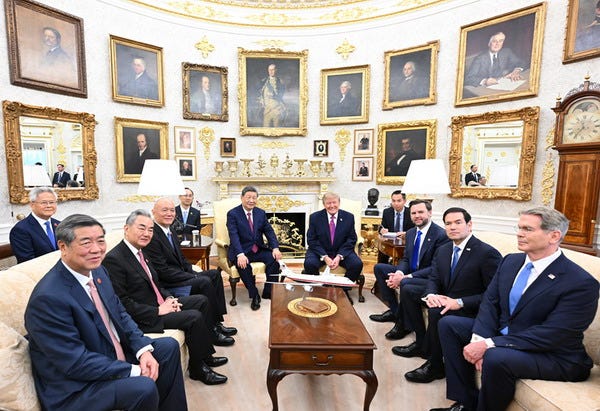
President Xi Jinping Holds Talks with U.S. President Donald J. Trump
On the morning of September 24 local time, President Xi Jinping held talks with the U.S. President Donald J. Trump at the White House.
President Xi pointed out that the Chinese and U.S. presidents exchanging visits in less than half a year is unprecedented in the history of China-U.S. relations. He and President Trump had maintained communication through different means, and worked together to steer the giant ship of China-U.S. relations. President Xi said that this May, he and President Trump agreed to build a constructive China-U.S. relationship of strategic stability. This new vision reflects the realities of China-U.S. ties, embodies the expectations for the future, and is an important step toward a right approach for the two countries to get along with each other. The two sides should turn this vision into action,strive to take their relationship where cooperation is the mainstay, competition is kept within proper limits, differences are managed and peace can be expected,and chart the right path for the two major countries to get along. China and the United States should, and have all the conditions to, achieve mutual benefit and win-win results in practical cooperation, contribute to each other’s success through healthy competition, properly manage differences as they seek greater common ground, and build peace through greater mutual trust, so that the people of our two countries and of countries around the world can all benefit from a constructive China-U.S. relationship of strategic stability.
President Xi stressed that the economic and trade teams of the two sides had a new round of consultations, and reached a new joint arrangement, which is good news for both the industries and people of our two countries and even the world economy. Cooperation is a two-way street. To keep the economic and trade ties stable, the list of cooperation needs to be lengthened, and the list of issues shortened. So long as both sides act in the spirit of equality, mutual respect, and mutual benefit, a pathway to resolving differences can always be found. It is hoped that the two sides will move in the same direction, adhere to mutual benefit and win-win results and promote the continued, steady development and improvement of China-U.S. economic and trade ties.
President Xi pointed out that both China and the United States have strong AI capabilities. They may have competition, but they may cooperate even more. The right thing to do is to draw on each other’s strengths, not guard against each other. The two sides can continue their dialogue on AI, exchange views on its risks and benefits,and jointly prevent the misuse and abuse of AI. AI must be kept under human control. A people-centered approach should be upheld, and AI should be developed for the positive and for good, so that AI will serve the progress of humanity.
President Xi stressed that the Chinese side’s position on safeguarding national reunification and territorial integrity is clear-cut. It is hoped that the U.S. side will adhere to the correct position of opposing “Taiwan independence,” and handle the Taiwan question with caution, so as to lay a solid foundation for China-U.S. strategic cooperation and the development of bilateral relations.
President Trump stated that President Xi’s state visit to the United States is a great visit. Both the United States and China are great nations. President Xi and he are good friends, and they maintain deep and close communication. Under their leadership, the U.S.-China relationship will undoubtedly be a success. A new round of consultations between the economic and trade teams of the two countries has produced new outcomes. The two sides should continue the dialogue and reach an even better deal. AI concerns the future of humanity. The United States and China should maintain dialogue and strengthen cooperation on AI.
The two presidents also exchanged views on major international and regional issues including the situation in the Middle East, the Ukraine crisis and the Korean Peninsula.
The two presidents agreed to support each other in hosting the 2026 APEC Economic Leaders’ Meeting and the G20 Summit.
Cai Qi, Wang Yi, and He Lifeng, among others, attended the talks.
Worth noting that the confirmation gap runs both ways. Beijing published the substantive account of the talks while Washington still has no comparable readout; on the truce extension, the direction is reversed — Bessent announced it, while, as you note, Beijing has yet to confirm it.
That makes your point about "highly constructive" especially useful: it is evidence inside a text someone actually chose to publish. A graded adjective can be compared with the standard one. An absence cannot be interpreted the same way until there is a corresponding record to inspect.