

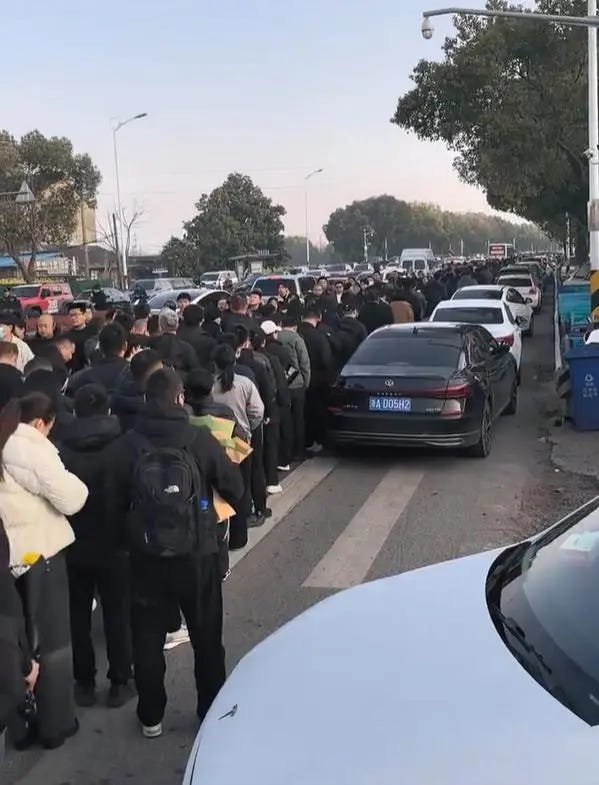
On March 24, 2026, Zhang Xuefeng, one of China's most influential education influencers, died of sudden cardiac arrest. He was 41. In the hours that followed, two starkly different reactions emerged on Chinese social media. Scores of young people from ordinary families called him "a guide for those born without privilege." Many intellectuals, meanwhile, dismissed him as a crass utilitarian who had reduced education to a job placement exercise. In Suzhou, where his company was based, crowds of residents showed up at the funeral home uninvited to see him off.
The New York Times described him, aptly in my view, as someone "known for dispensing ruthlessly blunt advice about how to maximize a student's chances at success." But how did an education consultant amass such enormous influence in just a few years, even upon his death, that ordinary citizens mourned him as though they had lost someone they personally knew?
To understand his appeal, you first have to understand the gaokao. The gaokao is, for the vast majority of Chinese students, the sole gateway to university. Held every June, it is a nationally standardised exam that ranks students by score and matches them to universities accordingly. Since its reinstatement in 1977, the gaokao has been the single most important mechanism for social mobility in China. For most ordinary families, it is the most reliable chance their child will ever have to change the trajectory of their life.
If the gaokao remains China's most critical channel for upward mobility, then the application process that follows it — choosing which universities and majors to list on your preference form — is the most opaque stretch of that channel. Zhang Xuefeng's rise from education consultant to nationally recognised public figure was not because he said anything particularly brilliant. It was because he spoke directly to the anxiety that had existed for years, but had never found a voice.
Put simply, within the gaokao system, the amount of information available to a family varies enormously depending on where they live and what class they belong to. A student in Beijing or Shanghai might have older peers sharing frank assessments of different universities and career prospects from as early as tenth grade. Their parents might be graduates of elite universities themselves, casually remarking over dinner that a certain department at a certain school isn't as strong as its reputation suggests. A student in a small county town, by contrast, is likely to hear only one piece of advice from their teachers: get a high score.
What Zhang did during his livestream was make that knowledge visible. He spoke bluntly about things like what jobs a given major actually leads to, how a given university is actually regarded within an industry, and whether a particular path makes sense for a kid without family connections. This kind of talk was easy for elites to look down on as “vulgar pragmatism.” But for most ordinary families, education leaves little room for dreams. Every point on that gaokao score is a bargaining chip, and it must be spent wisely, because after graduation, these kids still need to find a job and gain a foothold in an unfamiliar city, entirely on their own.
At the individual level, the average Chinese gaokao taker is around nineteen years old, having spent the previous twelve years in school. Given the academic intensity in most parts of China, the overwhelming majority of these students have poured nearly all of their energy into preparing for exams. Many have barely had the chance to figure out what they are good at, let alone what they want to do for a living. To expect them to deploy their gaokao scores strategically — making rational decisions about careers and cities — is simply unrealistic.
Zoom out further, four decades of rapid industrial upgrading have produced wave after wave of structural upheaval in Chinese society, rendering experience-based wisdom almost useless. Roughly every ten years, the groups that benefit most from China's economy shift markedly, making it impossible for parents to guide their children based on their own career trajectories. In the 1980s and early 1990s, graduates of vocational secondary schools — zhongzhuan — were guaranteed job placements by the state, while university admission rates remained low. Many of the best middle school students chose vocational school over the high-school-to-university track. Then, around 1999, a massive expansion of university enrollment and the abolition of guaranteed job placement dramatically reduced the returns on vocational education. Overnight, the university track became the obvious first choice.
In hindsight, these turning points seem unmistakable. But for those living through them, they were anything but. And so, for most families, the only option was to rely on someone like Zhang Xuefeng, who understood the rules of the game well enough to point others in the right direction.
Of course, decades of breakneck growth also served to cushion the consequences of poor information and poor choices. As long as someone's university wasn't too bad, even a misjudged major could be overcome: the tailwinds of industrial expansion and urbanisation were strong enough that switching careers mid-stream remained a viable path to a decent life. In other words, society as a whole still had a high tolerance for error.
But as China has moved away from that era of high-speed growth, and the rising tide no longer lifts all boats, the calculus has changed.
A dozen years ago, an ordinary student who got into a middling university’s computer science program had a realistic shot at landing a job at a top internet company, earning several times the national average salary. Today, even a degree from an elite “985” university, China's equivalent of the Ivy League, is no guarantee of entry into a leading firm. Some employers have even taken to scrutinising applicants’ undergraduate origins — the so-called “first degree”(第一学历)- as if having tested into a top graduate program from a lesser-known college were not a sign of perseverance, but a stain on one’s resume.
In this environment, Zhang Xuefeng told ordinary families the things they needed to hear: Where do you actually stand? What cards do you actually hold? Which majors give you a real chance of survival? Which choices are traps? Renwu人物 magazine called him “the opposite of an idealist.” But I would argue that for the many families with no connections, no safety net, and no capital for trial and error, his brutal honesty came closer to kindness than any amount of gentle platitudes ever could.
What Zhang represented was a challenge to a deeply rooted traditional Chinese shidafu ideal, which holds that education derives its nobility from rising above material concerns. Zhang told ordinary people to survive first. And yet, isn't the belief that every ordinary person deserves the right to make an informed choice a higher form of idealism? This questioning of the conventional narrative around education was already widespread while Zhang was alive. Now, with his passing, it’s been sanctified and placed beyond challenge.
more to read:

He was one of the most-watched figures among anxious parents navigating China’s most competitive college entrance exam, as South China Morning Post has put it.
"And yet, isn't the belief that every ordinary person deserves the right to make an informed choice a higher form of idealism?"
"But I would argue that for the many families with no connections, no safety net, and no capital for trial and error, his brutal honesty came closer to kindness than any amount of gentle platitudes ever could."
It's such a deeply empathetic, heart-warming tribute...
I perhaps wouldn't say Zhang challenged the traditional 'Shidafu' ideals. Probably no one had ever expounded the highest ideals of traditional Chinese intellects more inspiringly than Zhang Zai: 为天地立心,为生民立命,为往圣继绝学,为万世开太平. Though there are different interpretations, I believe 为生民立命 partially means serve the people, and serving the people should have always been one of the ideals of the 'Shidafu'. If our educators/intellects still value traditional shidafu ideals, they should be humbled by Zhang, and should not feel challenged by him.