

On October 29, The New York Times first reported that U.S. intelligence agencies had concluded that Alice Huang (黄乐), a Chinese businesswoman close to Jensen Huang, was working for Chinese intelligence. On November 6, the paper followed up, saying she had been recruited by China’s Ministry of State Security. The Chinese Embassy in Washington told NYT the claims were groundless and nothing but a smear against China. On November 8, Jensen Huang admitted in a letter to employees that he had been unfaithful to his wife, and Nvidia’s board announced an independent investigation the same day. On November 9, Chinese Foreign Ministry spokesperson responded that the so-called spy allegations had no basis.
As I see it, this is a textbook case of intelligence agencies using insider leaks to shape the agenda. Once anonymous officials leak something to The New York Times and it gets printed, it becomes “fact” by default. I get the sense that China’s MoFA was pretty clueless here too. The reporting rests on a classified memo that has never been made public. Unpublished means unfalsifiable, so Beijing has nothing to rebut.
The Chinese internet, for its part, has treated the whole affair mostly as entertainment. I’ve lost count of how many AI-generated spoof videos and memes I’ve seen of Jensen Huang dancing with Alice Huang, and I’m pretty sure they are all powered by Nvidia chips.
Frankly speaking, NYT did a good job on the background check. Ms. Huang had a romantic relationship with Jensen Huang, and she is also an executive at Megaspeed, a Singapore-headquartered company whose main business is buying Nvidia chips and renting out computing power. Between June 2024 and February 2026, its Malaysian affiliate bought at least $4.8 billion worth of equipment containing Nvidia chips. The U.S. Commerce Department has long been investigating whether it helped Chinese companies get around export controls.
You can tell that the NYT reporters tried hard to dig into her ties to the Chinese government, but the reporting still has no real substance. Let me quote some of their mood-setting material:
Megaspeed has been building data centers in Southeast Asia and then renting their computing power to Alibaba, a giant Chinese internet firm, giving China a backdoor way of getting access to advanced Nvidia chips. Nvidia is restricted by the United States from selling those chips directly to China.
Beyond its local connections, the network also has a financial link to the Chinese military establishment, through an investment in a cybersecurity subsidiary of China Electronics Technology Group, one of the country’s largest makers of military technology.
Flip this into an American version, and it would read: “Someone is close to a group of Texas businessmen who got their start in crypto mining and later pivoted to AI data centers. This circle also has a financial link to the U.S. military-industrial establishment, through an investment in a cybersecurity subsidiary of Raytheon, one of America’s largest makers of military technology.”
I trust nobody would conclude from this that the person works for the CIA, or is close to the government. After all, people invest because they want to lie flat and collect money, not to get a second job.
Of course, some will say that being able to invest in a state-owned enterprise proves the network’s government connections. But China Electronics Technology Group has 16 listed companies under it, which means ordinary investors can buy in too. That is also a “financial link.” Honestly, this doesn’t amount to any real information.
So here’s the question: what’s in it for her? If the sources had said she was a representative of Chinese tech companies (especially the internet giants going all in on AI) that want access to the computing power of Nvidia chips (renting out compute is legal and compliant), that would sound far more convincing. An executive at a compute company with close ties to Chinese tech firms, using everything at her disposal to build a relationship with her supplier’s boss? That’s business.
(Of course, there is one other possibility. Image: In the Name of the People)
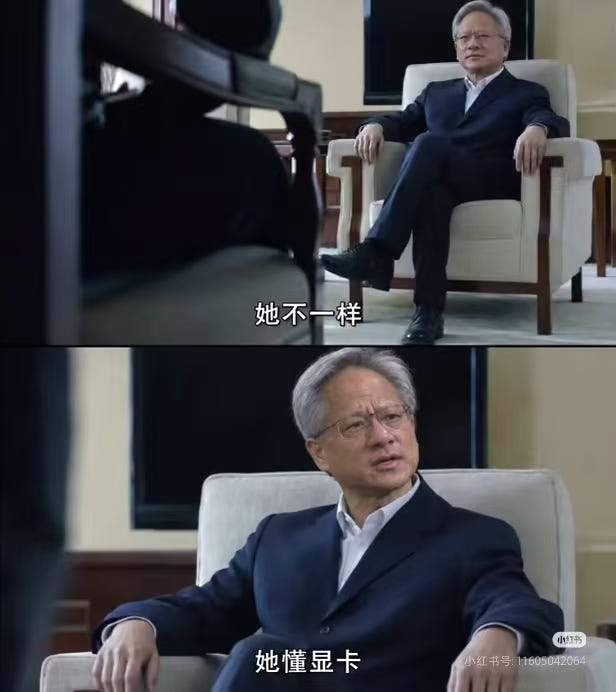
But to say she is a spy recruited by the Chinese state to secure chip supply, and to steer Nvidia into pushing for its top-tier chips to be sold to China, doesn’t actually hold up. The government’s perspective and the companies’ perspective are two different sets of interests.
From the companies’ perspective, training large models requires compute, and that means Nvidia’s GPUs. The H200 isn’t Nvidia’s latest processor, but China’s domestic chips still can’t match it. And the buyers the U.S. has approved are precisely internet giants like Alibaba, Tencent and ByteDance.
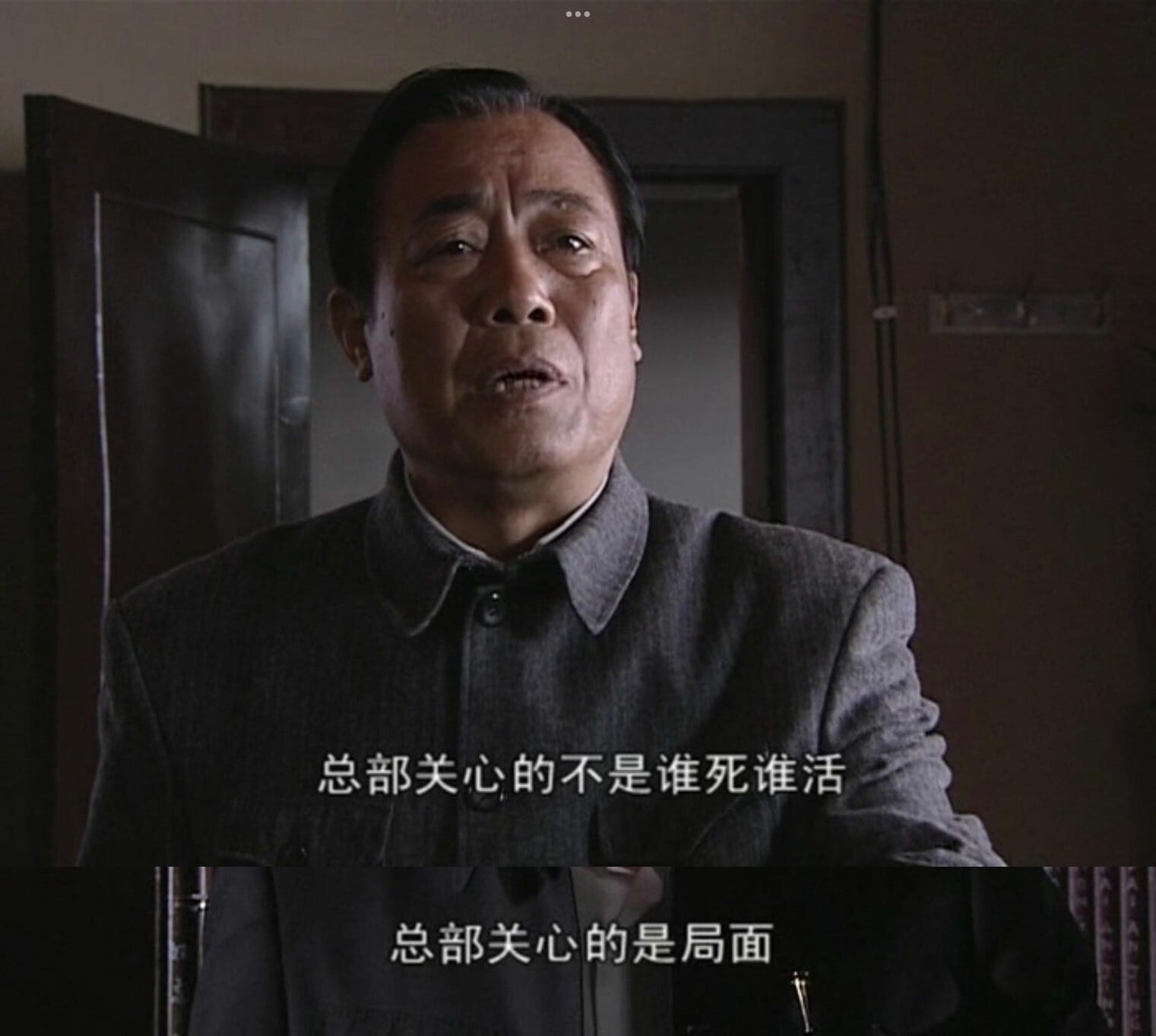
From the Chinese government’s perspective, though, the core goal is to cultivate domestic chips and reduce dependence on American ones, especially with the U.S. tightening chip exports to China. In the words of my favorite Chinese spy drama, Lurk (《潜伏》): “Headquarters doesn’t care who lives or dies. Headquarters cares about the big picture.”
For the government, Nvidia may be far, far ahead of domestic chips, but it is also their competitor. The Information reported in July that Chinese officials told Alibaba, ByteDance, DeepSeek and others they could be approved to buy a small number of H200s for training, possibly fewer than 200,000 in total, while inference should prioritize domestic processors. To that end, China is actually restricting Nvidia’s chips from entering the country. Yes, restricting, not securing. Reuters reported on November 5 that around 600,000 advanced Nvidia AI chips are piled up in Hong Kong, waiting to be shipped into the mainland. On the American side, the Trump administration allowed H200 sales to approved Chinese customers last December. It is Beijing that is limiting imports, out of a desire to reduce dependence.
So why would a government that has ample supply available, but doesn’t want to import it, send a spy to secure chip supply? It just doesn’t add up. Of course, some will argue that Alice Huang’s mission was to secure the latest chips, which is what the NYT reported:
The businessperson, Alice Huang, was recruited to collect intelligence on Jensen Huang, Nvidia’s CEO, as part of a drive by Beijing’s top spy agency to learn more about U.S. AI chips and potentially influence the company to push for its most advanced chips to be made available to China, the people said.
But then the next question arises. If Beijing is already worried about dependence on a chip like the H200, why would it go out of its way to secure a more advanced chip that would deepen that dependence even further? On this issue, the interests of the government and the companies are in tension.
This is why I think the story itself has neither head nor tail. The intelligence agencies watched her for two years, yet they have released no evidence that Alice Huang is a spy, and they can’t say what she actually did.
If you look at this through the lens of who benefits, the biggest winners are the hawks pushing for a chip embargo on China.
The U.S. is currently advancing three bills:
The AI Overwatch Act would give Congress oversight authority over advanced chip exports, to block White House decisions to loosen AI chip export licensing to China.
The Chip Security Act require companies to track where their chips go and build mechanisms such as location verification into controlled advanced chips, to combat smuggling and illegal transshipment.
The MATCH Act, which pressures U.S. allies to impose more export restrictions on chipmaking equipment to China.
Jensen Huang is the loudest voice in Washington against the chip bans. Prove that he is tied to a spy from China, and you can morally discredit everyone who opposes the export bans, and recast lobbying as a national security problem.
As 陸行之 Andrew Lu on Semi/Techs an analyst on Substack has noted, the timing of the reporting matters. On November 8, The NYT published an investigation saying that registered addresses of companies approved to buy the chips turned out to be empty “ghost offices.” The aim was to pressure the Trump administration and the Commerce Department to fully revoke or freeze the H200 export licenses for China.
And as for whether accusations surrounding Alice Huang’s identity are real, it’s really what you want to believe.
At the end of my article, I feel obligated to share the best of AI-generated clips:
https://www.bilibili.com/video/BV1ziWP6qEPU/?spm_id_from=333.337.search-card.all.click&vd_source=9a3fa150faf5cb1b8ef6b854a7d8ed76
I also recommend reading my friend, Robert Wu’s brilliant piece on the issue

This is a good case for her not being a government spy, and I tend to agree. However, if we are placing bets, my money would be on the corporate white glove hypothesis. It’s plausible to me that Alice Huang was an industry fixer US intelligence couldn't concretely tie to Beijing so they leaked enough information for public opinion to make the (false) connection.
Thanks for the article. We’ve reached the same conclusion. I’ve posted a similar article that breaks down the two main allegations:
1. Nvidia chips systematically routed to China, bypassing US export controls
2. Alice Huang was a Chinese spy
https://timothygoh.substack.com/p/the-nvidia-smoking-gun-control-and?r=1f61ax&utm_medium=ios