

The Xi-Trump meeting has just concluded. Below are some of my excerpts from the Chinese official readout.
A new vision on China-US relations:
It is worth noting that China has put forward (with both President Xi and Trump agreeing) a new vision for U.S.-China relations, namely “constructive strategic stability.” My quick thought is that there might be two considerations behind.
First, the very language of “strategic stability” carries an implicit suggestion that U.S.-China relations should be managed on the basis of a “two equal major powers” model, rather than within a hierarchical order dominated by Washington. In a certain sense, this also reflects China’s growing confidence in dealing with the United States.
Second, the term “strategic stability” is more familiar to the American strategic community and therefore easier for them to accept. However, the deliberate addition of “constructive” signals that this is not meant to be a passive form of stability in which the two sides merely probe each other’s red lines. Rather, it implies that Beijing wants to cooperate where possible and that the two sides should actively cooperate rather than settle for passive crisis management.
Xi also gave his definition, basically four “stabilities. “
应该是合作为主的积极稳定,应该是竞争有度的良性稳定,应该是分歧可控的常态稳定,应该是和平可期的持久稳定
positive stability with cooperation as the mainstay, healthy stability with competition within proper limits, constant stability with manageable differences, and lasting stability with expectable peace.
Taiwan
The Taiwan question was placed at the very end of the Chinese side’s statement, while the opening of that section immediately emphasized Beijing’s framing of Taiwan as the “most important” issue in the relations.
The expression “The U.S. side must exercise extra caution in handling the Taiwan question.” This is the only passage in the entire readout carrying an admonitory tone. This tonal contrast is itself the message, it underscores just how central the Taiwan question remains on China’s agenda.
Others
One small detail worth noting is that Xiaomi’s auto super-factory has suspended visitor registrations from May 13 to 22. This may suggest an American business delegation will use the window to take a close look at one of China’s most advanced EV production lines.
On Monday, I gave an interview to a Spanish television channel, my first time on a TV program. While preparing, I kept asking myself what Trump’s visit to China could deliver. I went through the usual checklist of soybeans, Boeing orders, and the rest of it, and eventually gave up trying to find the headline. I’d prefer focusing on the less photogenic stuff that matters more than the leaders’ handshake. The dialogue mechanisms, the working-level channels, and the unglamorous plumbing of the relationship are the things that actually hold weight. By the time the interview ended, I felt a bit of relief. I know it sounds diplomatic. But still, even if no short-term consensus emerges, as long as the two sides can still talk, even if they’re arguing, it beats mutual silence, where each side’s imagination of the other quietly replaces reality.
In a sense, Jensen Huang's boarding the plane at the last minute is also a positive signal. It suggests that even in chips, arguably the most contested front in the US-China divide, there is still an appetite to test whether this visit can establish a baseline. My friend afra recently wrote about her visits to Chinese AI labs, and she noticed that the competition narrative tends to cover the deep human network between the two AI worlds. They are bound together by the people doing the work.
Other than that, the formation of CEOs also tells some stories, Boeing and Cargill represent the areas where deals are most likely to break through—commercial aircraft orders and agricultural procurement have long been the easiest “deliverables” in high-level U.S.-China interactions, the kind of “meeting gifts” both sides are happy to cash in.
Elon Musk (Tesla) and Tim Cook (Apple), on the other hand, lead the two companies that form the tightest links in the bilateral supply chain.
GE Aerospace sits in the delicate position of being “both a competitor and a dependent.” BlackRock, Blackstone, Goldman Sachs, Mastercard, and Visa represent the market-access agenda in financial services—arguably the most flexible space for bilateral cooperation.
Illumina was once placed on China’s “Unreliable Entity List” and later removed; this in-and-out itself speaks to the high sensitivity of the biotech sector. And Chinese cross-border e-commerce players such as Temu and SHEIN are among Meta’s largest advertising clients—a reminder that even in seemingly walled-off domains, U.S.-China commercial interests remain deeply intertwined.
Another question hanging over the trip is whether Marco Rubio, previously sanctioned by Beijing, will actually make it to China. My read is that the purpose of Chinese sanctions has always been to compel a change in behavior, not to sever channels of communication. Since taking office, Rubio’s public posture on China has become more measured, and ahead of the visit, he signaled goodwill on the Taiwan question. By allowing him to participate, Beijing is sending its own signal that it isn’t refusing dialogue and is willing to manage differences. At the level of head-of-state diplomacy, having Rubio in the room directly reduces layers of communication and gives American policymakers a closer look at China than they would otherwise get.
I’ve also seen the argument that Washington can use this period of de-escalation to build out its own rare earth supply chain and consolidate its lead in AI. Fair enough, but the same logic cuts the other way. China can also use this window to patch vulnerabilities exposed by last year’s escalation. I don’t need to overstate China’s capacity for long-term planning. But on the current trajectory, compared with where things stood when tensions first spiked last year, China has more advantages than it did then.
I’ve been reading the memoirs of Zhang Guobao, the former vice chair of China’s NDRC. He describes how China’s strategic petroleum reserve was first planned back in 1996 and broke ground in 2002. It is precisely because of that kind of patient preparation that, amid the latest Strait of Hormuz crisis, China’s energy reserves look comparatively steady. The US side, by contrast, is chasing short-term results. chose to strike Iran rather than invest political capital into the harder, slower work like building the US industry.
Below is the translation of the Chinese official readout:
President Xi Jinping Holds Talks with U.S. President Donald J. Trump
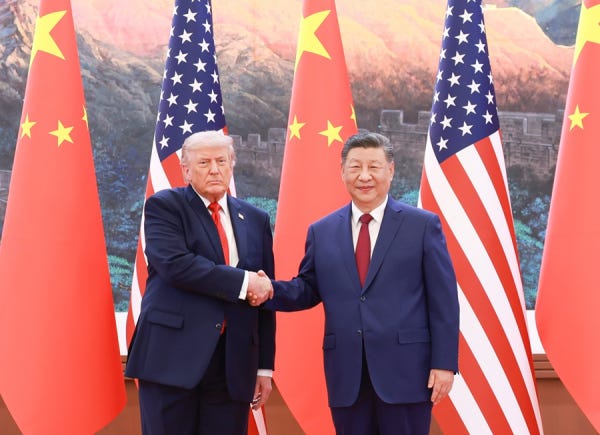
On the morning of May 14, President Xi Jinping held talks with U.S. President Donald J. Trump, who is on a state visit to China, at the Great Hall of the People in Beijing.
5月14日上午,国家主席习近平在北京人民大会堂同来华进行国事访问的美国总统特朗普举行会谈。
President Xi noted that transformation not seen in a century is accelerating across the globe, and the international situation is fluid and turbulent. Can China and the United States overcome the Thucydides Trap and create a new paradigm of major-country relations? Can we meet global challenges together and provide greater stability for the world? Can we build a bright future together for our bilateral relations in the interest of the well-being of the two peoples and the future of humanity? These are the questions vital to history, to the world, and to the people. They are the questions of our times that the leaders of major countries need to answer together. I stand ready to work together with President Trump to set the course and steer the giant ship of China-U.S. relations, so as to make 2026 a historic, landmark year that opens up a new chapter in China-U.S. relations.
习近平指出,当前百年变局加速演进,国际形势变乱交织,中美两国能不能跨越“修昔底德陷阱”,开创大国关系新范式?能不能携手应对全球性挑战,为世界注入更多稳定性?能不能着眼两国人民福祉和人类前途命运,共同开创两国关系美好未来?这些是历史之问、世界之问、人民之问,也是大国领导人需要共同书写的时代答卷。我愿同特朗普总统共同为中美关系这艘大船领好航、掌好舵,让2026年成为中美关系继往开来的历史性、标志性年份。
President Xi stressed that China is committed to a steady, sound and sustainable development of China-U.S. relations. I have agreed with President Trump on a new vision of building a constructive China-U.S. relationship of strategic stability. This will provide strategic guidance for China-U.S. relations over the next three years and beyond, and will be well received by the people of both countries and the international community. “Constructive strategic stability” means positive stability with cooperation as the mainstay, healthy stability with competition within proper limits, constant stability with manageable differences, and lasting stability with expectable peace. Building a constructive China-U.S. relationship of strategic stability is not a slogan. It means actions in the same direction.
习近平强调,中方致力于中美关系稳定、健康、可持续发展。我同特朗普总统赞同将构建“中美建设性战略稳定关系”作为中美关系新定位,将为未来3年乃至更长时间的中美关系提供战略指引,相信会受到两国人民和国际社会的欢迎。“建设性战略稳定”应该是合作为主的积极稳定,应该是竞争有度的良性稳定,应该是分歧可控的常态稳定,应该是和平可期的持久稳定。“中美建设性战略稳定关系”不是一句口号,而应该是相向而行的行动。
President Xi noted that China-U.S. economic and trade ties are mutually beneficial and win-win in nature. Where disagreements and frictions exist, equal-footed consultation is the only right choice. Yesterday, our economic and trade teams produced generally balanced and positive outcomes. This is good news for the people of the two countries and the world. The two sides should jointly sustain the good momentum that we have worked hard to create. China will only open its door wider. U.S. businesses are deeply involved in China’s reform and opening up. China welcomes more mutually beneficial cooperation from the U.S.
习近平指出,中美经贸关系的本质是互利共赢,面对分歧和摩擦,平等协商是唯一正确选择。昨天两国经贸团队达成了总体平衡积极的成果,这对两国老百姓和世界都是好消息。双方应一道维护好当前来之不易的良好势头。中国开放的大门只会越开越大,美国企业正在深度参与中国改革开放,中方欢迎美国对华加强互利合作。
President Xi pointed out that the two sides should implement the important common understandings we have reached, and make better use of communication channels in the political and diplomaticand military-to-military fields. The two countries should expand exchanges and cooperation in areas such as the economy and trade, health, agriculture, tourism, people-to-people ties and law enforcement.
习近平指出,双方要落实我们达成的重要共识,进一步用好政治外交、两军沟通渠道。拓展经贸、卫生、农业、旅游、人文、执法等领域交流合作。
President Xi stressed that the Taiwan question is the most important issue in China-U.S. relations. If it is handled properly, the bilateral relationship will enjoy overall stability. Otherwise, the two countries will have clashes and even conflicts, putting the entire relationship in great jeopardy. “Taiwan independence” and cross-Strait peace are as irreconcilable as fire and water. Safeguarding peace and stability across the Taiwan Strait is the biggest common denominator between China and the U.S. The U.S. side must exercise extra caution in handling the Taiwan question.
习近平强调,台湾问题是中美关系中最重要的问题。处理好了,两国关系就能保持总体稳定。处理不好,两国就会碰撞甚至冲突,将整个中美关系推向十分危险的境地。“台独”与台海和平水火不容,维护台海和平稳定是中美双方最大公约数,美方务必慎之又慎处理台湾问题。
President Trump said that it was a great honor to pay a state visit to China. The United States and China have a very good relationship. President Xi and I have had the longest and greatest relationship the presidents of the two countries have ever had. We have enjoyed friendly communication and worked out many important issues. President Xi is a great leader, and China is a great country. I have tremendous respect for President Xi and the Chinese people. Our meeting today is the biggest summit the world is watching. I will work together with President Xi to strengthen communication and cooperation, properly handle differences, make bilateral relations better than ever before and embrace a fantastic future. The United States and China are the most important and most powerful countries in the world. Together, we can do a lot of big and good things for the two countries and the world. I have brought with me the best representatives of American businesses. They all respect and value China. I strongly encourage them to expand their dialogue and cooperation with China.
特朗普表示,非常荣幸对中国进行国事访问。美中关系很好,我同习近平主席建立了历史上美中元首之间最长久和最良好的关系,保持着友好沟通,解决了很多重要问题。习近平主席是伟大的领导人,中国是伟大的国家,我十分尊重习近平主席和中国人民。今天的会晤是一次举世瞩目的重要会晤。我愿同习主席一道,加强沟通合作,妥善解决分歧,开启有史以来最好的美中关系,开创两国更加美好的未来。美中是世界上最重要、最强大的国家,美中合作可以为两国、为世界做很多大事、好事。我此访带来了美国工商界杰出代表,他们都很尊重和重视中国,我积极鼓励他们拓展对华合作。
The two presidents exchanged views on major international and regional issues, such as the Middle East situation, the Ukraine crisis, and the Korean Peninsula.
两国元首就中东局势、乌克兰危机、朝鲜半岛等重大国际和地区问题交换了意见。
The two presidents agreed to support each other in hosting a successful APEC Economic Leaders’ Meeting and G20 Summit this year.
两国元首一致同意相互支持,办好今年亚太经合组织领导人非正式会议和二十国集团峰会。
During the meeting, President Trump asked each of the business leaders who were traveling with him to present themselves to President Xi.
Prior to the talks, President Xi held a welcome ceremony for President Trump on the square outside the eastern entrance of the Great Hall of the People.
As President Trump arrived, honor guards lined up in salutation. After the two presidents stepped onto the reviewing stand, the military band played the national anthems of China and the United States. A 21-gun salute was performed on the Tian’anmen Square. President Trump reviewed the guard of honor of the People’s Liberation Army and watched the march-past in President Xi’s company.
Cai Qi, Wang Yi, and He Lifeng attended the talks.
会谈期间,特朗普逐一向习近平介绍随访企业家。
会谈前,习近平在人民大会堂东门外广场为特朗普举行欢迎仪式。
特朗普抵达时,礼兵列队致敬。两国元首登上检阅台,军乐团奏中美两国国歌,天安门广场鸣放礼炮21响。特朗普在习近平陪同下检阅中国人民解放军仪仗队,并观看分列式。
蔡奇、王毅、何立峰参加会谈。
Thanks Fred, for this nice summary of the Chinese readout from today's summit. If I may add, the framing of "constructive strategic stability" needs also to be understood as a response to the questions posed at the outset, and particularly the question of escaping the Thucydides Trap. This counterposition is central to understanding the significance of the agreement on the notion of "constructive strategic stability" because the TT concept is premised on an ontology of inter-state relations that stands in stark contrast to the ontology underpinning the four proposals - development, security, civilisation and governance. What has been advanced - even if in words alone for now - is the idea of inter-state relations that operates on a more Chinese-defined ontological foundation, in which interests are permanently intertwined. This conceptualisation transcends the dualism of the Thucydides Trap. Let's see how this plays out in practice.
Great backgrounder! Many thanks.