

Chinese maritime domain awareness provider Mingkun Technology has released monitoring pictures showing that US military forces are rapidly deploying to Europe and the Middle East following the surprise assault on Venezuela. According to Reuters, President Trump stated on January 2 that if Iran shoots and violently kills peaceful protesters, the United States of America will come to their rescue.
Mingkun’s data shows that between January 1 and 6, at least 17 C-17A Globemaster III strategic transport aircraft flew from the continental US to European military bases, including Ramstein, Brize Norton, Sigonella, and Rota.
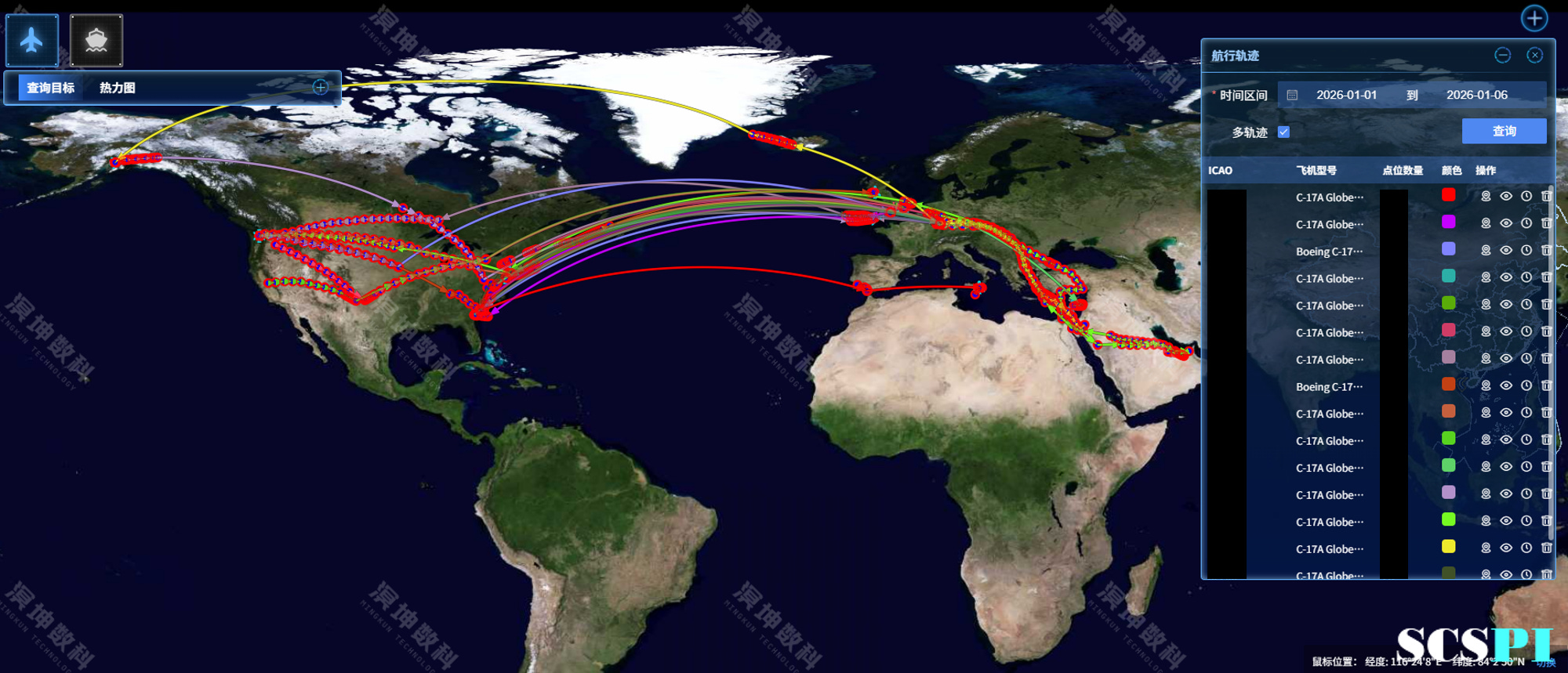
During the same period, at least 10 transport aircraft were redeployed from these bases to Al Udeid Air Base in Qatar—a forward hub for US military strategy against Iran.
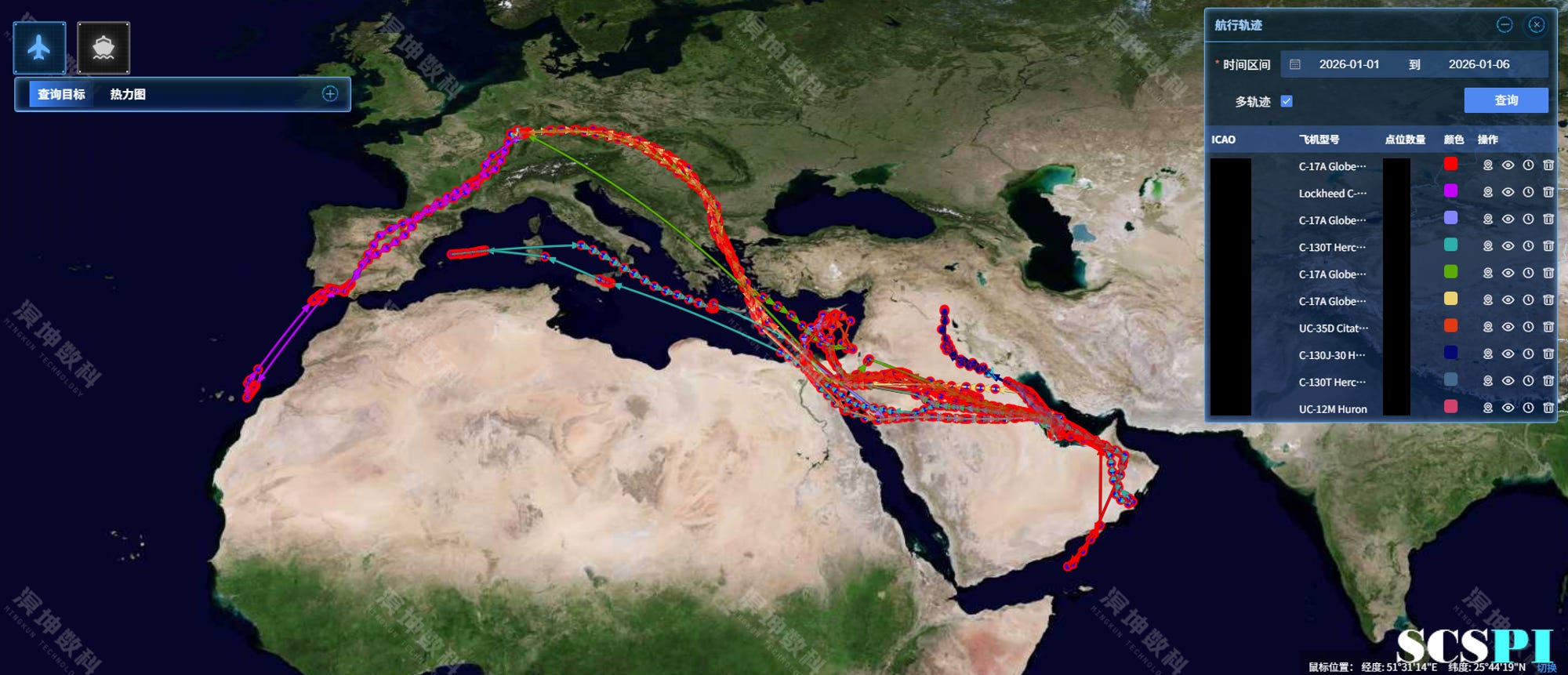
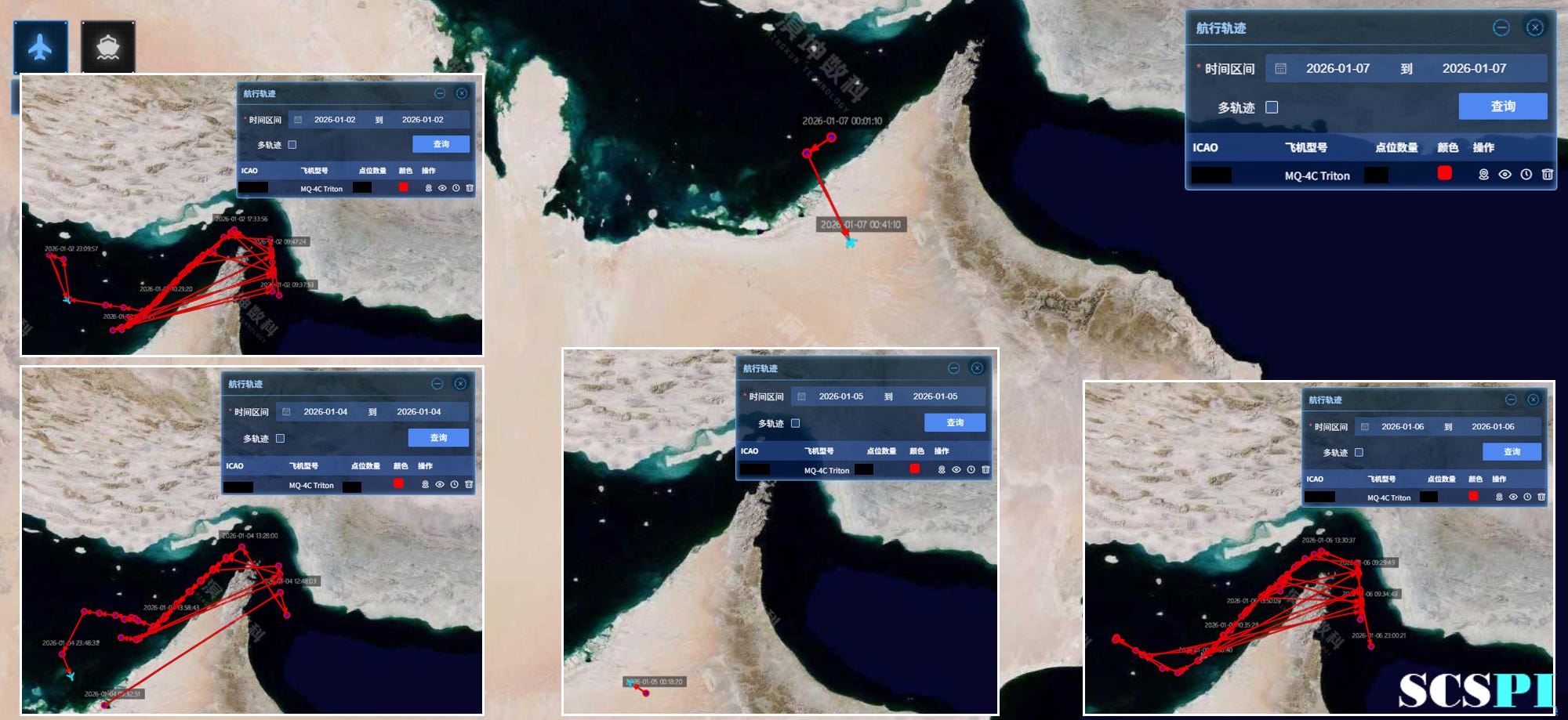
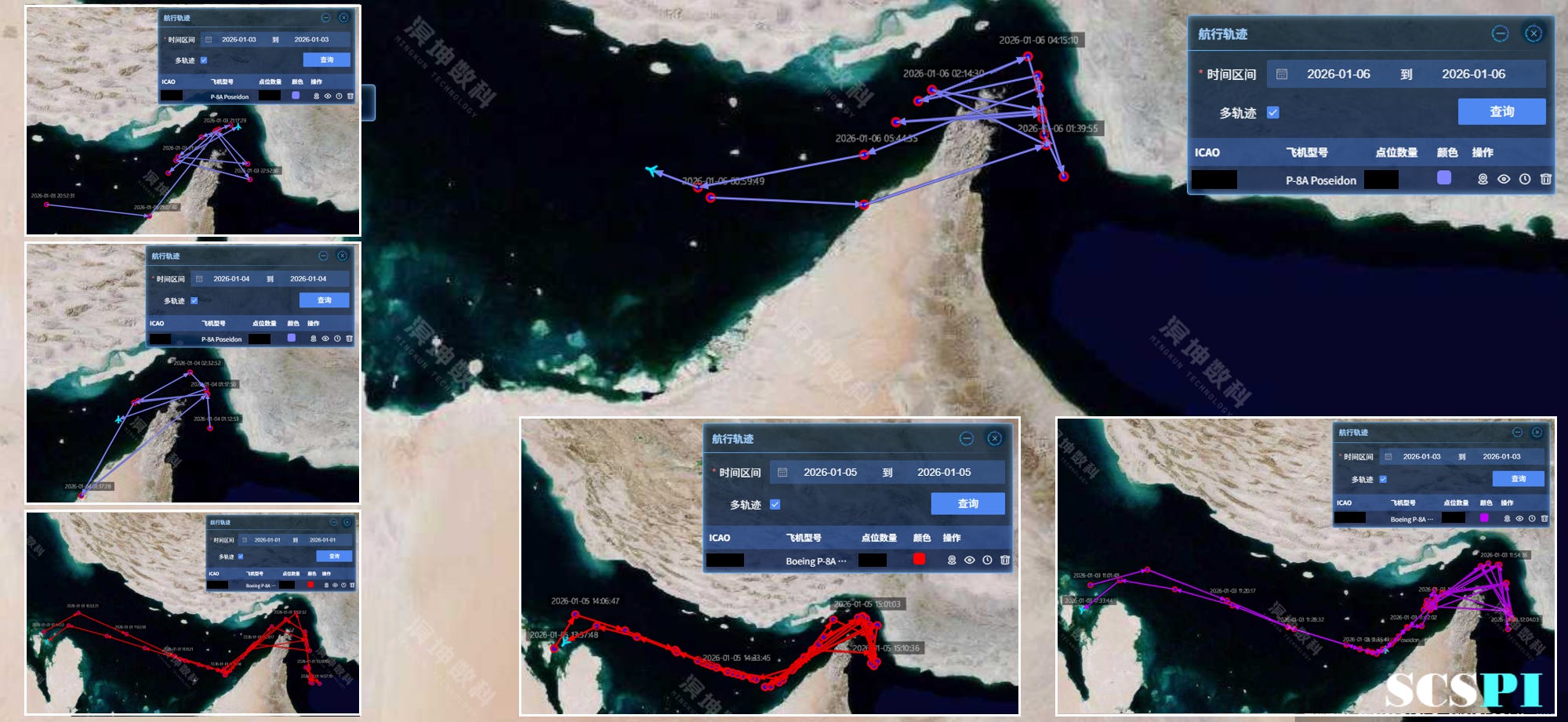
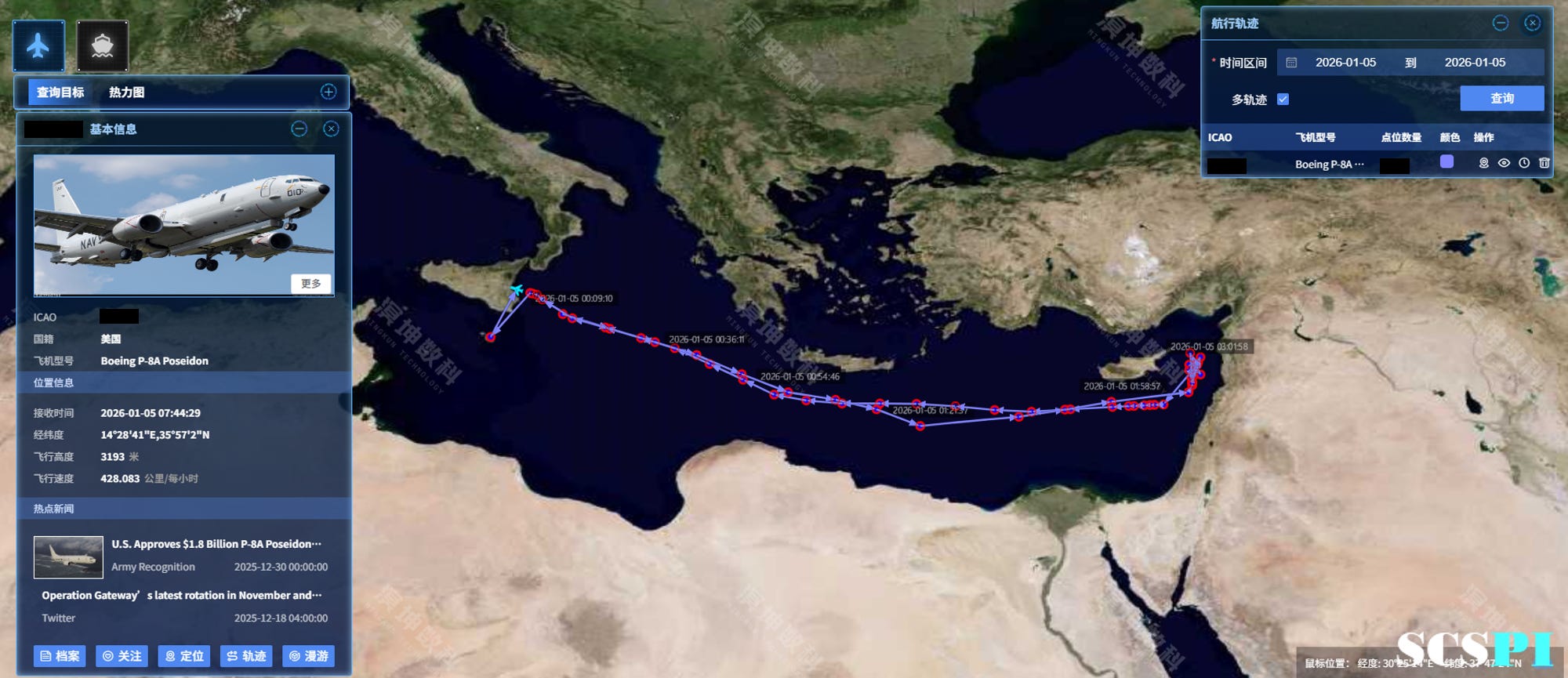
The company also detected a notable uptick in US reconnaissance activity around Iranian waters. From January 1 to 7, the US military dispatched at least 5 MQ-4C drone sorties for close-range reconnaissance near the Strait of Hormuz, along with 7 P-8A anti-submarine patrol aircraft sorties. Six of these departed from Al Udeid, flying along the southern Persian Gulf and the Strait of Hormuz to conduct surveillance of Iran; one sortie took off from Sigonella in Italy, heading toward waters off Syria and Lebanon.
The company’s Chief Scientist, Hu Bo胡波, also the Director of SCSPI, told me that current US military movements remain limited in scale, and large-scale military action against Iran is not imminent. He noted that naval forces responsible for regional air defense have not yet assembled, and that previous operations—Operation Midnight Hammer against Iranian nuclear facilities and Operation Absolute Resolve against Venezuela—both required three to five months of preparation despite their rapid execution.
“The US and Israel are capable of launching a sudden strike, but the problem is they can’t control Iran’s retaliation,” Hu said. “It’s not that the US lacks the capability to act—it’s that they have to think about what comes next.”
Hu believes Iran’s domestic situation is a key variable. In his view, Trump is adept at “picking low-hanging fruit,” preferring to seize opportunities when internal turmoil emerges in Iran—but only when he can ensure absolute advantage. If Iran remains internally stable, the US will struggle to find an opening in the near term.
As for what form future action might take, Hu suggested that if the US wants to proceed cautiously, it would more likely impose an air and naval blockade to pressure Iran into an internal crisis, rather than launching a direct, large-scale strike.
Posture changes like increased transport and tanker flights are signals of options and flexibility, not inevitability.
Militaries forward-position logistics to expand choices, not because they’ve already decided to act.
Analyzing patterns of deployment teaches more than reading them as forecasts of war.
All their hopes rest on internal regime change. The Patriot missile systems are woefully behind on refilling and new jet drones debuted by the IRGC can now strike defense systems at a rapid pace.