On the Xi-Trump Talks
What I think deserves attention is the agreement to “formulate an action plan for the constructive strategic stability relationship.” This signals that the talks are moving from statements of principle toward implementation. An action plan needs a clear division of labor and a timetable, which gives it more practical significance than simply restating a consensus. Trump also reaffirmed that the US does not support “Taiwan independence,” and that hasn’t changed.
This direction is a blow to the hawks who push for continued pressure on China. Stabilizing the relationship requires the US side to reduce unilateral policy moves and communicate with China. That is hard to reconcile with the confrontational pressure strategy some have advocated recently. As for who will lead the drafting and how the plan will take shape, we will have to wait and see.
One protocol detail from this meeting is worth noting. Xi’s decision to greet Trump at the airport follows the reciprocity in China–US diplomacy. When Xi visited the US in September, Trump met him at the airport himself. Now that Trump is in China, Xi has returned the courtesy.
On Trilateral Meeting
In the statement, “The three countries plan to increase the production and supply of refined petroleum products for the benefit of all nations. They reaffirmed the importance of stable energy flows.” For the US, it helps bring down inflation; for Russia, it boosts oil export revenues; and for China, as a major manufacturing country, stable oil prices mean more predictable manufacturing costs.
On the nuclear issue, I think China has a relatively small nuclear arsenal and doesn’t want to be pulled into a disarmament framework built around the US and Russia. During the Cold War, the two superpowers piled up arsenals far beyond what their defense actually required. While China follows a self-defense nuclear strategy and has pledged not to use nuclear weapons first, its arsenal is nowhere near their size. The three countries’ forces differ in scale and strategic role. But the three countries agreed to start dialogue on issues regarding reducing risks and preventing nuclear proliferation; it’s a real progress.
As for the term “a new Yalta,” I don’t think the Chinese like that concept. The Yalta Conference brought the US, Britain, and the Soviet Union together near the end of WWII and set the basic contours of the postwar order. For Beijing, a handful of major powers sitting down to decide the affairs of other countries and regions cuts against its long-standing foreign policy approach.
In practical terms, China is also reluctant to get involved in the specific affairs of other regions, which sets it apart from some other countries. Beijing has consistently held that internal factors drive developments. However powerful external influences may be, they only take effect through internal conditions. A region’s affairs should be decided by its own people and stakeholders, not by major powers negotiating among themselves and settling things on behalf of smaller countries.
I think the most important thing about this meeting is simply that the three sides have finally sat down to talk. All three want to keep new “powder kegs” from forming and to make sure their conflicts don’t endanger world peace. China in particular has benefited from economic globalization under relatively stable conditions, and it wants geopolitical stability, not to disrupt world supply chains.
Face-to-face talks let the three leaders explain how they read regional developments and why they reached their assessments. That beats relying on third-party accounts or guessing at one another’s intentions. Even when they disagree with each other’s reasoning, understanding the other two’s strategic thinking has value in itself. It helps reduce strategic miscalculation. Among major powers, the biggest danger is misreading one another’s intentions.
If the ultimate goal is peace and cooperation on transnational challenges like climate change, AI, and terrorism is part of it, then the starting point has to be relatively stable relations among these three powers. The trilateral meeting in Shenzhen lays the groundwork for exactly that.
I think Beijing is willing to facilitate communication between the US and Iran, just ending the conflict ultimately depends on the two sides themselves. As a major manufacturing country and one of the biggest buyers of Persian Gulf energy, China sees neither the Middle East conflict nor the high oil prices the conflict brings as serving its interests.
Below are the official readouts of the bilateral meeting between Xi and Trump, and the trilateral meeting; I translated them with the help of AI.
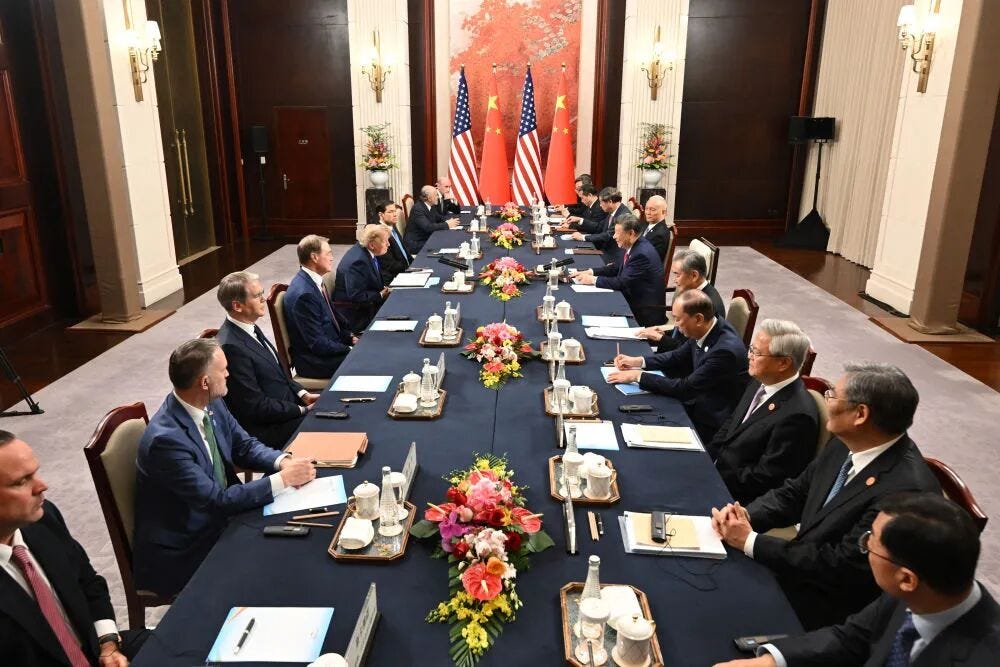
Xi Jinping Meets with U.S. President Donald Trump
On the afternoon of November 19, 2026, Chinese President Xi Jinping met in Shenzhen with U.S. President Donald J. Trump, who is in China for the APEC Economic Leaders’ Meeting.
President Xi pointed out that in the past few months, from Beijing to Washington, President Trump and I have jointly explored the right way for China and the United States, two major countries, to get along with each other. The two sides agreed on the new vision to build a constructive China-U.S. relationship of strategic stability, and then added new substance to it by placing the relationship on the basis of respect, fairness and reciprocity. This is recognized by the Chinese and American peoples, and well received by the international community. The overall stability and positive momentum of China-U.S. relations has brought tangible benefits to the people of our two countries, and injected stability and certainty into the world. I look forward to working with President Trump to continue taking the helm of China-U.S. relations, and ensure that this giant ship always stays on the right course and forge ahead at full sail.
President Xi stressed that building a constructive China-U.S. relationship of strategic stability is an unprecedented, groundbreaking endeavor. We need to keep at it with an enterprising spirit, hard and solid efforts, and the ability to get things done. The guiding role of head-of-state diplomacy is irreplaceable. To sustain the current momentum of stable and positive growth in the relationship, the key lies in taking actions to deliver on the consensus between the two presidents. Communication between our teams should also keep pace. It is important to make a longer list of cooperation and a shorter list of problems. Differences that cannot be resolved for the time being should be managed in a constructive way, and escalation should be prevented. On the question of Taiwan, the U.S. side should keep doing the right thing and avoid major setbacks in China-U.S. relations. In the economic and trade field, the two sides should enhance communication to address each other’s concerns and strive for mutually beneficial results. Cooperation has been quite productive between the two countries in such fields as counternarcotics, repatriation of illegal immigrants, and fighting telecom and cyber fraud. Such cooperation may be further strengthened on the basis of respect, fairness and reciprocity. China and the United States should strengthen communication and coordination, prevent the security risks of AI, and ensure that AI is always under human control.
President Trump expressed his gratitude toward the Chinese side for the warm hospitality, and said that since the establishment of diplomatic ties more than 40 years ago, significant progress has been made in bilateral relations. I have maintained close interactions with President Xi, our friendship has grown stronger, and we are charting the course for the bilateral relationship. Trade and investment between our two countries have been continuously strengthened, and cooperation in such areas as fentanyl has been productive. The two sides should keep up the momentum of steady growth of bilateral relations, enhance cooperation in farm products, energy, super intelligence and other fields, and handle each other’s concerns fairly. The United States does not support “Taiwan Independence.” Congratulations on hosting a successful APEC Economic Leaders’ Meeting. The United States is very strong. China is also very strong. Our two countries need to work together to lead and promote world peace and stability.
The two sides believed the meeting is positive and constructive, and agreed to formulate an action plan on building a constructive relationship of strategic stability, implement the consensus between the two presidents, and build a constructive China-U.S. relationship of strategic stability on the basis of respect, fairness and reciprocity.
The two presidents also discussed regional and international issues of mutual interest.
Cai Qi, Wang Yi, He Lifeng, Huang Kunming and others participated in the meeting.
Peace Declaration by the Leaders of China, Russia, and the United States
President Xi Jinping of the People’s Republic of China, President Vladimir Putin of the Russian Federation, and President Donald Trump of the United States of America met in Shenzhen on November 19, 2026. The Russian and US leaders thanked China for hosting this historic meeting. The three leaders exchanged in-depth views on the current international situation and committed themselves to maintaining strategic stability and international security.
China, Russia, and the United States, as permanent members of the United Nations Security Council, are committed to advancing UN reform so that the organization can respond more effectively to global challenges and fulfill its fundamental mission of maintaining international peace and security.
The three countries plan to increase the production and supply of refined petroleum products for the benefit of all nations. They reaffirmed the importance of stable energy flows.
The three leaders recognize the vital importance of the principle of state consent and respect for the immunities enjoyed by state officials. They agree that the International Criminal Court and other similar institutions must not abuse their jurisdiction.
The three leaders reaffirm that a nuclear war cannot be won and must never be fought. The three countries will engage in dialogue on reducing nuclear risks and preventing nuclear proliferation.
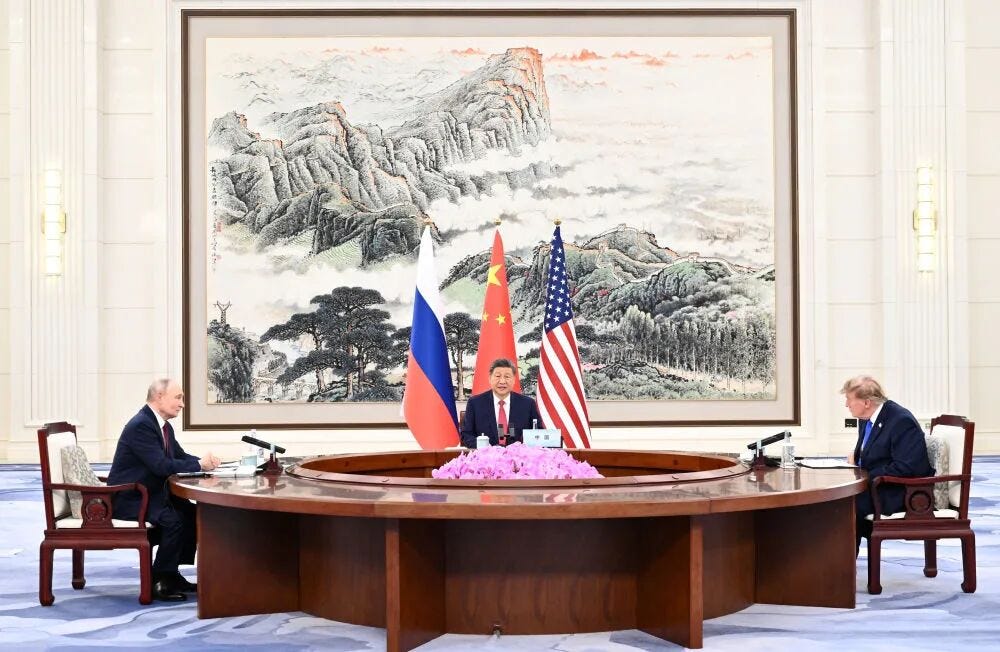
Detailed Report | Xi Jinping Presides Over China-Russia-U.S. Leaders’ Meeting
On the afternoon of November 19, President Xi Jinping met with Russian President Vladimir Putin and U.S. President Donald Trump in Shenzhen for a China-Russia-U.S. leaders’ meeting. The three heads of state held in-depth discussions on the theme of “Safeguarding World Peace and Promoting Strategic Stability in Relations Among Major Countries.”
Xi Jinping noted that this is the first time in history that the top leaders of China, Russia, and the United States have come together, a meeting of pioneering significance. History tells us that when major countries live in harmony, the world is at peace; when they fight, the world falls into chaos. Peace is the eternal aspiration of human society. Our planet has seen more than 10,000 wars, and more than 60 regional conflicts continue to drag on across the world today. Over 80 years ago, as the core force of the global anti-fascist cause, China, Russia, and the United States fought side by side and achieved great victory, winning peace and tranquility for the world. History is the best textbook. We must remember history, learn from it, and open up the future.
Xi stressed that humanity lives in one global village and forms a community with a shared future. In this global village, major countries bear special responsibilities. Positive interaction among major countries is not a multiple-choice question but a compulsory one. In recent years, China has advanced the new-era comprehensive strategic partnership of coordination between China and Russia and has actively worked to build a constructive China-U.S. strategic stability relationship, promoting a pattern of major-country relations characterized by peaceful coexistence, overall stability, and balanced development, which benefits both sides and the world. At present, the world is undergoing profound changes unseen in a century, and the world is far from peaceful. As major countries and permanent members of the UN Security Council, China, Russia, and the United States should set an example, cooperate to address global challenges, jointly uphold world peace and stability, and make greater contributions to human progress.
Xi pointed out that how major countries get along properly and jointly provide a foundation for world peace is a question of the times that must be answered. He put forward four views on this:
First, uphold mutual respect. Mutual respect is the basic norm of relations among major countries. China, Russia, and the United States have different national conditions, and they should respect one another, seek common ground while setting aside differences, and pursue common development. This includes respecting each other’s sovereignty and territorial integrity, respecting each other’s choice of social system and development path, and respecting each other’s core interests and major concerns. We must adhere to non-interference in other countries’ internal affairs and in each other’s domestic affairs. On major sensitive issues involving the other side, we should communicate in advance, put ourselves in each other’s shoes, act with prudence, and in particular must not cross each other’s bottom lines.
Second, uphold peaceful coexistence. The “Thucydides Trap” is by no means destiny; the key lies in how major powers choose. China, Russia, and the United States should be partners and friends, not engage in conflict or confrontation, and hold the bottom line of peaceful coexistence. All three are major victors of World War II and should firmly uphold the postwar international order, uphold the purposes of the UN Charter, and defend the hard-won victory of World War II. Nuclear war cannot be won and must never be fought; every effort must be made to prevent it.
Third, uphold win-win cooperation. China, Russia, and the United States have different development endowments and strong economic complementarity. They can leverage their respective strengths and exchange what they have with one another. They should strengthen economic and trade cooperation, jointly expand the pie of cooperation, and achieve mutual and win-win benefits, rather than pursue “decoupling and supply chain severance.” Global energy security faces severe challenges. The three countries can strengthen communication and coordination to jointly maintain the stable and smooth operation of energy industrial and supply chains and safeguard the security and stability of the global energy market.
Fourth, uphold dialogue and consultation. Differences among major countries are inevitable. Without communication, suspicion will spread, and small frictions can escalate into major conflicts. The three countries should maintain regular high-level exchanges, keep dialogue channels open at all levels, and establish crisis communication and prevention mechanisms to ensure that miscalculations are fewer, differences are kept under control, and friction does not escalate. The international community expects major countries to do more to promote mediation and dialogue on hot-button issues. China, Russia, and the United States should continue to push parties to conflicts to sit down and talk, resolving disputes through political and diplomatic means.
Putin said he thanks the Chinese side for arranging the first-ever Russia-China-U.S. leaders’ meeting in history. Russia, China, and the United States are major countries and permanent members of the UN Security Council. The fruits of victory in World War II bind us together. Upholding the purposes of the UN Charter and maintaining international peace are the shared responsibility of the three countries, and properly handling hot-button issues serves the common interests of all three. The three countries should adhere to the principles of sovereign equality and non-interference in internal affairs, and seek balanced solutions to each other’s concerns through cooperation. Russia is willing to work with China and the United States to respect one another, engage in equal dialogue, coexist peacefully, and manage differences appropriately, promote free and open international trade, safeguard energy and food security, strengthen international cooperation on AI governance, and jointly contribute to world peace and security.
Trump said the meeting of the leaders of the United States, China, and Russia has drawn global attention, is very important, and has made history. All three countries are nuclear-armed states and bear special and important responsibilities for maintaining world peace and stability. The three sides should jointly prevent nuclear proliferation and keep nuclear weapons from bringing disaster to humanity. Maintaining stability and achieving peace requires dialogue, and any issue should be resolved through dialogue. He looks forward to working with President Xi and President Putin to better protect our planet and make the future safer.
The three heads of state also exchanged views on major international and regional issues, including the Ukraine crisis, nuclear non-proliferation, the situation in the Middle East, and the Korean Peninsula.
In his concluding remarks, Xi said today’s China-Russia-U.S. leaders’ meeting was positive, constructive, and fruitful, and that the three countries share a consistent view on safeguarding world peace. All three remember the history of fighting side by side during World War II, and they stressed the need to cherish hard-won peace and for major countries to take the reasonable security concerns of all countries seriously. Dialogue and negotiation are the right choice for resolving differences; as long as dialogue does not stop and the door is not shut, there is hope for peace. Cooperation is the only way to meet challenges; it is necessary to strengthen cooperation on the basis of common interests, using cooperation to promote peace and seek win-win outcomes.
Xi emphasized that the seeds planted by today’s leaders’ meeting will surely take root, sprout, blossom, and bear fruit. The three countries should implement the consensus reached at the meeting, continue to strengthen communication, build consensus through dialogue, meet challenges with a sense of responsibility, promote peace through cooperation, and work together to build a better world.
After the meeting, the three countries issued the China-Russia-U.S. Leaders’ Peace Declaration.
Cai Qi and Wang Yi attended the meeting.