

This week I traveled to Zhejiang. After I got back, I wanted to write something. This piece is a set of observations and anecdotes from the trip.
Hangzhou
I have a small habit. Whenever I arrive somewhere new, I look at the advertisements in the local airport first. There are two reasons. First, airport advertising is usually the most profitable business in a given place, because airport passengers are a “high-premium crowd.” Advertisers will pay the most to reach them, so that wall is effectively a public ranking of local industry profits.
Second, the companies that hold airport ad rights for the long term are usually the regional leaders. Airport ad slots are non-standard resources. A company that keeps at it for years needs more than a decade of local operating experience.
In most places, airport ads are dominated by so-called “boomer” (老登) companies such as baijiu makers and local banks. In Hangzhou, however, from the moment I stepped off the plane and walked down the jet bridge, my view was almost entirely filled with Alibaba Cloud AI ads. On my right, just past the “Welcome to Hangzhou” sign, was an Alibaba Cloud display built to look like a computing data center, promoting its ultra-large-scale AI compute clusters. I couldn’t help sighing: Alibaba really is a homegrown Hangzhou company. The Huawei Cloud ads on my left, which pushed computing power and Agents, were also eye-catching, but next to Alibaba’s they fell a little short.
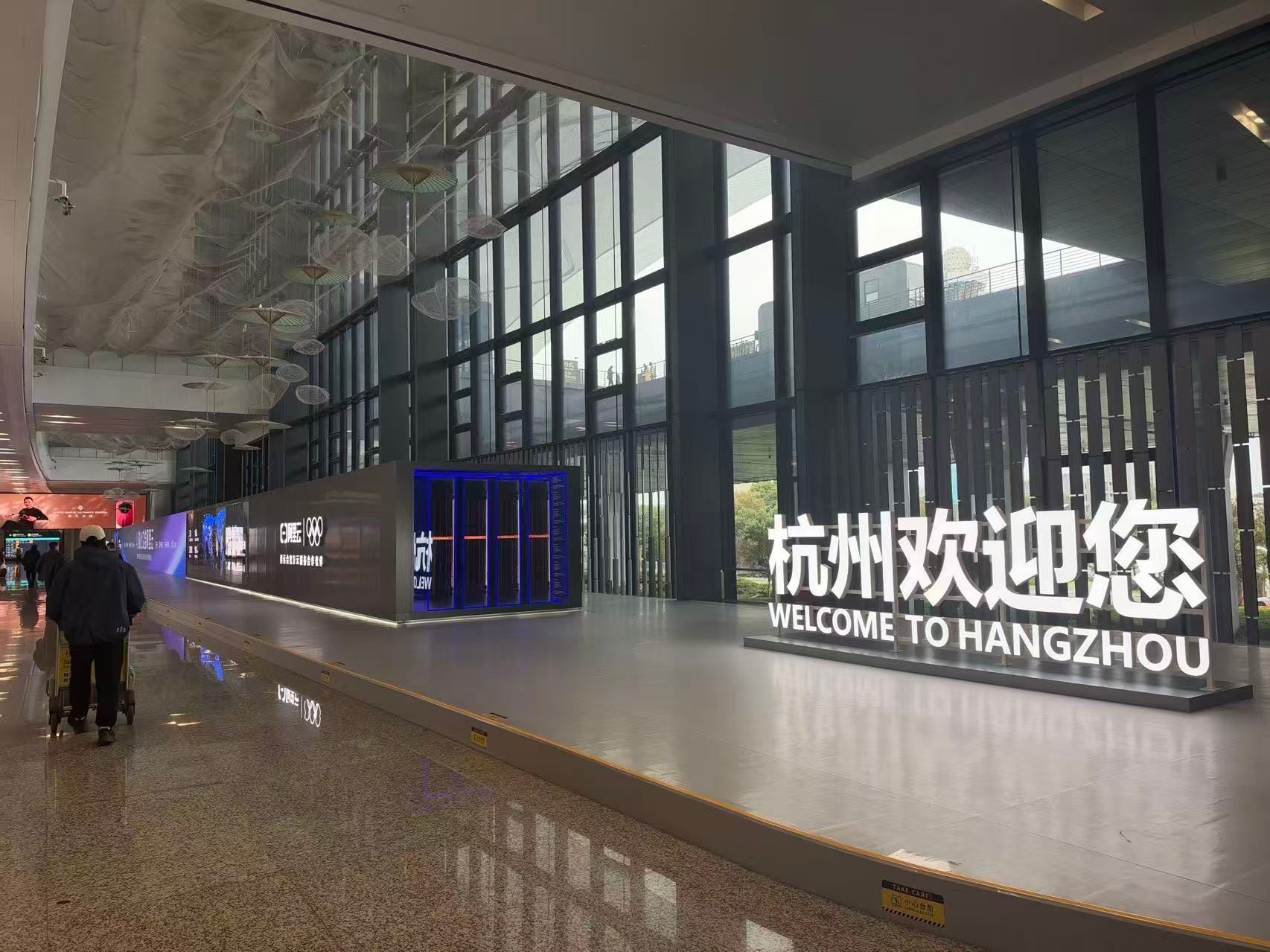

It was not until the baggage carousel that I saw a familiar baijiu ad. That placement read as a reminder to passersby that the brand still existed.
Further toward the exit was a telecom operator’s billboard. The picture was full of summer imagery, with a red lobster in the center labeled “OpenClaw.” Half a year ago it swept through the Chinese internet, and everyone was “raising lobsters.”养龙虾 Now almost nobody brings it up. The billboard was probably finalized at the peak of its popularity, and it was already out of date the moment it went up. Today everyone is talking about DeepSeek Harness. Who knows what will take the stage half a year from now.

Qiandao Lake
After a three-hour drive, I reached Qiandao Lake (the name literally means “lake of a thousand islands”). The area is now called Chun’an (淳安), and in older times it was called Hecheng (贺城). The old town has long been underwater. The trip was meant to be about ecology, but my inner “industrial party” instincts took over. Looking out at the vast expanse of water, I found my mind full of thoughts about state capacity and economic development. Most people who grew up in modern China rarely think about state capacity unless something goes wrong. (I would count myself as an exception.) Many of my friends are more inclined to criticize an oversized government and the many problems that come with it. What they say may not be without merit, but Qiandao Lake offers another perspective.
Qiandao Lake is an artificial lake created when the Xin'an River hydropower station (新安江水电站) dammed the river. The Xin'an rises in the mountains of southern Anhui. Its basin gets abundant rainfall, and the river winds through steep mountains. Near Tongguan Gorge (铜官峡), named after a "copper official" that the frist emperor in China is said to have appointed there more than two thousand years ago to oversee copper mining and coin minting, the riverbed suddenly narrows and the drop steepens. The upper valley is ringed by mountains, which naturally makes it suitable for water storage. It also sits close enough to the industrial heartland of the Yangtze River Delta.
As early as the Republican era, people had imagined building a hydropower station here, but the government of the time lacked basic administrative and mobilization capacity. Faced with a project of this scale, it could only look on helplessly. Not until 1952, just after the smoke of the civil war had cleared, did the new government quickly start surveying and preparing the project. The Yangtze Delta wanted to develop industry, but the local area produced no coal. To turn the wheel of industrialization, a stable power supply had to come first. It resembles the plot of Dawn of Lingao (临高启明): after the time travelers land on Lingao, one of the first things they do is build a simple dam on a local river to generate electricity. Of all industrial inputs, electricity is the one you cannot import and rely on.
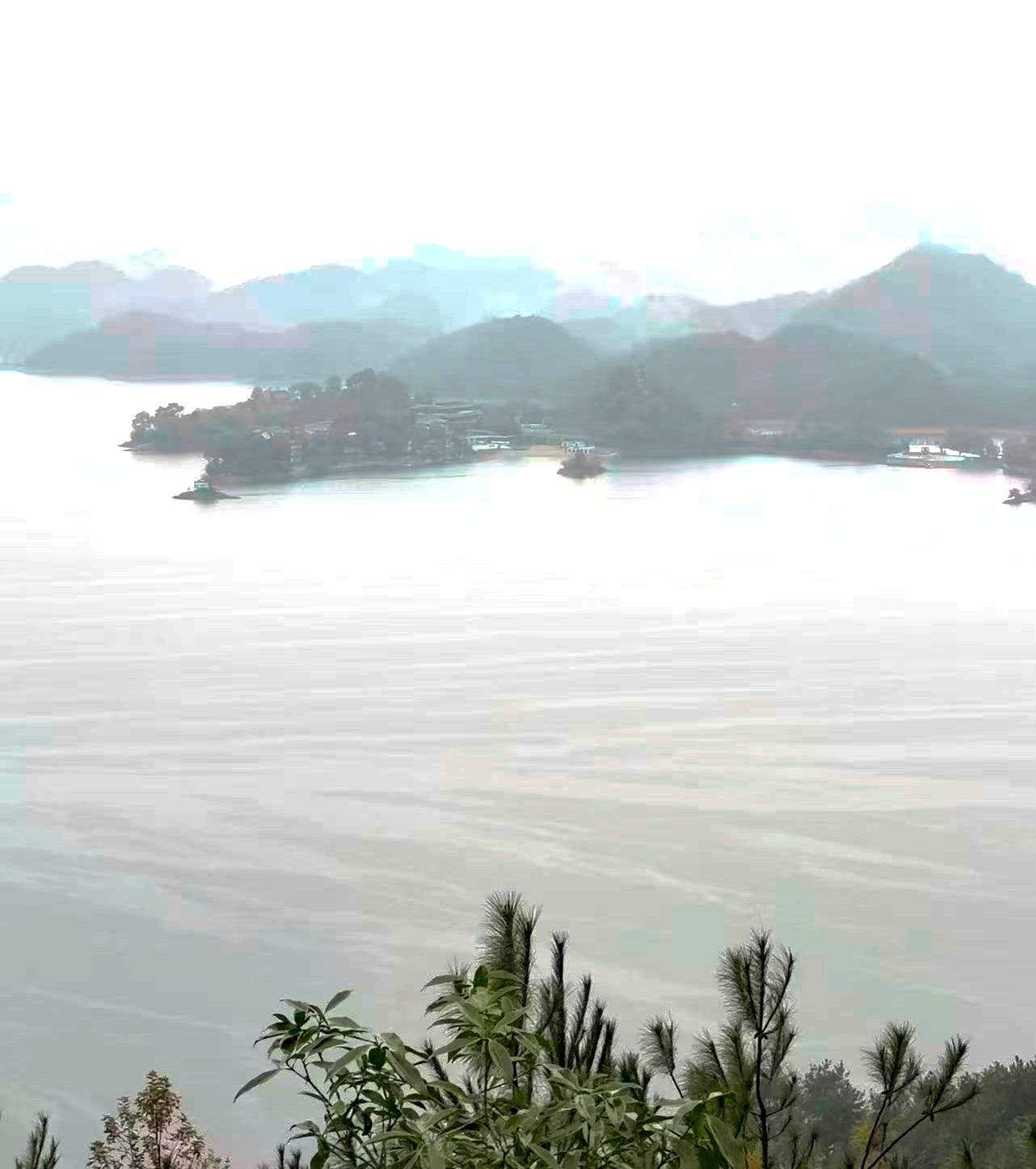
The tour guide kept talking about environment protection, but I couldn’t stop thinking about how China’s industrialization accumulated over time. China could never have started with the Three Gorges Dam. Before Xin’an, China had no experience designing, manufacturing its own equipment, and building a large hydropower station on its own. Many later Three Gorges projects drew on experience accumulated in places like this. You first have to build a somewhat smaller dam on a smaller river and work through the whole chain in practice: surveying, pouring concrete, manufacturing turbine units, and dispatching power across regions. Handling a string of unexpected problems under real geological and hydrological conditions cannot be learned from books or from the outside world. This kind of “build a smaller version first” experiment is part of the foundation of industry, and nothing can replace it.
Dinner&Finance
Local government officials came to receive us. The meal was home-style cooking, with no alcohol. They were very candid, and I learned more at the table than I had seen along the way.
In Chun’an淳安, the first topic was naturally Hai Rui (海瑞), a classic example of an incorruptible official in ancient China who once served as a local chief officer here, along with The Ming Dynasty in 1566 (大明王朝1566), a historical drama that Chinese audiences regard as a masterpiece. You could call it a heavier, historical version of Yes, Prime Minister. Its core thread is the fiscal crisis of the Ming Empire and how its bureaucracy ran.
Finance was also what the local cadres kept coming back to. The most immediate impression is that the local government takes environmental protection very seriously, and the fiscal cost of doing so is also very high. It has torn down many facilities that were nearly complete but never put into use, and every demolition and aftercare payment is real money. It has also shut down traditional industries and given up any future industrial growth that could pollute the water. As the conversation went on, the local demands were straightforward: either give us money, or raise our administrative rank.
To see why “raising the administrative rank” is mentioned in the same breath as “giving money,” you need to understand China’s administrative structure. Local government runs in layers from province to prefecture-level city to county. Unlike in many countries, a prefecture-level city like Hangzhou is more than a city. It is a large regional unit that covers both the urban core and the surrounding countryside and county towns, such as Chun’an. Within this system, administrative rank carries real weight. It shapes a locality’s bargaining power and its ability to secure land quotas, approvals, and resources from different departments. In most of the country, the system works on “city governs counties”市管县: the prefecture-level city manages its counties’ personnel and also controls their finances.
Zhejiang is an interesting exception. Its finances have long been run under a “province governs counties”省管财政 arrangement. Administratively, Chun’an falls under the provincial capital, Hangzhou. But financially, Chun’an skips Hangzhou and settles accounts directly with the provincial finance department.
The point of the arrangement is to keep the prefecture-level city from draining its counties. Manufacturing-heavy counties like Yiwu义乌 can run with fewer constraints, earn more, and keep more, which keeps the county economy lively. For a place like Chun’an, though, which has been designated an ecological function zone and has deliberately stopped pursuing industry, the arrangement creates a problem. It misses out on the benefit of “developing industry aggressively and keeping more of what you earn.” And since its finances are separate from Hangzhou’s, it can’t count on the transfers a wealthy provincial capital might provide. The province does offer ecological compensation, and Chun’an earns revenue from selling water to Hangzhou and Shanghai. Even so, with the heavy costs of large-scale environmental protection, the local government still has to find its own way forward.
As an outsider, I used to assume that with mountains and water like this, tourism alone would make the place rich. But for a local government that has to keep spending heavily to protect its environment over the long run, tourism revenue is not enough. Tourism is highly fragmented. Most operators are small sole proprietors and micro-enterprises, many with tax breaks, and sometimes the cost of collecting the tax is higher than the tax itself. Once you work through the numbers, you end up back at industry. Only industry at scale generates enough fiscal capacity to reinvest in ecology. The real question is which industry. The local answer is to build around the lake's good water: the beverage industry, and even three large whisky distilleries. I'm told they began production this year and are now new sources of tax revenue. (In the hotel lobby I even saw a fridge, selling locally produced caviar.) Unfortunately, the schedule was too tight for me to try any of it. If any readers do go, please send me a review.
has China been successful in narrowing the economic development gap and thus mitigating massive scale migration from countryside to metropolitan areas? population over-concentration in metropolis in South Korea and japan is ongoing, i believe.