The South China Sea Strategic Situation Probing Initiative (SCSPI) recently released a report titled US Base Expansion and Force Deployment in the Philippines, offering a systematic account of how the US-Philippine military alliance has been upgraded since the Marcos Jr. administration took office. SCSPI is a Chinese think tank focused on South China Sea affairs. Launched in April 2019, it tracks the major actions and policy shifts of the key stakeholders in the South China Sea and provides professional data services and analytical reports.
The initiative’s director, Hu Bo, is a prominent scholar in China’s maritime strategy field. He currently serves as a research fellow at Peking University’s School of International Studies and as director of the Center for Maritime Strategy Studies at Peking University. His work centers on maritime strategy and policy, with particular focus on sea power strategy, the South China Sea, international security, and the US military. He is the author of several books, including China’s Maritime Power in the Post-Mahan Era.
Back in January of this year, I published one of their analyses in my newsletter; Mingkun Technology—whose chief scientist is none other than SCSPI director Hu Bo—had detected US forces rapidly redeploying to Europe and the Middle East in the wake of American operations in Venezuela, and used those observations to map out the likely pattern of US action against Iran. I also interviewed Hu Bo on the subject. In his view, Iran’s domestic situation is the key variable; Trump, he argued, is adept at picking low-hanging fruit, inclined to seize the moment when internal turmoil breaks out in Iran, but only when he can guarantee an absolute advantage. If Iran stays internally stable, Washington will struggle to find an opening anytime soon. Subsequent developments, along with the ceasefire the two sides have since reached, have borne out his assessment.
The report argues that the US is transforming the Philippines into a forward hub, which looks more like an asset-light exercise in strategic posturing than actual preparation for war. It notes that since Marcos Jr. came to power in 2022, the Philippines has shifted from a balanced diplomacy to the front lines of confrontation. The number of bases under the Enhanced Defense Cooperation Agreement (EDCA) has jumped from five to nine, forming a strategic layout aimed at China that “locks down the Taiwan Strait to the north and controls the South China Sea to the south.”(北锁台海、南控南海) Advanced systems such as HIMARS, the Typhon mid-range missile launcher, and the NMESIS interceptor have arrived in succession, and the US presence is now said to “amount to a permanent military presence” in the country.
Yet the report also delivers a dose of cold water. These forces, it contends, are largely a peacetime presence and would prove highly vulnerable in an intense conflict; their real value lies in the political, strategic, and diplomatic realm, to disrupt the situation, that is, leveraging the Philippines’ geographic proximity to tie down and wear down China rather than to prepare directly for war. Because the Philippine bases are poorly developed and lack wartime resilience, the US has remained cautious about investing in their expansion, and in strategic terms, the Philippines serves more as a supplement to US bases in Japan than as a frontline in its own right. The report thus arrives at a somewhat ironic conclusion that the Philippines’ hope of using American power to deter China is little more than wishful thinking. For China and other stakeholders, the takeaway is that while the wartime threat of these deployments deserves attention, even greater vigilance should be paid to how they tie down and drain China in peacetime.
Below I’ve attached the brief version of the report. Thanks to the kind authorization from Hu Bo, I can share the report in my newsletter

U.S. Military Base Expansion and Force Posture Enhancement in the Philippines
Preface
Since Ferdinand Marcos Jr.’s inauguration in June 2022, the U.S.-Philippine alliance has strengthened significantly. The number of sites under the Enhanced Defense Cooperation Agreement (EDCA) has surged from five to nine, with the site in northern Luzon facing the Taiwan Strait and the site on Balabac Island approaching the frontline of the Nansha Islands (Spratly Islands). Consequently, the U.S. military presence in the Philippines now has acquired the practical significance of a “forward position on the first island chain”. Meanwhile, the scale and intensity of joint exercises such as Balikatan, Salaknib, and KAMANDAG have steadily increased year after year. Systems including the High Mobility Artillery Rocket System (HIMARS), the Typhon Weapon System, and the Navy-Marine Expeditionary Ship Interdiction System (NMESIS) have been successively deployed. Through these developments, the U.S. military is progressively incorporating the Philippines into its Indo-Pacific strategic system and command framework.
Nevertheless, the expansion of EDCA bases has fallen short of expectations, and U.S. efforts to strengthen its military presence in the Philippines continue to face constraints from multiple factors. First, the Philippines’ own capabilities are limited, providing little assistance to the U.S. in wartime; Second, while the U.S. needs the Philippines’ strategic geographic location, it would require significant investment to fully enable the EDCA sites for wartime readiness; Third, the political uncertainty within the Philippines and rising nationalism have added to U.S. hesitations.
Although U.S. forces have sharply increased their presence and deployments in the Philippines, these assets possess limited wartime utility, especially against a high-end opponent such as China. The main purpose of this strengthened military access is not genuine preparation for war, but rather strategic posturing, containment, and attrition: exploiting the Philippines’ geographical advantages to bolster U.S. force posture around the South China Sea and Taiwan Strait, shaping a favorable overall strategic environment, and using the Philippines to wear down China during peacetime. At the same time, the U.S. is cautious about making excessive investments in these sites and is wary of turning the Philippines into a wartime forward base.
This report aims to objectively outline and evaluate the expansion of U.S. military sites and other military presences in the Philippines, analyzing their impact on regional security in both peacetime and wartime for the reader’s reference and consideration.
Director of SCSPI Hu Bo
Key Findings
I. Base Expansion: From Strategic Access to Forward Presence
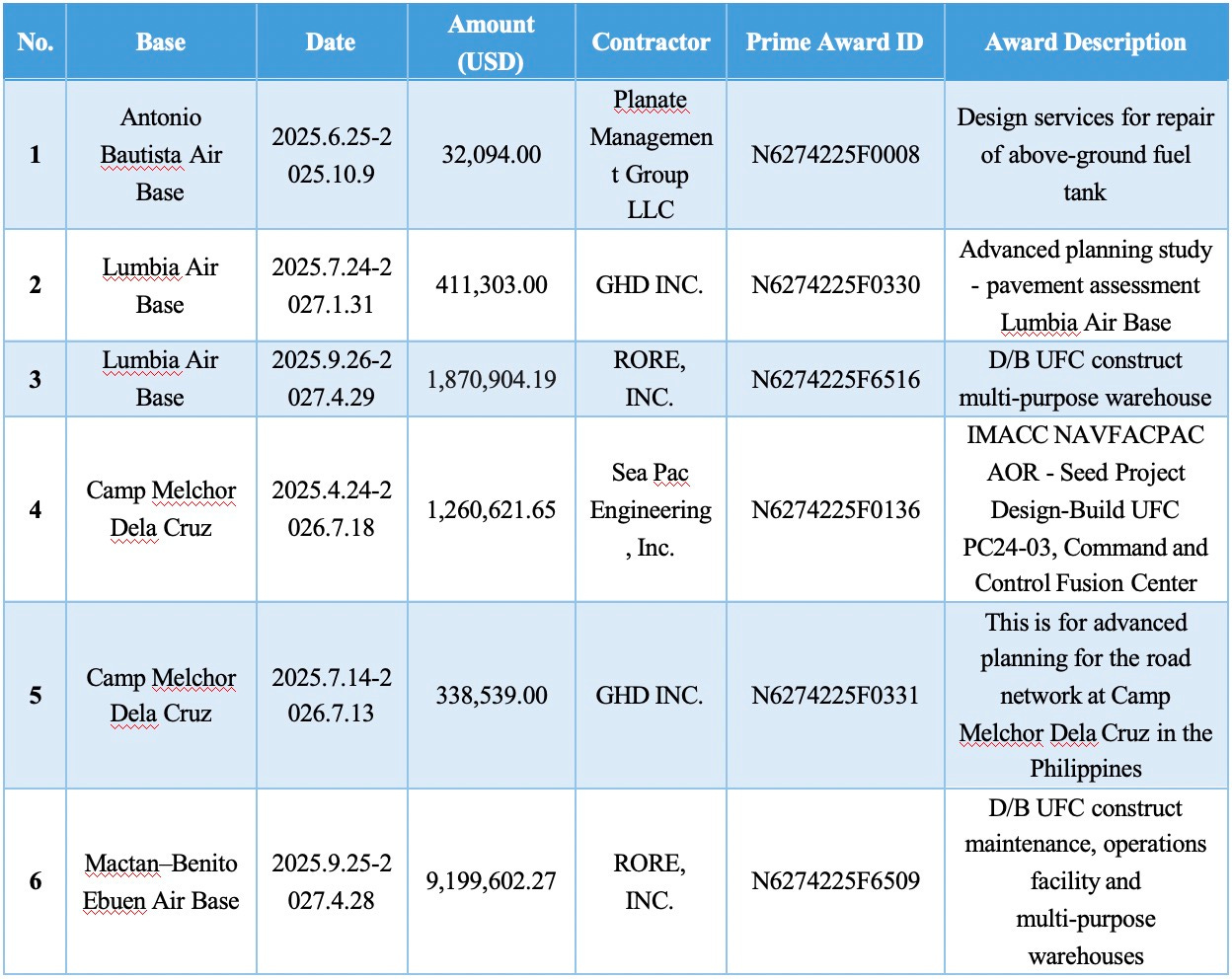
The expansion of U.S. military bases in the Philippines is a critical link in America’s strategy to implement “Integrated Deterrence” and optimize the Indo-Pacific pattern. The core objective is to transform the Philippines from a “strategic rear” into a “forward hub”. The northern base group is designed to block the Bashi Channel and Balintang Channel during crises and cut off access routes to the Western Pacific; the southern base group strengthens persistent presence and intelligence-collection capabilities in the South China Sea, providing direct support for sea-control operations. In recent years, leveraging the EDCA, the U.S. military has continuously pushed forward infrastructure expansion of military bases in the Philippines to enhance their capacity to support realistic combat-oriented joint drills and maritime cooperation activities.
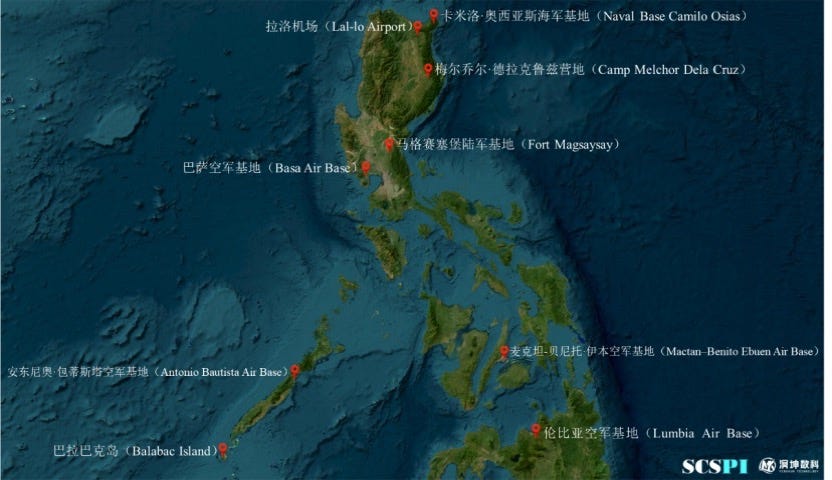
In March 2016, following the annual Philippines-United States Bilateral Strategic Dialogue, the two governments issued a joint statement announcing that, pursuant to the 2014 EDCA, U.S. forces would be granted access to five Philippine military bases. These sites are Basa Air Base in Pampanga, Fort Magsaysay in Nueva Ecija, Antonio Bautista Air Base in Palawan, Mactan–Benito Ebuen Air Base in Cebu, and Lumbia Air Base in Cagayan de Oro. In February 2023, the U.S. and the Philippines announced plans that in addition to the previous five bases invested and stationed by U.S. forces, they would establish and operate four additional new bases. In April, the Philippines announced the locations of these four additional sites: Naval Base Camilo Osias and Lal-lo Airport in Cagayan, Camp Melchor Dela Cruz in Isabela, and Balabac Island in Palawan.
II. Force Deployment: From Rotational to Combat-Ready Military System
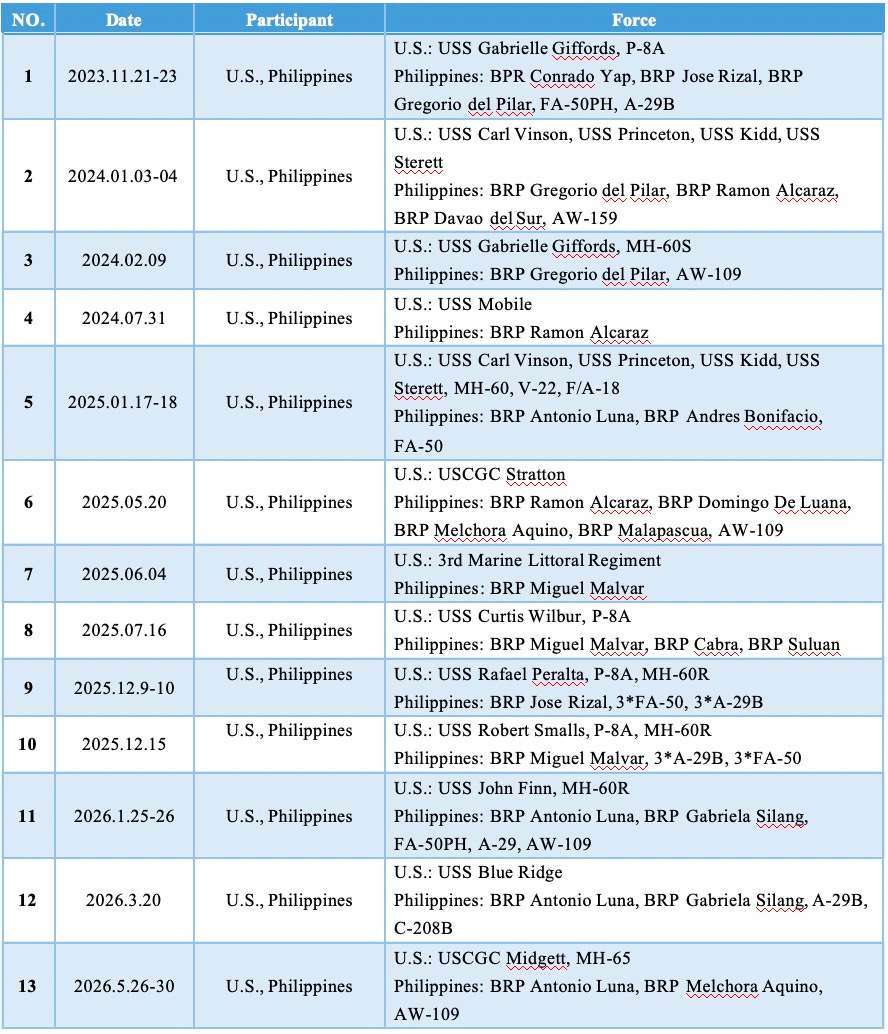
The characteristics of U.S. force deployments in the Philippines have undergone three major shifts: from intermittent exercise-based presence to sustained rotational deployments; from single-service operations to integrated joint operations; and from bilateral cooperation to multilateral alliance coordination. The U.S. military presence in the Philippines has already gone beyond the traditional scope of alliance cooperation, evolving into a fully functional, rapidly responsive, and tightly coordinated, combat-ready military system integrated with multilateral alliances. At present, the U.S. deployment in the Philippines “has effectively become equivalent to maintaining a permanent military presence” in the country.
III. Future Trends and Influencing Factors
For a long time, the U.S. and the Philippines have continuously deepened and broadened their bilateral alliance underpinned by agreements including MBA, MDT and EDCA. The fundamental drivers of progress in U.S.-Philippines relations are U.S. strategic competition with China and the Philippines’ strategy of deterring China. The U.S. exploits the Philippines to stir tension in the South China Sea and the Taiwan Strait, while the Philippines seeks to leverage U.S. power and capitalize on its geographic advantages to strengthen its own capabilities, conduct infringements and provocations in the South China Sea, and expand its international influence. However, constrained by domestic politics in both countries and different national interests, U.S. military deployments in the Philippines tend to follow a “light-asset” approach, avoiding excessive investment.
IV.Summary
As a major U.S. ally in the Asia-Pacific and a South China Sea claimant, the Philippines has long been regarded by the U.S. as a “strategic pawn” for stirring tension in the South China Sea and even the Taiwan Strait. Since Marcos Jr. took office in 2022, he has comprehensively restarted and upgraded the military alliance with the U.S., closely aligning Philippine strategy with Washington and shifting the country from “balanced diplomacy” to the “front line of confrontation.” Through EDCA, the U.S. continues to expand its military footprint on Philippine bases and conducts realistic combat exercises involving autonomous weapons and unmanned platforms to enhance bilateral and multilateral interoperability.
However, Philippine bases offer limited utility in wartime. Therefore, the Philippines’ strategic positioning is primarily as a supplement to U.S. military bases in Japan, and U.S. investment in base expansion has fallen short of expectations. To enhance interoperability and combat readiness, bilateral and multilateral joint exercises and training between the U.S. and the Philippines are expected to continue on the rise, strengthening their distributed denial capabilities in the Indo-Pacific. At the same time, to address the region’s lack of forward ammunition and equipment production capacity, the U.S. may push for the establishment of joint ammunition manufacturing and storage facilities, as well as ship repair facilities, at Subic Bay, thereby enhancing the Philippines’ ability to provide logistical support to U.S. forces.
The U.S.-Philippines military cooperation has leapt from a traditional “defensive alliance” to a key component of the Indo-Pacific “integrated deterrence” framework. The EDCA base network has completed a strategic encirclement layout against China that “locks the Taiwan Strait from the north and controls the South China Sea from the south.” Continuous investment in infrastructure expansion is turning the Philippines into a forward combat hub.
Deploying assets such as F-35, NMESIS, HIMARS, and unmanned surface vessels, the U.S. has achieved a shift from “rotational access” to “quasi-permanent presence” and from “bilateral exercises” to “multilateral joint operations”. Through a tiered cooperation network of the “core four countries” (U.S.-Philippines-Japan-Australia) plus extended partners, the U.S. has further embedded the Philippines within its Indo-Pacific strategy and command chain.
However, these forces are primarily a peacetime presence and would be extremely vulnerable in a high-end conflict. Their existence serves more political, strategic, and diplomatic purposes—using a relatively small military footprint to disrupt the situation, shape the environment, and push developments in a direction favorable to the U.S. Judging from U.S. investment and troop deployment, these bases are mainly intended to function as backup and logistics nodes in times of crisis or conflict, serving as supplements to U.S. bases in Japan.
Since 2013, although the U.S. has made significant progress in expanding Philippine bases and increasing its military presence there, the importance of these developments should not be overstated. The current situation in both the South China Sea and the Taiwan Strait remains tense but has not yet erupted into open conflict (“hot but not exploding”). The U.S. is willing to exploit these Philippine bases, actively using them to shape the strategic environment, contain China, and drain Chinese resources, yet it is unwilling to invest too heavily—especially since the existing infrastructure in the Philippines is poor and would require massive additional investment to achieve wartime resilience. The Philippine expectation that U.S. military presence will deter China is fundamentally unrealistic.
For China and other stakeholders, it is essential to objectively assess the trajectory of the U.S.-Philippine military alliance development and its impact on their own interests. While taking seriously the wartime threat posed by the U.S. military presence and deployments in the Philippines, greater attention should be paid to the restraints and attrition these arrangements and related activities impose on China during peacetime.