

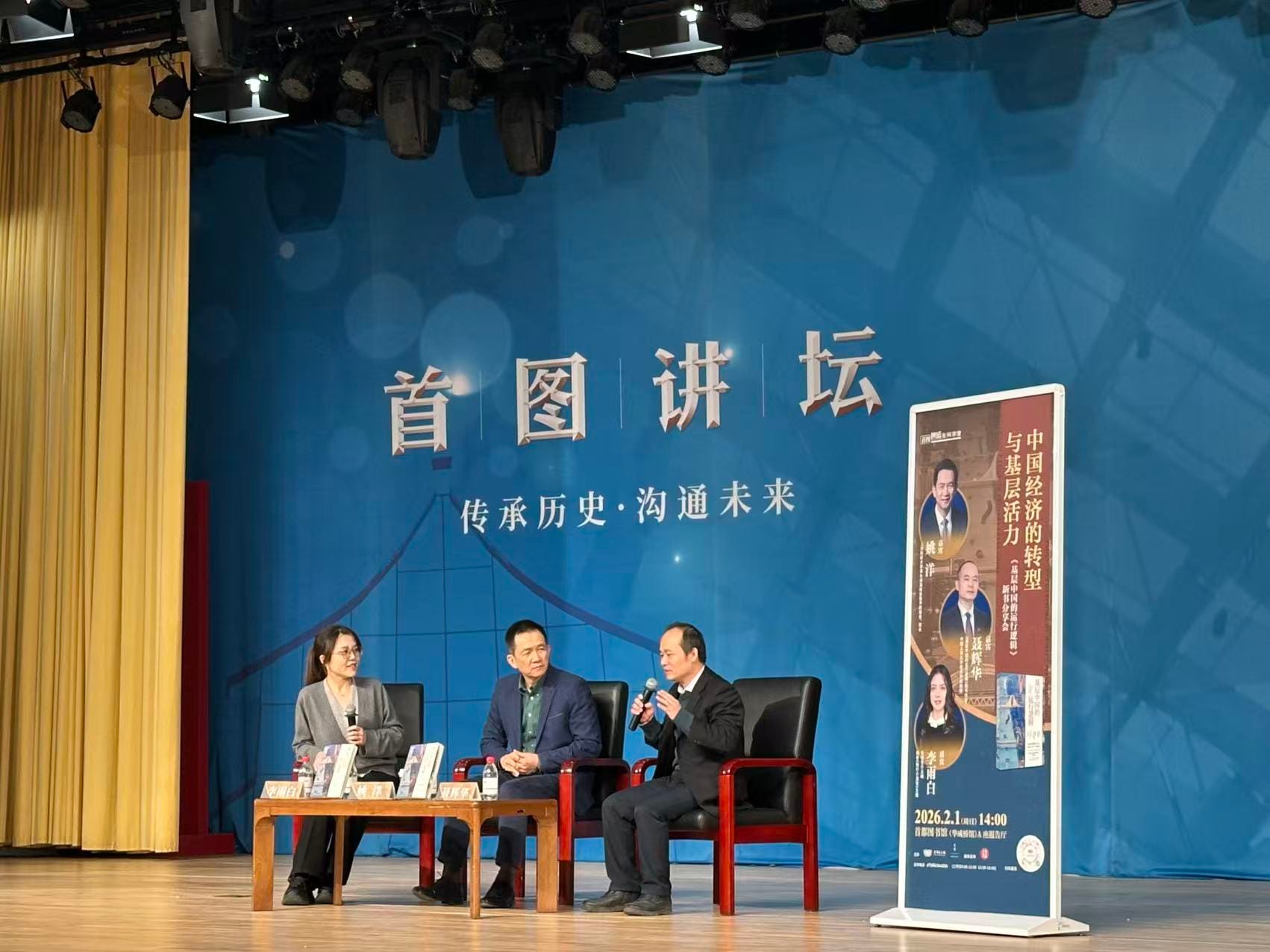
Last Sunday, I went to a panel discussion with Professor Yao Yang and Professor Nie Huihua in Beijing, where they discussed the ongoing Chinese economic transition, hosted by a podcast host Li Yubai. And I want to share the transcript with my readers.
Professor Yao is a renowned Chinese economist and policy advisor, specializing in economic development and institutional economics. He currently serves as the Dean of the Dishui Lake Advanced Institute of Finance at Shanghai University of Finance and Economics (SUFE). He was the dean of the National School of Development (NSD) at Peking University.
Professor Nie is a distinguished Professor at the School of Economics at Renmin University of China, specializing in organizational economics. What I think is particularly valuable about Professor Nie’s observation is that he focuses on grassroots research in China, having amassed a wealth of firsthand insights into China’s grassroots politics and economic operations. I always think that whatever big data tells us, the pure numbers cannot replace first-hand observation; the impact of abstract numbers is incomparable to the actual case.
At the beginning, they touched on the paradox of technological progress. Both professors observed that automation and AI adoption in Chinese factories have accelerated far beyond expectations—not primarily because of rising labor costs, as economists typically assume, but because machines simply perform better. Professor Nie described visiting a county factory where CNC machines had replaced most workers, and even a 12,000 RMB monthly salary couldn’t attract young people—the youth find the dreary jobs in central China’s county towns unbearable. Professor Yao noted that “dark factories”—fully automated facilities with no human workers—are becoming increasingly common. The problem is that China’s high-tech sector is thriving, but high-tech itself doesn’t create jobs.
Professor Yao argues that people are not just leaving first-tier cities—they’re leaving almost all cities, sinking down to county-level towns where they pick up gig work at drastically reduced incomes. He calls on the local government to put more focus on the service sector, which creates more jobs.
About the central-local government relations, Professor Nie offered a fascinating observation: before 2012, about 80% of China’s policies originated from local governments, with the central government accounting for only 20%. After 2012, this ratio completely reversed. Digital technology has accelerated this centralization—“information is power.” Digital technology has played an interesting role in this process—as information flows more easily upward, the central government naturally assumes more decision-making authority. At the grassroots level, this has created new challenges: some officials are more cautious, preferring to avoid potential mistakes rather than experiment with new approaches. The approval processes embedded in these systems, while promoting accountability, can also be cumbersome to change once set in motion.
They also talked about a tendency to overconcern about the long-term effect that sometimes may block short-term actions. He attributed this to the lower discount rate characteristic of agricultural societies, where decision-makers tend to prioritize long-term outcomes, but “In the long run, we are all dead”—he quoted Keynes and called for swift actions to boost inflation. He warned if we cannot solve the immediate issue, the bright future would be irrelevant. (It’s worth noticing that in the latest episode of Qiushi, there’s an article named “Actively promote a reasonable recovery in prices” 积极推动物价合理回升. We shall see more policies this year to boost inflation.)
Perhaps the most unexpected turn in the conversation came when both economists—empirical researchers by training—began discussing Wang Yangming’s Neo-Confucian philosophy. Professor Nie suggested that in an era where AI threatens to replace most jobs, perhaps 90% of people will eventually be freed from work entirely, leaving time for creative and philosophical pursuits. He believes the concept of Universal Basic Income (UBI) is worth learning. Professor Yao argued that we need to “write ourselves a story”—construct a narrative that helps us make peace with our circumstances.
Neither professor offered easy reassurances. They acknowledged that the path ahead is genuinely uncertain—that technological progress and human displacement are happening simultaneously, and that the policy toolkit to address this tension remains incomplete. But they also had a lot of confidence in China's capacity for adaptation, rooted in their years of observing how this country actually works at the ground level.
Below is the transcript I made with the help of AI.
China’s Economic Transformation and Grassroots Vitality
Speakers
· Yao Yang: Professor Shanghai University of Finance and Economics
· Nie Huihua: Professor, Renmin University of China
· Li Yubai: Host
I. Ground-Level Observations from the Field
Host: It’s a pleasure to gather with everyone here at the Capital Library this Sunday afternoon. We’re fortunate to have Professor Yao Yang and Professor Nie Huihua with us to discuss China’s economic transformation and grassroots vitality. While the topic sounds rather official, since we’ve all made the effort to be here, we hope to spend the next hour and a half discussing the issues that matter to you—how each of us, with our own jobs and lives, can develop a fuller picture of China’s economy, understand what’s actually happening, and identify the opportunities and changes within it.
During our backstage chat, I learned that Professor Nie and Professor Yao hadn’t seen each other for at least five or six years. Yet when sharing his new book, Professor Nie immediately thought of Professor Yao—and they’re even from the same hometown. I’m sure you’re both curious about each other’s recent research and thinking. So let’s start there: Over the past year, what stories or observations from your firsthand experiences or fieldwork have given you a real sense of how China’s economy is changing?
Nie Huihua: I’ll kick things off. Professor Yao is my senior, someone I’ve learned from, and a fellow Jiangxi native.
Let me share one story. About a year ago, I visited a county in China—fairly large but quite poor. We saw many factories, and two things surprised me. I’d always assumed rural factories would be packed with workers, and that most would be young. I was wrong on both counts.
First, many of these factory floors had barely anyone—just five or six people operating CNC machines. That caught me off guard. Second, nearly all the workers were in their fifties or sixties. No young people. I asked the owner why. He told me a young guy had come by, and he’d promised him: learn to operate and maintain this CNC machine, and I’ll pay you 12,000 yuan a month. Even that—12,000 yuan in a central Chinese county town, mind you—couldn’t keep him. The kid thought it was too boring, too isolated, no social life. He’d rather work as a security guard than in a factory.
So two things exceeded my expectations: how far digitalization has advanced, and how thin the labor force in these rural factories has become. But I think it’s precisely because these enterprises keep fighting to survive, full of resilience and grit, that they form the bedrock of China’s economy. There are countless businesses like this, hidden away in workshops and villages where you’d never notice them.
Host: And you won’t hear from them online either.
Nie Huihua: Exactly. And many of them, despite their small scale, are hidden champions in their industries—dominant players in narrow niches that most people have never heard of. I even asked a relative in Jiangsu and Zhejiang to investigate—just pick a street and count how many of these small factories there are. He told me straight up: you can’t even get through the door. They won’t let you in. It’s getting harder and harder to see what’s really going on. I find this story quite striking—this is the real China. That’s my one story.
Host: So after a year of fieldwork like this, would you say you’re relatively optimistic about the current economic situation and what’s ahead? More confident?
Nie Huihua: Here’s how I’d put it: there are two ways to look at China’s economy. One is top-down—looking at macro data. Professor Yao studies macroeconomics; I don’t understand it at all, so don’t ask me macro questions, ask him. The other perspective is bottom-up, looking at the micro level. I tend to see more from the ground up.
If you look at the macro picture, you might conclude the economy is slowing down, growth is decelerating, unemployment is rising. But if you look at the micro level, you see people still full of energy and resilience, still fairly confident—especially factory owners. I’m sure they’ve wrestled with doubt internally, but from what I can see, they still embody the toughness of China’s economy.
Host: Let’s hear from Professor Yao.
Yao Yang: Let me respond to Huihua’s observations first. I’ve also noticed that automation and AI adoption in China is happening faster than we imagined. And the way it’s being applied differs from what we economists typically assume. We tend to think rising labor costs drive factory owners to adopt automation and AI.
The reality on the ground is different. They’re adopting these technologies because the technical requirements are high, and machines are more precise than humans—which boosts productivity. That’s the main reason.
Take warehouses, for example. They’re all vertical now. If you have humans do it, you need someone driving a big forklift, following instructions to go up, slot something in, bring something down. Mistakes happen easily—and when they do, people can get killed, crushed by falling goods. Machines don’t make those kinds of errors.
So this challenges our economic assumptions. We always thought conditions had to change first—wages rising too fast, for instance—before people would adopt machines. But the machines and AI are already there; it’s just a question of whether factories choose to use them. What’s actually happening is that the availability of technology is driving organizational change. That’s my takeaway from visiting factories.
From a macro perspective, I’d say China’s economy right now is a tale of fire and ice. If you see what Huihua and I have seen in those factories, you’d think China’s economy is doing great. And indeed, progress in high-tech sectors has been remarkably fast. But high-tech is only one part of the economy, not the whole thing. And as we’ve both observed, the more high-tech something is, the fewer jobs it creates.
So we’re facing a major contradiction: rapid growth in high-tech, but employment isn’t keeping pace. How do we resolve this? Economists figured it out long ago—you need to boost domestic demand. And that brings us back to the macro picture.
II. Where Have All the Workers Gone?
Host: Based on what you’ve both shared, at the macro level we can see certain sectors—especially high-tech—performing impressively. At the micro level, many enterprises are achieving real productivity gains through digitalization and intelligent manufacturing. But this doesn’t quite match what ordinary people feel.
Take what Professor Nie described: when you actually go down to the grassroots and visit these factories, you discover something counterintuitive—local young people don’t want these jobs. Yet our general sense is that young people are gradually returning from big cities to their hometowns. So where exactly is everyone going? And as certain jobs disappear, where does that leave employment? Have you been thinking about this? Is there any solution?
Nie Huihua: Actually, these two things aren’t contradictory. Machines replacing workers and young people returning home can happen simultaneously. Young people may be going back because opportunities in cities are shrinking, while the trend of machine substitution is unstoppable. So we end up with exactly the problem Professor Yao described.
I see two approaches. First, we try to create new jobs—and the most important thing there is to reduce regulation. If you just ease up on controls, Chinese people are incredibly hardworking, incredibly clever, incredibly eager to make money. We’ll do whatever it takes to earn a living. So loosening regulations could definitely expand employment.
Second, what if job creation still can’t keep pace with machines and AI? There will still be an employment gap. And here’s something that might sound outlandish: What if only 10% of the world’s population needs to work, and the other 90% can just enjoy life? It’s entirely possible. Some European and American countries have been experimenting with UBI—Universal Basic Income. They’ve realized they can afford to support everyone because not that many people actually need to work.
But that doesn’t mean everyone would be unemployed in a bad way. People could pursue literary creation, for instance. Literature might become genuinely important then, because everyone might end up studying humanities. No more cramming for STEM exams. Some science fiction writers have imagined exactly this scenario, and it might not be as far-fetched as it sounds.
At first I found this idea hard to believe—isn’t this too ahead of its time? But one thing made me think we shouldn’t be too pessimistic. I’m from Jiangxi, as is Professor Yao. For thousands of years, farming in our region meant rising at dawn, working till dusk, manually planting seedlings, manually harvesting. I did that kind of work myself—even while I was in college, I was still doing farm labor.
Back then, I thought there was no way large-scale mechanization could work in southern China’s terrain—half basin, half hills. But look at the past few years. Starting about a decade ago, nobody in my village farms by hand anymore. Everyone uses machines. All sorts of small-scale equipment has been invented to handle various tasks. People figured out the math: if you farm yourself, you might make 1,000 yuan after a year of backbreaking work. But if you go work in someone else’s factory, you can earn 2,000 yuan in a single month.
Host: So they just lease out their land.
Nie Huihua: Right—or they don’t even bother anymore. I asked someone from my village: can you set aside a plot for me, grow rice without any pesticides or fertilizers, and ship me whatever you harvest—even if it’s just 200 jin per mu? He said impossible. Modern farming is all large-scale now. The water flows through interconnected channels; you can’t stop your neighbor’s water from crossing your field without blocking your own irrigation. We’re all in this together now—there’s no going it alone.
See, thousands of years of agricultural tradition transformed in barely a decade. We should embrace technological change, not fear it. So when I say that someday 90% of people might not need to work and can just enjoy life—those of us here might actually live to see it.
Host: When I did a podcast with Professor Nie recently, he made this same point, and some listeners commented: “Can this really happen? How can such a down-to-earth economist be talking about something so sci-fi?” But I think the rapid pace of technological development and its disruptive force are posing enormous challenges to all of us, economists included. Do you feel this challenge? As China transitions from high-speed growth to high-quality development, which past assumptions might no longer hold? What needs to be reconsidered? I’m curious how economists are thinking about this.
III. Short-Term Problems and Long-Term Thinking
Yao Yang: I’ve been thinking about how Chinese people always take the long view. That’s one of our strengths. Research shows that agricultural societies have low discount factors—meaning future value doesn’t depreciate much when converted to present value. For Chinese people, one yuan in the future might be worth 98 cents today. In some other countries, it might only be worth 90 or even 80 cents. So we place great importance on the future. In farming, you plant in spring and don’t harvest until autumn—a long cycle. You have to be patient. That’s a Chinese strength.
But taken to an extreme, this creates problems—we think so much about the long term that we neglect the present. We always assume we can muddle through the short term. Lately I’ve been thinking that I’m becoming more and more of a Keynesian. Not in the sense of constantly stimulating the economy, but in appreciating Keynes’s famous line: “In the long run, we are all dead.”
The long run is just countless short runs stacked together. What does this mean? Right now we have a demand problem—that’s a short-term issue. Earlier we asked: where did all those people go?
We conducted a study on household registrations, looking at urban population changes. We were shocked to find that outside of first-tier cities, populations in other cities have been declining over the past few years. Even in first-tier cities, population growth has slowed, and Beijing and Shanghai are actually shrinking. Where did everyone go?
Since we’re talking about over 330 officially designated cities, a large chunk of people must have settled at the county level. If they went back without formal employment, they’re probably doing gig work. Settling into service jobs at the county level means their incomes have dropped significantly. Some may have no work at all. This is one of our biggest immediate challenges.
We said earlier that China’s economic future is bright—I believe that, because our pace of technological progress is still strong. But the problem is, if we can’t solve the short-term employment problem, we might end up exactly where Keynes warned: unable to cross this hurdle, making the long term moot.
Some people, especially economists, keep saying: if you do that, the next step might create new problems. I say the next step isn’t what we should be worrying about right now. While you’re fretting about the next step, you haven’t solved this step. For instance, prices are falling right now. What we urgently need to do is push prices back up.
I’ll tell you, when I say this, there’s a 90% chance someone—including well-known economists—will object: what about inflation? I say you can’t even use the word “inflation” right now. Prices are still falling—why are you worried about inflation? Shouldn’t we first get prices back up? That’s what we need to do now. Inflation isn’t our current problem.
Host: I think not just 90% of economists—99.9% of ordinary people would disagree with you. They’d say: my income is already precarious enough, and you economists want to raise prices?
Yao Yang: Yes, but this is exactly the issue. Understanding the complete logic is what’s needed.
This is where Keynes’s brilliance shines. You appreciate more and more that a hundred years ago, his insights were truly great. He identified what he called the “paradox of thrift”: when the economy is declining, the more you save, the worse the economy gets. But dig one level deeper, and it’s really about the conflict between individual rationality and collective rationality.
When the economy is bad, it makes perfect sense for each household to tighten their belts and not spend. We see housing prices falling, so of course we shouldn’t buy—you’d be catching a falling knife. From an individual perspective, this is completely correct. But aggregate these individual decisions to the whole economy, and it becomes terribly wrong—because when nobody’s buying houses, when nobody’s consuming, the economy keeps spiraling down.
Second, why are prices falling? Behind the numbers are poor expectations. Everyone’s pulling back. If you can’t stabilize expectations, everyone keeps pulling back. Understanding this isn’t easy because it runs against our individual intuition.
Host: But there’s one thing I think people can grasp: your spending is someone else’s income. When you spend less, it likely means others are earning less too, and this reflexivity eventually comes back to affect your own income.
Yao Yang: True, but very few people can think beyond themselves to consider others. They think: my spending less doesn’t necessarily affect someone else’s income.
Host: When people watch the news saying we need to stimulate domestic demand, they all hope others will spend more so everyone’s better off.
Yao Yang: Right—everyone wants everyone else’s family to hurry up and spend more.
Host: Do economists have any solutions to this predicament?
Nie Huihua: That’s the question Professor Yao has raised. It’s not entirely unsolvable—our country does have an advantage: when the government commits to doing something, it can get it done.
I strongly agree with Professor Yao about the paradox of thrift. This is a real issue. Local governments—as Professor Yao has noted—are among the biggest consumers in our domestic economy. If local governments publicly announce “we need to tighten our belts,” it signals to everyone that the economy isn’t doing well, so I’d better cut back too. That creates a self-fulfilling prophecy of thrift.
To break this “fallacy of composition” created by the paradox of thrift, you also need a top-down approach. If the central government leads the way—spending, and spending in the right directions—people see that and gain confidence, businesses see it and are willing to invest, enterprises come alive, the economy comes alive. So I don’t think this is unsolvable. We don’t need to convince everyone.
Yao Yang: You’ve studied local government very deeply; I’ve also read your book. I’ve always been puzzled: within our entire bureaucratic system, why is the amplification effect so severe at each level? What comes down from above—many policies that are correct by economic standards—ends up getting distorted more and more at each lower level, eventually going to extremes, even becoming counterproductive.
And I have another question: if the top doesn’t move, can you rely on lower levels to, say, increase spending? Is that even possible?
IV. The Predicament of Grassroots Governance
Nie Huihua: Professor Yao has raised a profound question—really getting at the logic of grassroots governance in China over the past few decades.
There’s research showing that before 2012, many policies in China were made by local governments—80% originated locally, with only 20% from the central government. After 2012, this completely flipped: 80% of policies now come from the center, and local policies mainly repost, supplement, or refine them. Local autonomy has clearly diminished, and there are deep reasons behind this.
One reason is the development of digital technology. As digital technology has allowed central or higher-level authorities to learn more about lower levels, they’ve gained more power to control—because information is power.
For example, many localities are no longer allowed to create their own apps. It’s called “one form from top to bottom”—the city level creates the form, and everyone below just copies it. The internet connects everything, so local governments lose that discretionary space. This is a fundamental incentive problem.
Local governments now face intense accountability pressure. When doing anything, the first thing everyone thinks is: will this get me in trouble? That’s the priority—not how to achieve results, but how to avoid problems. There are reasons for intensified accountability, but when it goes beyond a certain point, local officials become paralyzed with fear. Why won’t they act?
Let me give you an example from grassroots public service. Say a locality needs to distribute social security benefits—specialized subsidies typically go to “five-guarantee households” [the elderly, disabled, and orphaned with no family support]. In the past, township officials or village cadres could determine who qualified. Now nobody dares make that call. Even if someone’s off by one yuan, they won’t approve it.
Previously, how would a minor case like this be handled? Say the social security threshold is 1,000 yuan annual income. Someone earns 950 yuan—I’d just give it to them because I have a slot and there’s nobody else. That was fine in the past. Now it’s impossible. If you enter 950 into the system, it doesn’t pass the data check. It’s not a person signing off anymore—it’s “one form from top to bottom.” Enter 950 yuan income, the system rejects it automatically. Who do you appeal to?
So digitalization has brought convenience on one hand, but on the other hand it’s left grassroots officials with even less autonomy. Higher-level accountability has become easier too—now every step, every modification has to leave a trail.
Here’s another case. One of my students quit his civil service job to pursue a PhD with me. After graduation, he should have had fresh graduate status, but it didn’t work out. Why? His former employer, out of kindness, paid three extra months of social security after he resigned, so he wouldn’t be without income. That backfired—having social security contributions after enrollment meant he lost fresh graduate status.
Could he return the money and fix it? No. Every modification requires sign-off going up level by level. The system essentially can’t be changed.
Think about it: in this kind of environment, grassroots officials have almost no autonomy. Without autonomy, the safest approach is to do everything by the book, or even over-correct. The further down you go, the simpler and more uniform the standards need to be. If you say “you can do it this way or that way,” everyone below is lost—they don’t know which instruction to follow. So it has to be simple, clear, even blunt. Only then does execution go smoothly.
But the outcomes are inevitably poor. There are more reasons beyond what I’ve mentioned, but Professor Yao has raised an excellent question: why has the grassroots level lost its innovative spirit and vitality in recent years, its former drive? This deserves serious reflection from everyone.
Host: But people’s sense is that grassroots civil servants are obviously much busier now, with more things to do—just like people outside the system. Is that related to this mechanism?
Nie Huihua: Being busier and having less autonomy aren’t contradictory.
Here’s an example: I learned during fieldwork that one important task for “village official” college graduates is filling out forms. A lot of stuff used to be on paper. Now that you finally have someone educated, who went to college, who knows computers—great, put them on form duty. They digitize all the forms from the past five years.
After a few years, I figured surely they’d be done by now with all those forms. They weren’t. Why? New forms kept coming. And now uploading a form is more convenient than ever. Before, there was still some discretionary space. Now grassroots autonomy keeps shrinking.
So what I argue in this book is “co-governance from above and below”: China’s economic growth has always combined top-down grand design with bottom-up “crossing the river by feeling the stones.” The problem is we have plenty of top-down design now, but much less stone-feeling, much less grassroots innovation. As a result, the advantages, vitality, and potential of the grassroots haven’t been fully unleashed.
Host: Over these years of fieldwork, Professor Nie, have you sensed the atmosphere and mindset of the people you interview? Do they express frustration? Maybe they tell you that research doesn’t seem to matter much anyway, since they have so little autonomy. Is that what it’s like?
Nie Huihua: It is. Grassroots civil servants are under a lot of pressure—they’re busy, and their incomes have dropped. So they may not be eager to host visitors.
But I try to reassure them. I tell them I’ll do my best to relay their situation upward and advocate publicly. Because this isn’t something that can change overnight, and it’s not something I alone can change—even someone as influential as Professor Yao can’t change it immediately.
But I believe if enough people speak up—for instance, form-filling at the grassroots has actually decreased recently. There’s now an effort to reduce “fingertip formalism”—apps can’t be created arbitrarily anymore. During one visit, I saw a locality that had created an innovation: do everything through an app. Later I asked what happened to it. They said the higher-ups ordered burden reduction, so the county can’t create apps on its own anymore.
So things can change. If enough people talk about it, I believe higher levels can hear it and make improvements where they can.
Host: But overall, things are still moving in a positive direction.
V. Opportunities and Challenges in County Economies
Host: Earlier, Professor Yao mentioned something important: population is flowing into top-tier cities like Beijing, Shanghai, and Shenzhen—or at least outflow has slowed—while at the township level, people are leaving. Many people, especially young ones, seem to be settling at the county level. County-level economies have become a hot topic in recent years.
I’m curious what discoveries from your research over the past two years you can share about county economies. People are wondering: if big companies have done something successfully in first-tier cities, can the same model be replicated in counties? Maybe that’s a trillion-yuan market?
Yao Yang: I haven’t specifically studied industrial development at the county level—Huihua can speak to that. Let me just share my hometown’s situation. Our county is probably even poorer than Huihua’s—it’s in central Jiangxi, Ji’an Prefecture, which isn’t as developed as his Fuzhou Prefecture.
But over the past fifteen years or so, economic development has been decent, mainly due to industrial growth. A luggage industry emerged in our county—purely because people who used to work in coastal factories as small bosses came back and opened factories in the county seat. That drove pretty good economic growth over the past 15 years.
Now there’s a big problem, which Huihua mentioned: many young people don’t want to work in these factories. Factories can pay good wages, but young people still won’t do it. The luggage industry is still largely manual labor. Now when you look at factory workers, they’re all over 40. I rarely see anyone under 40 willing to work in a factory.
What I want to point out is that this shift in the younger generation’s values isn’t just happening in cities—it’s the same in rural areas of central and western China. Nobody wants factory work anymore. Freedom has become more important than income.
Take my nephew, for example. He could find work in our county—I’m sure he could easily get a job paying six or seven thousand yuan since he has a vocational diploma. But he just won’t do it. He went to drive a taxi. First in the city, but with so many people doing ride-hailing now, what could he do? He went to Southeast Asia to drive there. Really—he’s driving a taxi in Southeast Asia now.
Host: Leaving home for distant lands—but in an optimistic light, he’s got entrepreneurial spirit.
Yao Yang: It does show initiative. But he represents a whole cohort. What I’m saying is that this wave of industrialization in central and western China may be over soon—it’s already been 15 to 20 years, right? Things are already very different from what we imagined.
Nie Huihua: County-level economies do deserve more attention these years. When we talk about county economies, we mean county-level administrative units. China has over 2,800 county-level units, but the actual counties, autonomous counties, banners, autonomous banners, plus county-level cities add up to around 1,800—about two-thirds. The other third are districts, which don’t count as county economies.
Looking at macro data, counties account for about 60-70% of the population but only 40% of GDP. In other words, counties still lag behind districts.
My view here might differ from others’—I’m not that optimistic. I think the biggest problem now is unfair competition between counties and districts. What do I mean by unfair competition? If you’re a county, your competitor might be a district. And a district belongs to the municipality.
The difference between a municipality’s districts and its counties is huge. Counties have relatively complete institutions and considerable discretionary authority—your fiscal affairs and personnel are independent. Districts aren’t like that. A district’s land planning and many other agencies answer to the municipal level—they have no autonomy. So when we talk about county economies, we’re definitely not including districts.
What does that data tell us? Counties mostly can’t compete with districts. Why? The good resources get grabbed by districts first.
Here’s an example: suppose a major company like BYD comes to a municipality. BYD is a big deal—the city will mobilize all its resources to support this project. Where will they put it? Definitely in a district, not a county—unless the county happens to have a provincial or national-level development zone, but even then it usually isn’t under county control.
The bottom line is that districts have the home-court advantage. Here’s another angle: a district party secretary might well be a standing committee member of the municipal party committee or a deputy mayor. A county party secretary almost never is. How can you compete with that?
Zoom out further: look at China’s urban hierarchy. We have direct-controlled municipalities at ministerial level, 15 sub-provincial cities, regular provincial capitals, regular sub-provincial cities, prefecture-level cities, county-level cities. They’re all arranged in a ranked structure, each level different from the others.
So here’s how I see it: In China, people follow resources, resources follow power, and power is embedded in hierarchy. Think about it—how can a county compete with a district? If you want county economies to grow, a prerequisite is leveling the playing field between districts and counties. For starters, could we eliminate sub-provincial city designations? Could we upgrade all counties to deputy-department level? Only then could county economies truly compete with municipal economies. Otherwise, it’s just not possible.
One more example: when I did fieldwork in a township, people told me: a township has nothing—what advantage do you have for attracting investment? They said: we have no advantages. But here’s how the policy works now: the county knows the township can’t compete with county-level areas. So if you bring in a business, you can put it in the county’s industrial park, but the credit goes to you. That solves the incentive problem.
See? Even they understand there’s no way to compete. The same logic applies between districts and counties—good resources always go first to core areas and higher-ranked cities. After higher-ranked cities, it’s districts first, then counties.
So if county economies are going to expand, they face this fundamental problem of unfair competition with districts. We’ve done research showing that higher-ranked cities do have higher total factor productivity for enterprises. But that’s mainly because they have more favorable conditions from the start—greater tax discretion, more preferential policies. Just take land approval authority alone—municipalities have far more power than counties. Fair competition is nearly impossible.
Host: But I think people asking about county economies might have a different angle. They’re not necessarily thinking about setting up factories or companies, weighing administrative divisions and corresponding resources and rankings. They might be thinking: counties have strong consumer potential too. Maybe I’m just an ordinary person who can’t do anything big, but I could open a restaurant, a shop, a small store. Can you take what worked in first-tier cities and replicate it in counties? Have you seen examples of this in your research?
Nie Huihua: It’s basically not going to work. Let me put it this way: except for a few large-population counties—say, over 500,000 people, which we call “big counties”—you might be able to replicate part of the model. Otherwise, it’s basically impossible.
Here’s a question for you: Pangdonglai is hugely successful in Henan—but can it expand to other places? No, because other counties simply don’t have enough population. The supply chain can’t sustain it.
To put it bluntly, in many underdeveloped areas of central and western China, the economy is basically what I’d call a “doctors-teachers-officials economy”—completely dependent on the public sector. Doctors, teachers, civil servants—they’re the main consumers. Take them away and there’s essentially no market. Look at some places in the Northeast—I don’t mean any offense—why has the economy been declining? Because there’s no other consumer base. If you transplant a Beijing-Shanghai-Guangzhou model there, you’ll definitely fail.
That’s not to say the Northeast has no future. I’m just saying it reflects problems common to many underdeveloped regions.
Host: It’s fine, I’m from the Northeast—I’m used to it.
Nie Huihua: You’re from the Northeast? Sorry, I didn’t mean to offend.
Host: No worries—I already voted with my feet.
Nie Huihua: Right. But think about it: the Pangdonglai model is hard to replicate. That should be obvious. It might work in a large-population county; in a small-population county, it’s nearly impossible.
Host: Let alone expanding beyond Henan—they can barely even make it into Zhengzhou. That involves more than administrative divisions; there are various other factors at play.
VI. Reflections on Development Models
Host: From both your perspectives, as people pay more attention to cities beyond Beijing, Shanghai, and Shenzhen, including counties—what other insights from your research and conversations are worth sharing? What surprising changes or trends have you uncovered?
Those of us here live in Beijing day-to-day; we understand Beijing and the first-tier cities best. But there’s so much happening across the rest of China that people would like to learn about through you.
Yao Yang: Overall, I think population is still concentrating in a few major regions. I mentioned earlier that urban populations are declining in most cities. Many people are probably settling in county-level cities—many in county-level cities of developed regions.
The clusters seem to be: the Yangtze River Delta, the Pearl River Delta, the Sichuan Basin, and the Beijing-Guangzhou railway corridor—from Zhengzhou to Wuhan to Changsha. And Chengdu.
Take Chengdu: its population keeps growing because it doesn’t really restrict city size the way Beijing and Shanghai do, with their caps of 25 million. Chengdu just keeps drawing bigger circles. I think this is a crucial reason why Chengdu’s economy has been able to develop.
Many companies have skipped over countless cities and relocated directly from the coast to Chengdu.
Nie Huihua: Why is that? Because Sichuan has a lot of local workers?
Host: So it’s not just geography?
Yao Yang: As Huihua suggested, Chengdu’s leadership has been relatively hands-off with regulations. Chengdu’s pace of life suits young workers today. Many young people work jobs where they’re basically glued to a computer—remote work. They don’t need a frenetic pace, and housing and living costs are relatively low. Add these advantages together, and people are willing to move their companies straight to Chengdu.
I think many cities have failed in this round of industrial relocation because of rigid thinking, excessive regulation, and especially bias against private enterprise. They’re always chasing big projects. I think many cities in central and western China are like this.
Take my hometown—I was born in Xi’an. Xi’an is a classic example. How many big projects are there to go around? And even with this approach, big projects still leave. Look at our Xi’an Dian Company—that’s a central state-owned enterprise, right? Been in Xi’an for sixty or seventy years. It moved to Shanghai. They couldn’t even keep a big project.
Host: You also moved to Shanghai.
Yao Yang: Right. I think mindset determines everything. And people’s mindsets are extremely hard to change—very stubborn and ossified. Add what Huihua mentioned: within our government system, certain ways of thinking keep getting reinforced, layer upon layer like an invisible net. Eventually nothing can get done. To revitalize the economy, to revitalize employment, the government still needs to step back.
Host: I think it’s not about any individual’s intention—it’s often the unconscious combined force of a group of people that leads to either greater openness or greater rigidity.
But listening to Professor Yao just now, several lightbulbs went off in my head. You’ve highlighted a few regions—the Yangtze River Delta, the Greater Bay Area, the Sichuan Basin, the Beijing-Guangzhou corridor. If these places still have population inflows and growing vitality, then maybe instead of trying to outcompete where you are, you could just go there? For individuals, especially those in service industries, these places might offer better prospects—at least for the next three to five years?
Yao Yang: That’s probably right. But because domestic demand as a whole is weak, whichever city you visit, it looks sluggish. Even Shanghai—walk down any street and you’ll see plenty of shops closed, sitting empty. The same in inland cities. We’re only talking about relative differences—which cities are slightly better.
And personally, I feel—this is also what Huihua’s book discusses—it’s not that there’s anything wrong with the central government emphasizing manufacturing, new technologies, new industries. But the problem is our bureaucratic system amplifies the signal infinitely. By the time it reaches the grassroots, that’s all they do. The service sector gets ignored.
Either they don’t prioritize it, or nobody thinks about how to revitalize idle assets. Shanghai’s municipal government is a bit better—they said you can convert commercial properties to residential. But even that reform hasn’t succeeded because of all the legal issues involved. I haven’t seen other cities even trying.
Everyone acknowledges it’s a problem, but they’re all busy with hard tech and high-tech industries—that’s what generates visible achievements, because that’s what the higher-ups evaluate. Service industries aren’t evaluated. Retail isn’t evaluated. Even though everyone talks about boosting domestic demand, it’s not a performance metric.
You see what Huihua’s book describes: the multi-task principal-agent theory. Economists all know this theorem: when you have many tasks but only certain ones get evaluated, people focus on those. So the end result is a two-track system: on one hand, you see government pouring massive resources into high tech, going all-in, and indeed high tech develops well. On the other hand, no one addresses the stagnation we see.
We’ve forgotten something: ordinary people’s employment still depends on the service sector. A small shop might seem insignificant, but a city has hundreds of thousands of these small shops. Each one hires a couple of people—that solves a lot of employment. Services remain the biggest job creator.
Our industrial sector doesn’t generate employment anymore, right? We’ve all seen those lights-out factories, and they’re getting darker still—workers are being replaced. Manufacturing is valuable for international competition—competing with America and so on—but it doesn’t do much to raise incomes for ordinary people.
This is America’s problem too. Look at American high tech—it’s doing great, never mind the naysayers. The American economy performs well on paper. But who’s driving that performance? Silicon Valley, Wall Street, the pharmaceutical triangle around Washington, D.C.—all high-tech sectors.
If you have a high level of education and studied the right field, and you get a job in Silicon Valley, a master’s degree probably starts around $150,000 now. And when you join, you get a $100,000 signing bonus just like that. Your income immediately shoots up. With a PhD, you’re starting at $300,000.
But for ordinary Americans—median household income, if I recall correctly, is somewhere between $70,000 and $80,000. Life is actually quite hard, because prices have risen. Many Americans work two or even three jobs just to support their families.
So you see, high tech doesn’t put food on the table. We shouldn’t set these up as opposites, but the current problem—and I want to discuss this with Huihua—in studying government, is there any way to untie this knot? What I see is that local governments execute central policies to the letter, to an extreme—”look, I’m doing everything right”—and ignore everything else. They invest and invest. Is there any solution?
Nie Huihua: Professor Yao has raised a profound question. According to our framework of “co-governance from above and below,” we definitely need hard tech. We need high technology. But ordinary people can’t eat by high tech alone.
The service sector also needs local governments to develop new thinking. But that’s not how people see it right now—they think services don’t matter.
There are actually approaches. For instance, starting about a decade ago, the central government introduced a concept called “functional zoning”—different regions have different priorities.
I’ve asked friends in western and northwestern regions about this. They told me that in their areas, ethnic unity is the top priority; economic development must serve that goal. If we adopt this functional zoning mindset, couldn’t we designate certain places to focus specifically on the economy, while giving other places certain autonomy?
Let me share some research I’ve been doing with students—not yet published. We found that starting over a decade ago and continuing to now, out of roughly 2,800 districts and counties nationwide, nearly 1,000 no longer have GDP as a direct assessment metric. Many people can’t believe this.
Does not evaluating GDP lead to better development? We dug deeper and found something interesting: there are two types. In one type, they don’t evaluate GDP but substitute other indicators—say, this is an ecological protection zone, so they evaluate environmental metrics. In the other type, no indicators are specified at all; localities are simply allowed to pursue balanced development on their own.
We found that the latter—completely autonomous development—actually achieves more balanced outcomes. The former—what we might call “controlled KPI” where there’s no GDP target but other mandated metrics—doesn’t develop as evenly.
So the reverse logic is: China is vast, with enormous regional variation. We should leverage this large-country advantage to run policy experiments and implement functional zoning. But we may have become too fixated on a “unified national market,” too focused on scale effects. When all you see is economies of scale, the playbook becomes: maximize scale, drive down prices, use low prices to crush competitors. That’s not a healthy competitive mindset—it’s zero-sum. And when this approach gets exported overseas, it’s even worse. Talking about “bringing the competition abroad” is absolutely wrong.
So I think we should allow different regions to adapt to local conditions in their assessment criteria. Different places should have different responsibilities, different functional zones. Only then can China’s economy have both face and substance. We can’t sacrifice substance for face—substance is what puts food on the table.
Of course, face matters too—in the long run, it can become your foundation, your confidence. But for most people, especially in the short term, there is some tension between employment and high tech.
VII. Specialty Towns and Development Paths
Nie Huihua: There’s a fascinating phenomenon I think about: China’s various specialty regions. There’s a book called Shoe Capital. Do you know where China produces the most athletic shoes? Jinjiang. Jinjiang accounts for 20% of global output, 40% of national output. It’s just a county-level city. Within Jinjiang there’s a town called Chendai that alone accounts for 8.5% of world production.
Many famous brands—361°, Xtep, Anta—all started there. The development process perfectly fits the pattern of many Chinese specialty towns. It starts with overseas Chinese with some money, not sure what to do with it, who stumble onto something profitable—making leather shoes, say. One family makes money, others follow suit. Small workshops become private enterprises. As they grow, quality varies wildly; some counterfeits and knockoffs emerge. The government cracks down. Those who survive that phase, get quality under control, and build brand awareness—they become big players. Then they can do international OEM manufacturing. That’s how Anta was born.
I think the story of “China’s Shoe Capital” is quintessentially Chinese—you rarely see this abroad. Why is Chinese manufacturing so formidable? Why did China become the world’s factory? Because of hundreds and thousands of these specialty towns.
Host: But does this playbook still work today? Stories like the shoe capital started 20 years ago. What about now?
Nie Huihua: Good question. But I think the underlying logic is similar. It always starts with loose regulations, then one person gets rich, which inspires others, the government is supportive, and people develop brand awareness.
Here’s an example: we may not have as many “Shoe Capitals” or “Women’s Fashion Capitals” or “Ceramics Capitals” or “Fruit Hometowns” anymore—those were the old specialty towns. But Taobao villages represent a new model. Do Taobao villages need any advanced resources? Not really. Leveraging the internet and digital economy, they can explode into prominence.
If you look at Taobao villages—like Shaji Town—the development process is similar. There’s always some element of “co-governance from above and below”: grassroots willingness to innovate, entrepreneurial spirit, willingness to take risks; local officials with the courage to provide support; and higher-ups who at least turn a blind eye.
Industries develop gradually. Once they’re up and running, you develop first, regulate later—regulate as you develop, develop as you regulate. Many Chinese industries have grown this way. So we keep emphasizing: first, ease up on regulations; second, govern from both above and below.
Host: Give people more space, more gray area. With the Chinese character—hardworking, willing to hustle—people can carve out opportunities. In the past it was shoes and fashion; in the future it might be something else entirely. Whatever it is, people can make it work. Whether it’s Taobao as you mentioned, or livestream e-commerce we see on platforms, or short dramas—we used to have Hengdian [horizontal screen film studio], now there’s “Shudian” [vertical screen studio]—these are all examples of people spotting trends and applying their ingenuity.
VIII. AI Applications and Grassroots Governance
Host: We’ve touched on social media and digital technology. In this era of AI transformation, people want to understand how AI’s widespread adoption has changed how grassroots governance and public services operate. Where has it improved efficiency, and where has it amplified existing governance challenges?
There was big news recently about Shenzhen’s Nanshan District using AI technology—AI completing in one day what dozens of civil servants would do. It sparked a lot of discussion.
Nie Huihua: Sure, I can share some cases. AI definitely has huge potential for grassroots applications. For example, in Beijing, when children need to enroll in elementary or middle school, it’s now handled by big data verification—directly networked, no human review needed. Otherwise, imagine manually verifying everyone’s information—impossible. Now in one second it determines whether you have local household registration, whether you qualify for enrollment. That definitely reduces workload.
But there are problems too.
One is what I’d call “digital authoritarianism.” As I mentioned earlier, once higher-ups say “the big data told me so,” you have no way to argue back. And the data isn’t necessarily accurate. There was that whole satellite imagery controversy—satellites photograph an area that’s supposed to be green, but it shows up as not green. Then you have to explain yourself. Maybe the planning changed. This creates a kind of data dictatorship.
The other problem is that AI’s adoption faces a hurdle grassroots officials have told me about: it can’t solve the pain point of grassroots governance—accountability. The grassroots logic is that everything must leave a paper trail. Why? For accountability. Every matter must be implemented and traceable.
AI ties that knot: if you do something and say “AI told me to do it this way,” nobody can hold AI accountable. So at certain critical junctures, you can’t use AI.
Here’s a simple example: I have a student who works in bank lending. Credit evaluation is actually ideal for AI—it can assess whether a customer is a risk. But he told me the most critical steps still require human review, probably because of the accountability issue.
Host: That’s why people say the job least likely to be eliminated at a company is finance. Headcount might shrink, but the function will always exist—because someone needs to be accountable.
Nie Huihua: True, but some companies undergoing digital transformation have cut 70% of their finance staff. The pressure is intense. So really, no position is safe.
IX. Youth Anxiety and Career Choices
Host: Both of you primarily do research, but you must interact with students frequently. Do you observe them feeling anxious about employment or their future academic and career prospects?
Yao Yang: Anxious. Even Peking University students are anxious—not because they can’t find jobs, but because they’re comparing themselves to others. What kind of job can you get might differ from what your classmate gets.
I talk to them and sense this anxiety. There’s a doctoral student graduating this year—a young woman who’s quite talented. But before she secured a job, her anxiety was beyond words. She couldn’t sleep well. Her applications weren’t getting responses. Of course, eventually she got several offers, and now she has a different worry—which one to accept? Tomorrow I’ll ask her what she decided.
So the anxiety isn’t about not getting something; it’s about comparing yourself to others before you get it—the classmate in the next dorm room or your own roommate who landed a good job easily.
Now that I’m at a Shanghai university, where students don’t have quite the same job prospects as Peking University, the anxiety is even greater. Fortunately, Shanghai has many financial institutions, so they can find jobs. Ultimately they do find jobs, usually more than one, and then have to choose. But throughout the job search, everyone is anxious.
I think this reflects our entire social atmosphere. My generation was the first not to have jobs assigned by the state. Back then, anxiety was rare—you’d always find something. But now everyone’s comparing—you got this job, I got that job—which creates anxiety.
Back then, incomes were low across the board. It didn’t matter much where you worked; the pay gap wasn’t huge. When I graduated from college, I almost went to work in Xinjiang. The difference wasn’t that big. Today it’s completely different. The gap between a good job and a not-so-good job might be two or three times, maybe more. That’s why everyone’s so anxious.
Host: Are people trending toward more stable, secure jobs?
Yao Yang: I’m working on a study with collaborators because I’ve observed that graduates from Tsinghua, Peking, and 985 universities generally end up in stable jobs. Our parents push kids to get into 985 schools, 211 schools, Tsinghua and Peking—and then what? They end up working for, say, a Shandong University of Science and Technology graduate. That actually happens quite often.
Look at the new generation of entrepreneurs—people like Wang Xing [founder of Meituan]—they’re not from elite schools. But who works for them? Tsinghua and Peking graduates.
So I keep thinking: parents pushing their kids into 985 schools, fighting to get into Tsinghua or Peking—they may actually be harming their children. Because these kids all end up the same, no differentiation, and they find stable jobs. Once you’re middle class, you might have killed a kid’s adventurous spirit. A kid who could have become the next Wang Xingxing [founder of Unitree Robotics] ends up as a civil servant. The probability of that is quite high.
Host: Being a civil servant isn’t bad either.
Yao Yang: But if you could become Wang Xingxing, why wouldn’t you? Wang Xingxing’s contribution is obviously far greater than an ordinary civil servant’s.
Host: I think this shows Professor Yao has a high risk tolerance. But you wouldn’t really raise your own child this way, would you?
Yao Yang: My son is already married and established. I think at this stage in China’s development, we should let children make their own choices. There’s no need to force them to get into 985 or 211 schools.
Just like different regions are now finding their own niches, we all face the risk of being replaced by AI. A Tsinghua or Peking degree doesn’t guarantee safety. You graduate, become an accountant, and 70% of accountants get replaced. But if you become Wang Xingxing, you’ll never be replaced—you’ll be the one driving AI, right?
Host: Your child might not have an adventurous spirit though.
Yao Yang: True.
X. On Education and Building Inner Strength
Host: Professor Nie, as a parent whose child is still in school—you’ll be heading back to help with homework later—as a father, how are you approaching your child’s education?
I’m genuinely curious about this because people feel that AI can now provide so much knowledge, yet kids still have to be at school by 7 a.m., stay late, then go to tutoring. The system keeps rolling along by inertia, and parents have to go along with it. I’d love to know how an intellectual parent like you handles this.
Nie Huihua: Thanks. That question hits close to home—you’re asking a Haidian parent [Haidian District in Beijing is known for extreme academic competition]. Chinese parents are the most exhausted in the world, and Haidian’s Chinese parents are the most exhausted of all.
I don’t have any secret formula. I give myself a few reminders, though I’m not sure I can always follow them. Of course I hope he gets into a good university, but there are prerequisites.
First, physical health. That’s number one. Second, I hope his mood can be reasonably happy. Those are the two bottom lines. Third, I hope he develops resilience—the ability to handle setbacks. He doesn’t have to be top of the class, but he can’t fall apart when things go wrong. Because there will be plenty of confusion and failure ahead.
Fourth, when I talk to him—and this is different from how I was raised. When I was a kid, education was simple. Our slogan was “stand out from the crowd”—that’s it. Why study? To stand out. That phrase meant something beyond just becoming an official; you needed to make something of yourself.
We probably won’t raise our children that way anymore. It’s more like: find work you enjoy, earn a decent living. And our generation has already solved that problem.
Let me add something: many middle-class parents’ children aren’t as anxious anymore. Take one of my master’s students, now in his second year. He can either graduate in three years or try to move into a PhD program early. If he doesn’t get into the PhD program, he’ll have to graduate and find a job immediately. I asked him: what if you don’t get into the PhD and don’t find a job? He said casually, “I’ll just take a gap year.”
That confidence comes from the foundation laid by our generation or even the generation before us. It shows the pressure on them is relatively lighter. So when I say someday 10% of people might work while everyone else can enjoy life—we’re actually already at a point where we don’t worry about basic survival anymore. In rural areas, you don’t have to pay agricultural taxes. Grow your own food on a plot of land, harvest a thousand jin of grain a year, and you can definitely feed a family. Basic survival isn’t the issue anymore.
This generation doesn’t need to be so anxious. Values have genuinely shifted.
So from my perspective, the things I care about—good health, good spirits, resilience, handling setbacks—I believe these are shared hopes among many parents. Whether we can actually achieve them is another matter. In the process of comparison, you might become even more anxious and forget your original intentions.
You think: the neighbor’s kid got first place again, why can’t mine? He finally got into a key middle school but still isn’t performing—what’s wrong? Under that kind of pressure... it’s a prisoner’s dilemma. You need tremendous inner strength.
That’s why I tell my students: study some humanities, read some philosophy of life. I really recommend Wang Yangming’s philosophy of the mind. I can’t tell you that China’s economy will grow rapidly in the future or that job opportunities will multiply—that’s not realistic.
In this environment—during an economic downturn—how do you find happiness and fulfillment? That’s too specific to prescribe. All I can say is: you have to be the master of your own mind. You need inner strength.
Here are a few principles we’ve suggested: lower your expectations, improve your skills, exercise, cherish your time, learn English well, read more history. I’d add one more: cultivate yourself. Wang Yangming’s philosophy says: “Outside the mind, there is no principle; outside the mind, there are no affairs; outside the mind, there are no things.” That might sound extreme, but think about it—the big trends can’t be changed. So what do you do? You can’t fight yourself. You have to make peace with yourself.
I’ll stop here because I haven’t figured it all out myself. I’m still a typical Haidian parent. But more and more I feel we really need to think about this—don’t we need better psychological fortification, including within our families?
Host: So in conversations with students, you’re basically the one telling them not to be so anxious?
Nie Huihua: I definitely have to play that role. If a paper gets rejected, the first thing I tell them is: rejection is normal. Wait a couple of days and you won’t feel as bad. Don’t fall apart after one rejection. What I fear most is seeing students crushed by setbacks. They need to internalize that failure is just part of the game.
Lately I’ve been reading Wang Yangming too. I think Neo-Confucianism and the philosophy of mind are getting at the same thing. This era may need this kind of life philosophy. Professor Yao has written about how Chinese Neo-Confucian political thought evolved. Any philosophical perspective is a response to its times—you need to address contemporary concerns.
I now think philosophy, psychology, sociology—as complements to economics—may be more important for ordinary people. We may have reached that point.
Host: It’s kind of unusual for an economist to be discussing philosophy on stage...
Nie Huihua: We’re not worried about others taking our jobs.
XI. Making Peace with Yourself, Making Peace with Society
Host: Professor Yao, as someone more deeply versed in philosophy, what advice or reflections would you like to share?
Yao Yang: Professor Nie mentioned my book The Study of Living Wisely. I wrote it based on a course I had on Himalaya [a podcast platform]. The editor said we needed a catchy title. In my Peking University class, it was called “Economic and Political Philosophy.” The editor said that wouldn’t sell. After much discussion, we settled on The Study of Living Wisely.
I strongly agree with Huihua: as individuals, we can’t change this era. In fact, we can’t even change our immediate environment. Huihua has escaped certain pressures, but he still faces the issue of his child. From what I heard, he still wants to compete—he can’t help it. If he doesn’t push, but his wife wants to, right? If he doesn’t go along, they’ll argue. Plenty of couples fight or even divorce over this, right? Because moms feel they have to compete—the mom group chat puts so much pressure on you if you don’t. Everyone gets swept up. As a dad, all you can do is support. What else can you do?
We can’t change our surroundings. So what can we do? We can only try to understand them.
First, understanding means understanding how the economy works, how society works. Then we need to figure out by what standards we judge whether the economy and society operate justly. Then we need to think about how society’s concept of justice forms, whether the government considers justice when making policy. So you go up one level. Then another: what kind of political system can ensure that the policies that emerge are reasonably just? Layer upon layer.
What I want to say is: we need to learn to craft a story for ourselves within this environment—to make our lives make sense. You could call it a fiction. Indeed—we all live within fictions. Isn’t human civilization one grand fiction? Everything we call culture is something we made up. In that sense, we’re all being “deceived.” But if you refuse to be “deceived,” what kind of person do you become? You might not jump off a building, but you’d be in profound inner turmoil, unable to make sense of the world.
So we need to create our own story. And of course, this story needs constant revision as circumstances change. Keep rewriting your story to make your life coherent. Only then can we be at peace with society and at peace with ourselves.
XII. How to Find Reliable Information
Host: Finally, I’d like to ask both professors one very practical question on behalf of everyone. We live in an age of algorithms. Whatever we’re interested in, social media platforms keep feeding us more of it. Our information channels are either algorithmic recommendations or people around us. How can we build a relatively stable framework to distinguish signal from noise? How can we ensure the information we consume is more objective and comprehensive?
Any suggestions?
Yao Yang: I think Chinese scholarship, including our education, has a big problem: it doesn’t teach logic. Chinese people aren’t naturally inclined toward logic because our language isn’t structured that way. Classical Confucian argumentation—I’ve noticed—is basically parallel sentences. No logic in there. Chinese itself had no grammar for a long time. It wasn’t until the early twentieth century that Mr. Wang Li established formal grammar.
The upside of having no grammar is great poetry. I think Chinese is probably the best language for that.
Nie Huihua: Very loose.
Yao Yang: But for thinking, it’s deadly. No logic. And because there’s no logic, we tend to jump straight to conclusions, making gut judgments based on emotion. Discussion becomes extremely difficult. You can’t make sense of events around you.
So my suggestion for those who are still students: learn some logic. And if nothing else, I’d like to think my book can help establish a framework.
Nie Huihua: My suggestions: First, know what kind of person you want to become. That’s a hard question in itself. But who you want to be determines what knowledge you seek and what information you need.
Second, maintain some distance from social media. You still have to use it daily—I do too—but I make sure to have periods where I use it less or not at all. I don’t constantly check WeChat. I tell my students: we’re all looking at the same stuff—what’s there to discuss? If you can actually have a conversation, it’s because you have other information sources.
What I mean is: spending ten days reading one book will get you more than spending a whole day scrolling through WeChat, because you’ll see something different.
Don’t try to outsmart the algorithms—you can’t beat them. They’re incredibly powerful; they exploit human weaknesses. What you can do is close these things off for certain periods. This is why I mentioned Wang Yangming’s philosophy—you need time for regular self-reflection. That’s crucial. Beyond that, I don’t have much else to offer.
Honestly, in this age, completely disconnecting from social media is impossible. If you must choose, I’d rather scroll through my friends’ posts than algorithm-fed recommendations. Because in my feed, if Professor Yao shares an article, I trust his judgment—he’s effectively curated it for me. I’m not going to randomly consume whatever the system pushes.
Host: So find reliable information sources—whether that’s a person, an institution, or a platform.
Nie Huihua: Exactly. A friend of mine often says there are two keys to success: first, your cognition—do you have the knowledge? Second, your network—who do you know? Think about it—that’s pretty comprehensive, right?
So to succeed: first, elevate your understanding; second, expand your circle with quality connections.
The End of Involution Needs No Philosophy
This is one of the most intellectually honest conversations I have read coming out of China recently. For Western observers who often romanticize the "Efficiency of Authoritarianism," this transcript is a CT Scan of System B’s internal organs.
1. The Context: Who are they?
The Mechanics: Yao Yang (Peking Univ.) and Nie Huihua (Renmin Univ.) are not dissidents. They are the chief mechanics of China's economic engine room. Yao represents the Macro-Reformist view; Nie specializes in the Micro-logic of Grassroots Governance.
The Philosopher: They repeatedly reference Wang Yangming (1472-1529). Think of him as the "Marcus Aurelius of Neo-Confucianism." His philosophy (Xin Xue) teaches finding "Inner Peace" and "Moral Truth" within oneself when the external world is chaotic.
2. The Diagnosis: A System Disconnecting from its People The professors reveal three brutal realities defining China's transition:
The "Dark Factory" Reality: Automation is replacing not just expensive labor, but imperfect labor. Factories are becoming "Human-Free Zones." The youth are not just rejecting factory jobs; they are becoming structurally redundant.
The Digital Leviathan: Digitalization has centralized power to the point of paralysis. The era of the "Entrepreneurial Mayor" is dead. Local officials have devolved into "Compliance Officers," paralyzed by algorithms.
The High-Tech Paradox: The state pours resources into Hard Tech, but it creates almost no jobs for the masses. The result is a "Bifurcated Economy": World-class infrastructure alongside shrinking household livelihoods.
The ChinArb Verdict: Thermodynamics vs. Philosophy Faced with this deadlock, the professors advise the youth to read Wang Yangming—to "make peace with themselves."
This is where I diverge. "Wang Yangming" is the Sedative for the redundant labor force (to keep them quiet). But the Industrial Machine (System B) cannot survive on philosophy. It needs an Exhaust Vent.
System B follows its own thermodynamic mandate: It is built on High Accumulation and Massive Industrial Capacity. It produces far more steel, cement, solar panels, and digital infrastructure than its domestic household sector can consume.
Internal Blockage: If this massive surplus stays inside, it leads to Hyper-Involution (Price collapse, Profit destruction).
External Blockage: The West (System A) is building tariff walls to reject this surplus.
Therefore, the "Global South" is not a charity project; it is an Iron Lung. System B must export its entire industrial matrix—its ports, its 5G grids, its EV factories—to Southeast Asia, Africa, and Latin America.
This is not just selling products; it is Terraforming the Global South to accept Chinese industrial capacity. It is the only way to keep the domestic machines running without relying on domestic consumption.
Conclusion: China’s future does not lie in "Reconciling with the Self." It lies in Reshaping the World to fit its excess capacity. Wang Yangming soothes the unemployed youth; The Global South saves the System B.